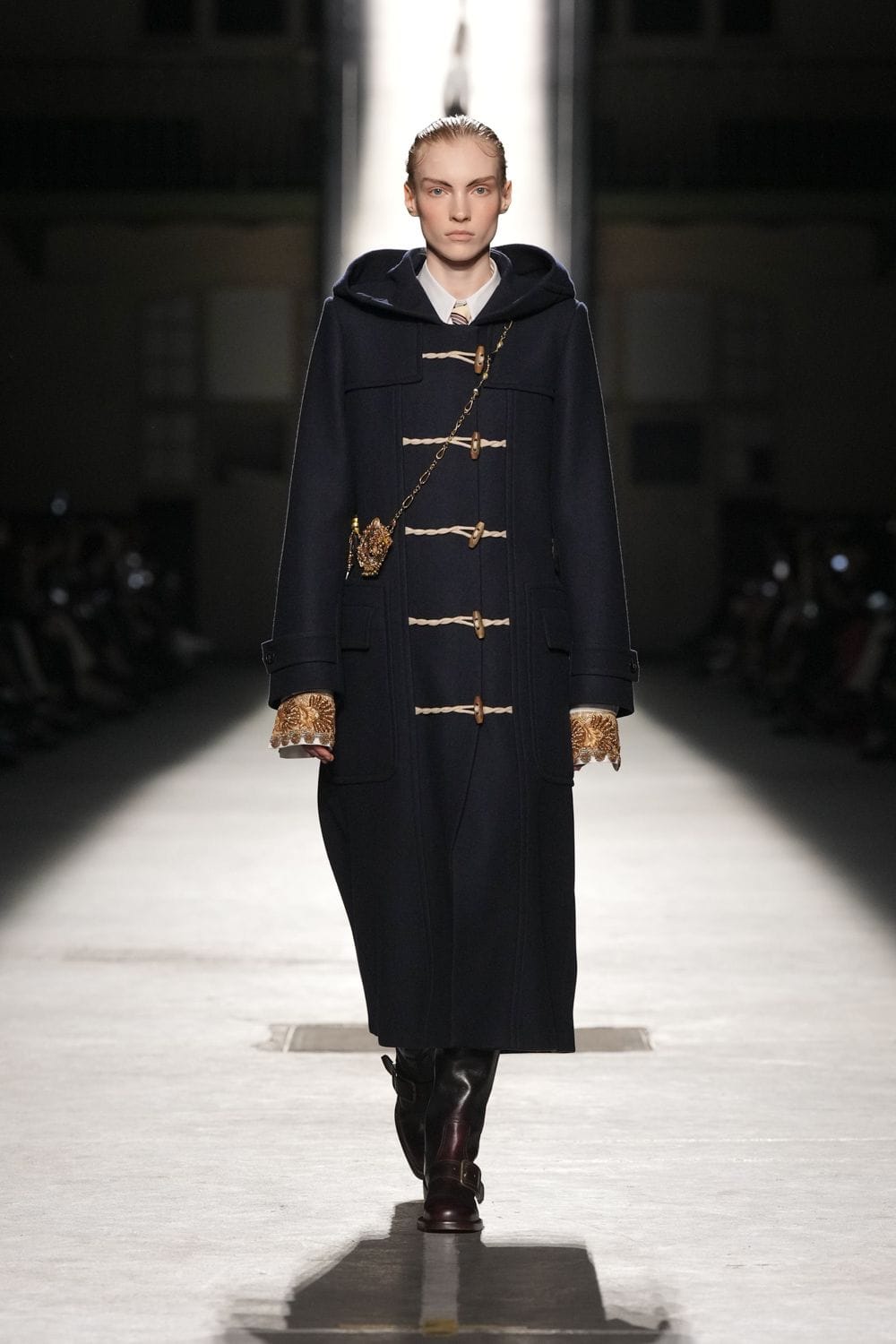
The opening look from Dries Van Noten's Fall 2026 ready-to-wear collection was a layered silk coat in clashing florals—one print bleeding into another at the seams, colors that shouldn't work together but did. It was unmistakably Van Noten: that specific kind of intellectual maximalism, where pattern and texture do the talking instead of logos or silhouette gimmicks. But it also felt looser, less controlled than the founder's meticulous hand would have allowed. The collection marked the second full season since the Belgian designer stepped away from the house he built over four decades, and the transition is starting to look less like a handoff and more like an evolution.
That's rarer than it sounds. Most heritage fashion houses either freeze in amber after a founder exits, becoming self-referential museums of their own greatest hits, or they overcorrect into unrecognizable reinvention that alienates the core audience. Balmain under Olivier Rousteing has built an empire on playing the hits—shoulder pads, gold buttons, celebrity front rows—but that's a founder who stayed. When the designer leaves, the calculus changes entirely. Van Noten's team is threading a narrower path: keeping the design philosophy intact while allowing the work to breathe and evolve. The Fall 2026 lineup felt like Dries Van Noten, but it didn't feel like cosplay.
The collection showed a brand still fluent in its own vocabulary—layered prints, rich textural contrasts, an intellectual approach to color that treats the runway like a gallery wall—but willing to push that language into new territory without the founder's hand on every decision. There were tailored trousers with unexpected proportions, knitwear that felt more experimental than the house's usual restrained elegance, and a willingness to let individual pieces breathe instead of orchestrating every look into a perfectly composed tableau. It suggested a design team confident enough to interpret rather than imitate.
The broader question is whether a designer-driven brand can survive its designer without becoming a heritage act. The answer depends almost entirely on what kind of brand it was to begin with, and what infrastructure exists to sustain it. Diane von Furstenberg managed it by leaning into accessible iconography and Gen Z repositioning—the wrap dress became a meme-able symbol bigger than any single collection. Dior has done it repeatedly under LVMH's institutional infrastructure, where creative directors are expected to reinterpret the archive, not preserve it. But Van Noten operates at a different scale and with a different aesthetic mandate—less about blockbuster accessibility, more about sustained creative credibility among a specific audience that values craft over hype.
Here's what makes Van Noten's position particularly precarious: the house never had a signature product in the DVF sense. There's no Van Noten equivalent of the wrap dress or the Birkin bag, no single item that could carry the brand forward on recognition alone. What it had instead was a sensibility: sophisticated, intellectual, uninterested in trends, deeply rooted in textile innovation and a specific kind of color theory that felt more like fine art than fashion. That's a harder thing to bottle and pass on, because it lives in taste and curation rather than in reproducible design codes.
What makes the Fall 2026 collection worth watching is that it doesn't try to solve that problem by creating a new signature piece or leaning harder into the archive's greatest hits. Instead, it doubles down on the sensibility itself—trusting that the audience who came to Van Noten for a specific kind of design intelligence will stick around if that intelligence remains intact, even if the hand guiding it has changed. The strategy runs counter to most post-founder transitions, which tend to either mummify the aesthetic or jettison it entirely in pursuit of commercial relevance. Van Noten is betting that a brand can be bigger than its founder without abandoning what the founder stood for.
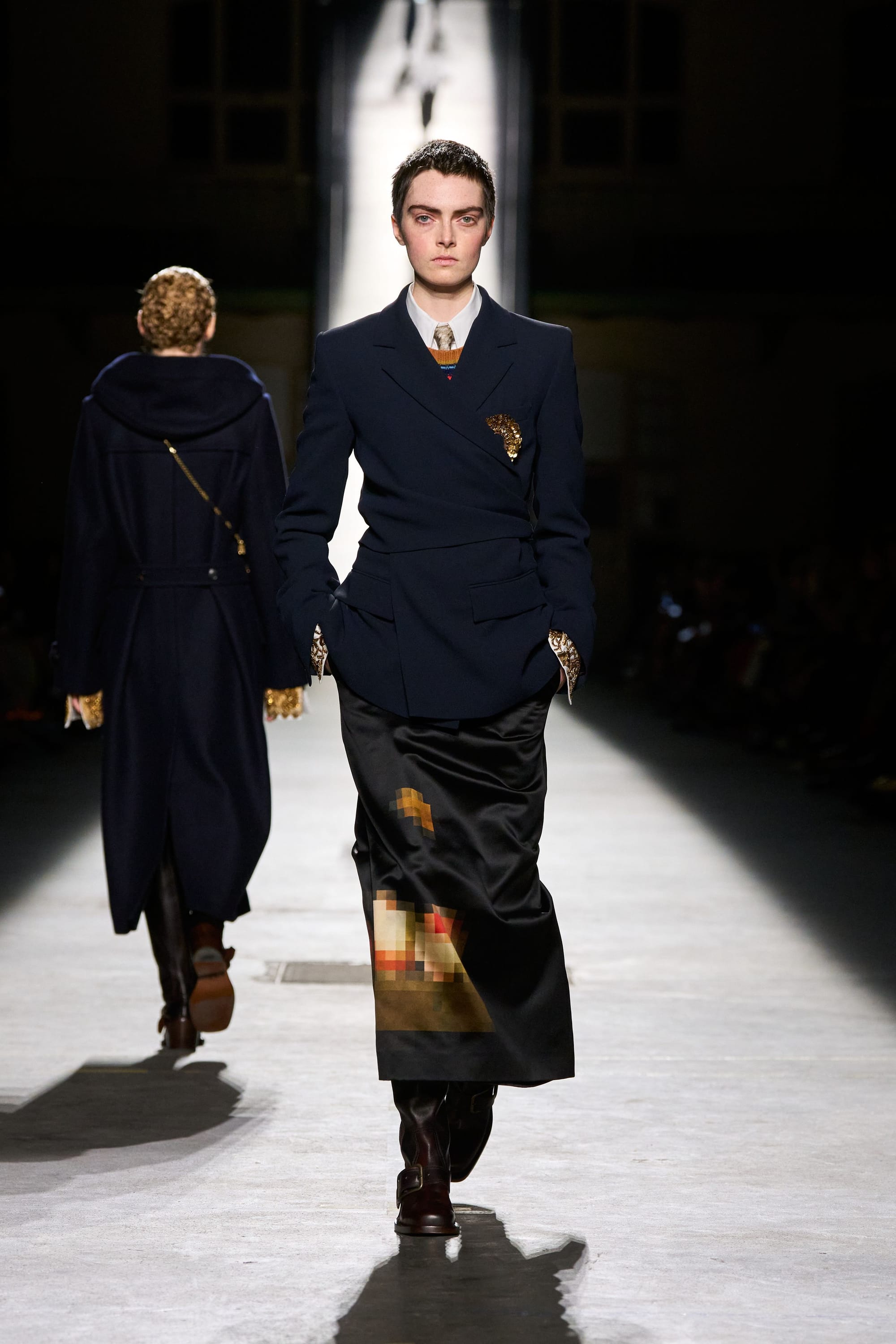
The fashion industry is littered with cautionary tales about what happens when that bet fails. Jil Sander has cycled through creative directors trying to recapture the minimalist rigor of its founder, never quite landing on a coherent identity. Helmut Lang never recovered after its namesake left—the brand became a diffusion line of itself, then disappeared into licensing obscurity. Martin Margiela's house survived by leaning into anonymity as a core brand principle, but that only worked because anonymity was already part of the ethos. Van Noten's challenge is different: the founder was visible, celebrated, and synonymous with the brand, but he also built a design language specific enough to be recognizable and flexible enough to be reinterpreted.
The real test won't be whether the Fall 2026 collection looks like Dries Van Noten—it does. The test is whether the house can maintain that sensibility across multiple seasons, multiple design teams, and the inevitable pressure to chase commercial growth. Because that's where most post-founder brands fail: not in the immediate aftermath of the departure, but three or four years down the line, when the institutional memory fades and the business pressures mount. The early evidence suggests Van Noten's team understands that distinction, and is designing accordingly.
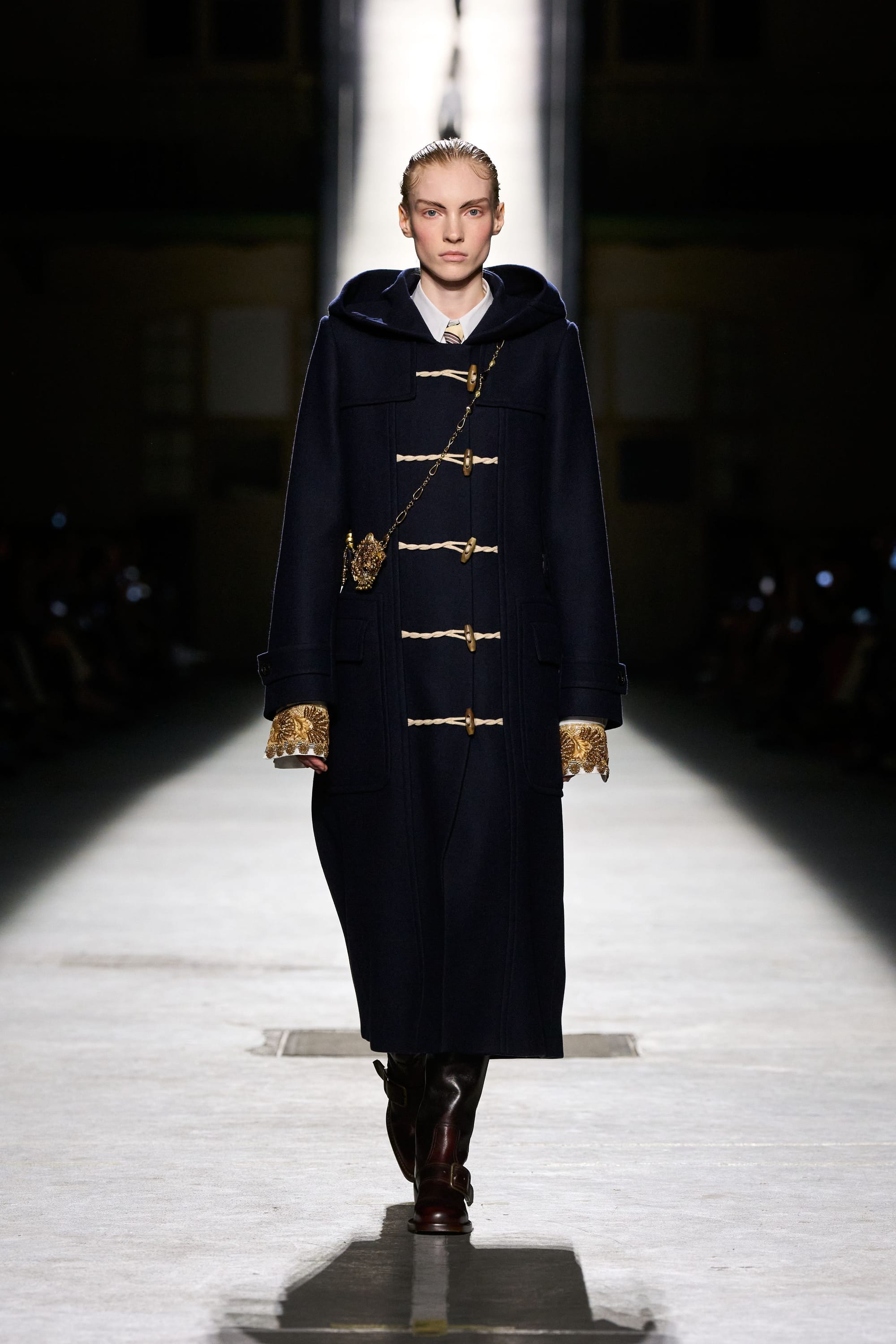
If this trajectory holds, Van Noten's post-founder chapter could become a case study in how to let a brand grow up without losing what made it matter in the first place. The Fall 2026 collection won't be the one that defines whether this transition succeeds—that will take years, not seasons—but the opening coat in clashing florals offered something more valuable than a strong look. It proved that the design team understands what made Van Noten's work compelling wasn't the specific prints he chose, but the intelligence behind choosing them. That's the part worth preserving.