Warner Bros. announced a Harry Potter reboot series for HBO. Sony is developing 13 Going On 30 as a remake. Universal has a Wicked sequel in production before the first film finished its theatrical run. The announcement cadence has become so predictable that entertainment journalists now maintain running spreadsheets of which beloved IP will get strip-mined next.
The pattern is obvious: studios are remaking everything that worked once, hoping the title alone will do the heavy lifting. What they're discovering, slowly and expensively, is that audiences are protective of the classics they love��but they're also desperate for new films that capture that same sense of comfort. The problem isn't that reboots exist. The problem is that Hollywood has convinced itself that brand recognition is the same thing as emotional resonance, and the difference between those two things is where all the charm disappears.
The reboot obsession isn't about creative ambition. It's about corporate risk management. When David Zaslav took over Warner Bros. Discovery, he inherited a playbook that treats every IP as a renewable resource: mine it until the audience stops showing up, then repackage it for the next generation. The Harry Potter HBO series is the purest expression of this logic—a story that was already told across eight films, now stretched into what HBO promises will be a "decade-long" serialized adaptation. The pitch isn't that they have a better way to tell the story. The pitch is that they own the IP and need to monetize it on a platform that requires exclusive content.
But IP recognition doesn't guarantee emotional investment. Harry Potter worked because it arrived at a specific cultural moment, cast unknowns who grew up on screen, and built a world that felt lived-in rather than manufactured. The HBO series will have higher fidelity to the source material, better special effects, and more runtime to explore subplots the films condensed. What it won't have is the element of discovery—the sense that this story is being told for the first time by people who care about getting it right. That's not a production problem. That's a structural problem baked into the entire premise of remaking something that already succeeded.
The same logic applies to 13 Going On 30, a film that worked because Jennifer Garner brought warmth and specificity to a high-concept premise. The story—woman wakes up in her adult body after wishing to skip adolescence—only functions if the lead performance makes you believe the emotional stakes. A remake can replicate the premise, cast a charming lead, and update the references to TikTok and Instagram. What it can't replicate is the feeling of watching a star discover a role that fits her perfectly. BuzzFeed's op-ed on nostalgia-driven reboots argues that audiences long for new films that capture the same sense of comfort—but comfort isn't a formula you can reverse-engineer. It's the byproduct of creative teams taking risks on stories they believe in, not studios de-risking their slates by repackaging what already worked.
The reboot problem is compounded by the fact that studios are remaking films that succeeded because they were *small*. 13 Going On 30 had a $37 million budget and made $96 million worldwide. It wasn't a tentpole. It was a mid-budget star vehicle that worked because it knew what it was. A 2025 remake will have a bloated budget, a marketing campaign designed to justify theatrical distribution, and the pressure to launch a franchise. The original film ended with a wedding and a happy ending. The remake will end with a post-credits scene teasing a sequel, because no studio greenlights a reboot without a multi-film plan. That's not filmmaking. That's product development.
The irony is that audiences *do* want comfort. They want films that feel warm, familiar, and emotionally satisfying. But comfort doesn't come from seeing the same story told again with updated technology. It comes from stories that understand why the original worked and build something new on that foundation. Romance adaptations have become Hollywood's most reliable counter-programming strategy precisely because they deliver emotional stakes without requiring billion-dollar budgets. The best ones don't remake classics—they tell new stories in the same emotional register.
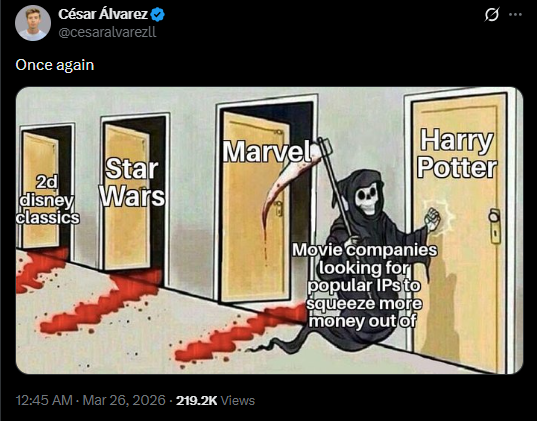
What makes the reboot obsession particularly frustrating is that Hollywood has proof that original stories can succeed. Everything Everywhere All at Once made $140 million worldwide on a $25 million budget and won Best Picture. Past Lives made $46 million on a $12 million budget and became one of the most critically acclaimed films of 2023. Both films delivered the emotional comfort audiences crave—not by remaking something familiar, but by telling new stories with care, specificity, and emotional intelligence. Studios looked at those successes and decided the lesson was "make more A24-style films"—which is how you end up with Sony's indie division churning out prestige bait that feels focus-grouped rather than felt.
The reboot machine also flattens the cultural specificity that made the originals work. Harry Potter succeeded in part because it arrived in a pre-social media era when fandoms built themselves through message boards, midnight book releases, and theater premieres. The HBO series will launch into a media environment where every casting choice, plot decision, and promotional image gets dissected in real time by audiences who have spent two decades building their own relationships with the material. That's not an audience waiting to be served—that's an audience waiting to be disappointed. And the disappointment isn't about the quality of the show. It's about the impossibility of replicating an experience that was never just about the story.
The business logic behind reboots is simple: IP is safer than original ideas, and safer bets get greenlit faster. But safety is a short-term strategy. Hulu's canceled Buffy revival is what happens when a studio realizes too late that nostalgia isn't a business plan—it's a feeling you can't manufacture. The Buffy reboot was supposed to bring the franchise to a new generation, but it collapsed under the weight of fan expectations, creative turnover, and the realization that the original show's magic was tied to a specific moment in television history. You can't reboot a cultural moment. You can only reference it and hope the audience doesn't notice the difference.
What Hollywood needs isn't fewer reboots—it's better reboots. The ones that work, like Dune or The Batman, succeed because they bring a clear creative vision to material that can support reinterpretation. Denis Villeneuve didn't remake David Lynch's Dune—he adapted Frank Herbert's novel with a different aesthetic and emotional framework. Matt Reeves didn't remake Christopher Nolan's Batman—he told a noir detective story that happened to feature a superhero. Both filmmakers understood that the IP was a starting point, not a blueprint. The reboots that fail are the ones that treat the original as a template to be replicated rather than a foundation to build on.
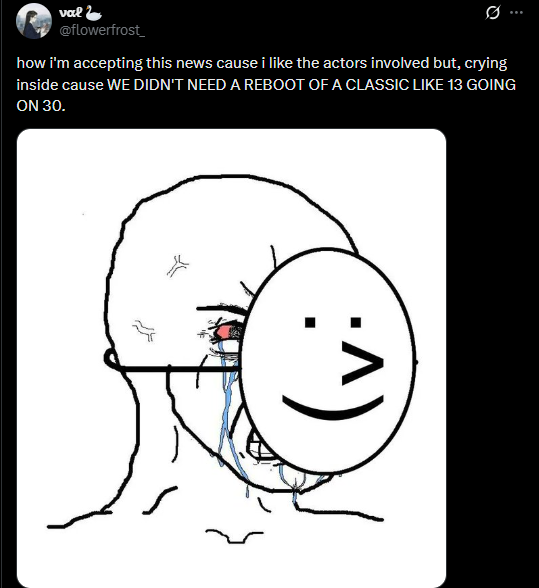
The reboot era will end the same way every other risk-averse studio trend ends: with diminishing returns, audience fatigue, and a scramble to find the next safe bet. But the damage will linger. An entire generation of filmmakers is learning that the path to a studio greenlight runs through existing IP, not original ideas. That's how you end up with a film industry that's technically proficient, visually polished, and emotionally inert. Audiences don't need another Harry Potter. They need the thing that Harry Potter was in 2001—a story that feels like it was made for them, not sold to them. Until studios understand the difference, they'll keep remaking the movies we loved and wondering why nobody loves the remakes.