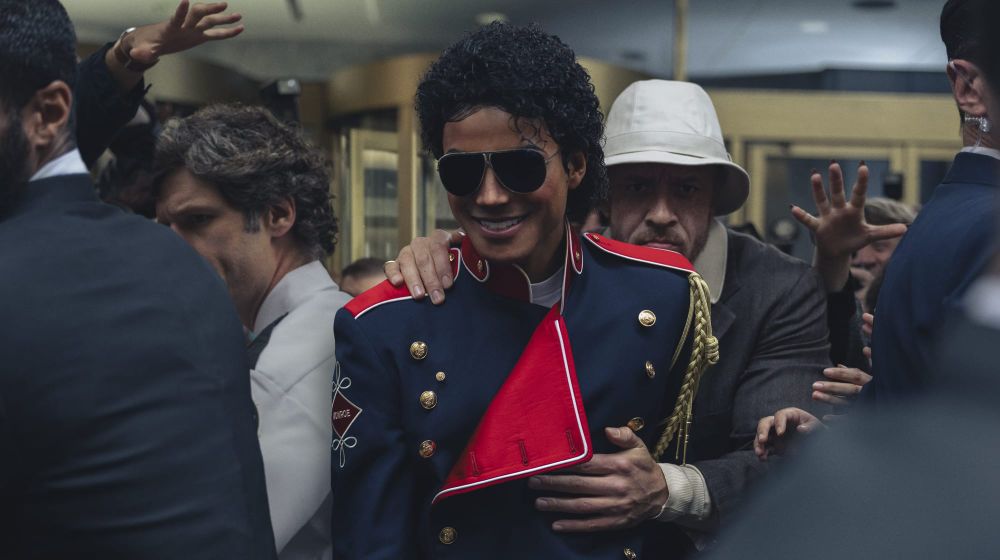
Three-week tracking for Lionsgate's Michael indicates an opening between $55M-$60M when it hits theaters on April 24, according to Deadline. If those numbers hold, the Michael Jackson biopic will surpass Bohemian Rhapsody's $51M opening from 2018, setting a new record for the musical biopic genre. Advance ticket sales are reportedly tracking ahead of that film's pace at the same point in the release cycle.
The projection arrives at a moment when theatrical releases are increasingly bifurcated: franchise blockbusters on one end, everything else fighting for scraps on the other. Musical biopics have emerged as the rare middle-ground formula that still reliably draws audiences to theaters — even when the subject's personal history is as fraught and contested as Jackson's. Bohemian Rhapsody grossed over $900M worldwide despite criticisms of its sanitized portrayal of Freddie Mercury's life. Elvis crossed $280M globally in 2022. Rocketman, Respect, and Bob Marley: One Love all found theatrical audiences in an era when mid-budget dramas routinely go straight to streaming.
What makes the Michael projection particularly notable is that it's succeeding in spite of — or perhaps because of — the controversy that has surrounded Jackson's legacy since the 2019 documentary Leaving Neverland. The film has faced public pressure from advocacy groups and survivors' organizations, yet none of that appears to be dampening commercial interest. If anything, the controversy may be fueling it. Audiences have demonstrated repeatedly that they will show up for musical biopics even when — or especially when — the subject's life story includes uncomfortable truths the film may or may not address.
This is the theatrical business model Hollywood has left: IP-driven spectacle and music-driven nostalgia. Gaming IP is the only blockbuster formula that still works, and musical biopics are the only prestige-adjacent genre that can still justify a wide theatrical release. Everything else — the dramas, the comedies, the mid-budget thrillers — has been ceded to streaming platforms that treat them as content rather than events.
The musical biopic's resilience comes down to a few structural advantages. First, the music itself is pre-sold. Audiences know the songs, which means the film functions as both narrative and concert experience. Second, the format allows for spectacle — elaborate performance sequences, period recreation, visual excess — in a way that justifies the theatrical ticket price. Third, and perhaps most importantly, the genre thrives on a specific kind of emotional transaction: the promise of intimacy with a public figure whose life was performed for mass consumption. The biopic offers the illusion of getting behind the image, even when the film itself is just another layer of image management.
Michael is directed by Antoine Fuqua and produced by Graham King, the same producer behind Bohemian Rhapsody. The Jackson estate is involved, which means the film will almost certainly prioritize the music and the myth over any uncomfortable interrogation of the man. That's not a criticism — it's the genre's operating logic. Musical biopics are hagiographies with a beat. They succeed not by telling hard truths but by offering audiences permission to love the music without guilt. Whether that's a fair trade is a question the box office won't answer.
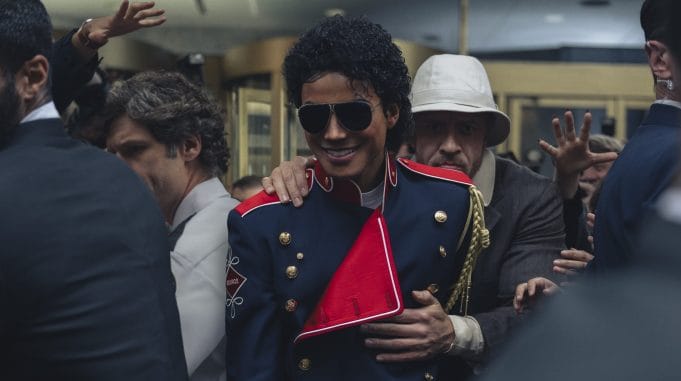
What the Michael opening will answer is whether the musical biopic formula has hit saturation. Bohemian Rhapsody's success triggered a wave of imitators, and Hollywood has been mining the back catalogs of dead musicians ever since. Bob Dylan, Janis Joplin, and Donna Summer biopics are all in development. At some point, the market will tire of the formula. But that point isn't April 24, 2026. For now, the musical biopic remains the most reliable bet in theatrical exhibition — a genre that can weather controversy, critical skepticism, and cultural backlash as long as the songs still hit.
The real question isn't whether Michael will open big. It's whether Hollywood will learn the right lesson from its success. The industry's tendency is to replicate formulas until they collapse, rather than invest in the structural changes that would make a wider range of films commercially viable in theaters. Musical biopics work not because they're inherently superior to other mid-budget films, but because they're one of the few genres that still gets the marketing spend, the wide release, and the cultural positioning that signals to audiences: this is an event. If Hollywood applied that same infrastructure to other kinds of stories, the theatrical landscape might look different. Instead, we get another record-breaking opening for a musical biopic, and another round of executives greenlighting the next dead musician's life story.