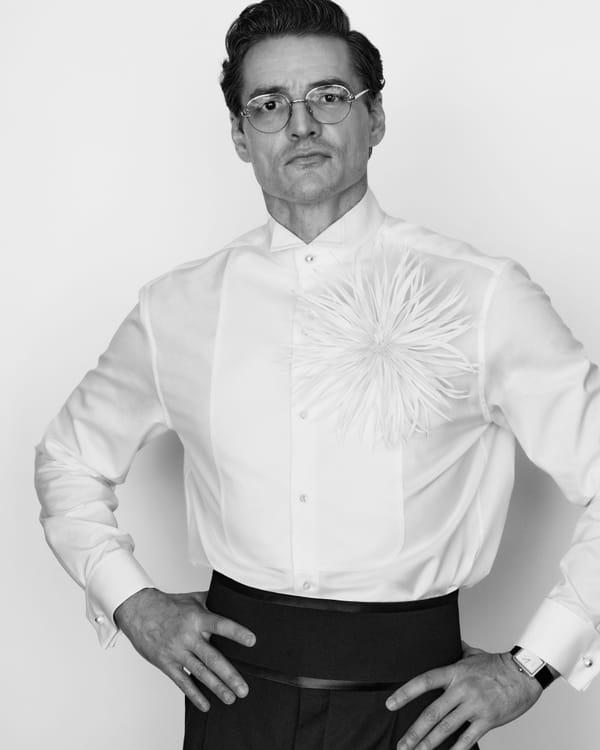
The opening look at Off-White's Fall 2026 show was a white shirt. Not deconstructed, not emblazoned with quotation marks, not subverted with industrial hardware. Just a white shirt—impeccably tailored, elegantly proportioned, worn with wide-leg trousers and an air of quiet confidence. It was the kind of garment Virgil Abloh might have called boring before he made it interesting. But this wasn't Abloh's collection. It was Ib Kamara's first full ready-to-wear showing since taking the creative reins at Off-White, and that opening look signaled something crucial: the house is moving forward, not sideways.
Kamara faces a challenge that few designers inherit: how do you evolve a brand built on the singular vision of a cultural icon without erasing what made it matter in the first place? Abloh didn't just design clothes—he built a visual language that connected streetwear, fine art, architecture, and Black cultural commentary into a coherent aesthetic philosophy. His death in 2021 left Off-White with a legacy so potent it threatened to become a prison. Kamara's Fall 2026 collection is the first real test of whether the house can be more than a monument.
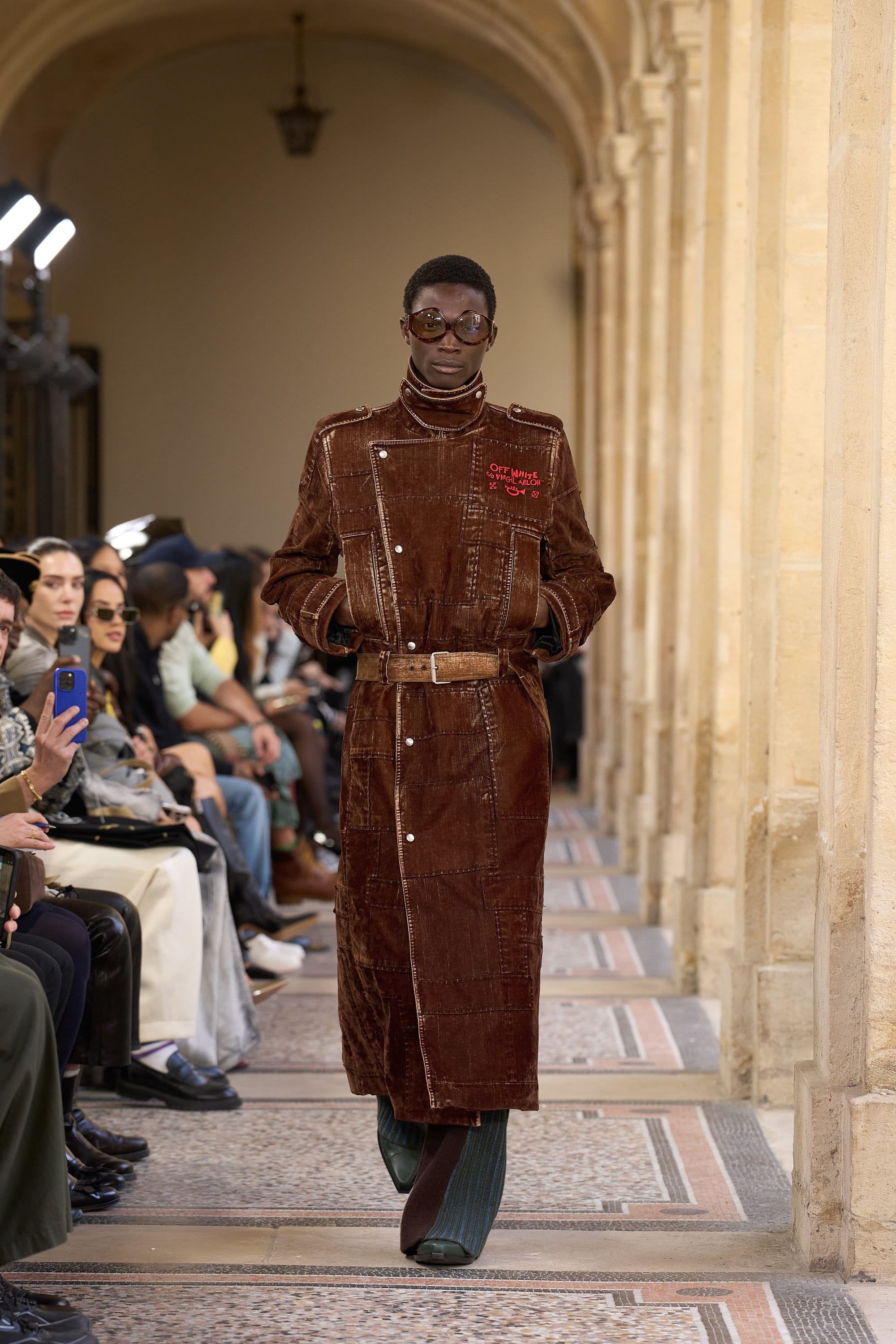
The answer, at least on the runway, is yes—but only if Off-White is willing to embrace a version of itself that prioritizes wearability and commercial viability alongside conceptual provocation. Kamara's collection featured tailored suiting, elevated knitwear, and refined outerwear that felt closer to Dior's recent pivot toward understated luxury than to the deconstructed streetwear that made Off-White a phenomenon. The signature arrows and quotation marks appeared sparingly, deployed as accents rather than anchors. The color palette was muted—charcoal, cream, navy, punctuated by occasional bursts of red and yellow that felt intentional rather than obligatory.
This is a significant departure from the Abloh playbook, and it's precisely what Off-White needs to survive as a business. Abloh's genius was in creating cultural moments that transcended fashion—collaborations with Nike, installations at the Louvre, collections that functioned as social commentary. But cultural moments don't pay the bills. Ready-to-wear does. And Off-White's parent company, Farfetch (before its own financial restructuring) and now its new ownership under LVMH's influence, needs the brand to sell clothes, not just ideas.
Kamara understands this. His background as a stylist and editor-at-large for British Vogue means he knows how fashion operates as both art and commerce. He's spent years watching designers navigate the tension between creative vision and market demands, and his collection reflects that fluency. The pieces are designed to be worn by actual people with actual bodies and actual budgets—or at least budgets that exist within the realm of aspirational luxury rather than archive-collector fantasy.
But there's a risk here, too. Off-White's cultural cachet was built on its refusal to play by luxury's traditional rules. Abloh's collections were often unwearable in the conventional sense—garments that existed as much for Instagram as for the closet, designed to provoke conversation rather than move units. That approach made Off-White one of the most talked-about brands in fashion, a status that translated into collaborations, licensing deals, and a brand valuation that justified its acquisition by luxury conglomerates. If Kamara makes Off-White too wearable, too commercial, too safe, the brand risks losing the cultural edge that made it valuable in the first place.
The Fall 2026 collection walks this line carefully. The tailoring is sharp but not conservative. The knitwear is elevated but still streetwear-adjacent. The outerwear references Abloh's architectural sensibility without replicating his signature deconstructed puffer jackets. It's a collection that says: Off-White can be a serious fashion house without abandoning its roots. Whether the market agrees remains to be seen.
The business strategy here is clear: Off-White is positioning itself to compete in the contemporary luxury space, not the streetwear market that birthed it. That market has become increasingly crowded, with brands like Aimé Leon Dore, Kith, and Fear of God offering similar aesthetics at comparable price points. Meanwhile, the luxury sector is undergoing its own transformation, with brands like Saint Laurent struggling to articulate what luxury even means in a post-pandemic, post-hype-beast economy. Kamara's Off-White is betting that there's space for a brand that can speak both languages—streetwear's cultural fluency and luxury's craftsmanship—without being beholden to either.
This is also a bet on Kamara's own creative identity. Unlike Olivier Rousteing at Balmain, who has spent over a decade refining a single maximalist aesthetic, Kamara is still defining his design language. His editorial work has been characterized by a fluid, boundary-pushing approach to styling—mixing high and low, masculine and feminine, historical and contemporary. The Fall 2026 collection hints at what that might look like translated into ready-to-wear, but it doesn't yet commit fully. There are moments of brilliance—a draped coat that recalls both Abloh's architectural interests and Kamara's own editorial eye for volume—but also moments that feel tentative, as if Kamara is still figuring out how much of himself to inject into the brand.
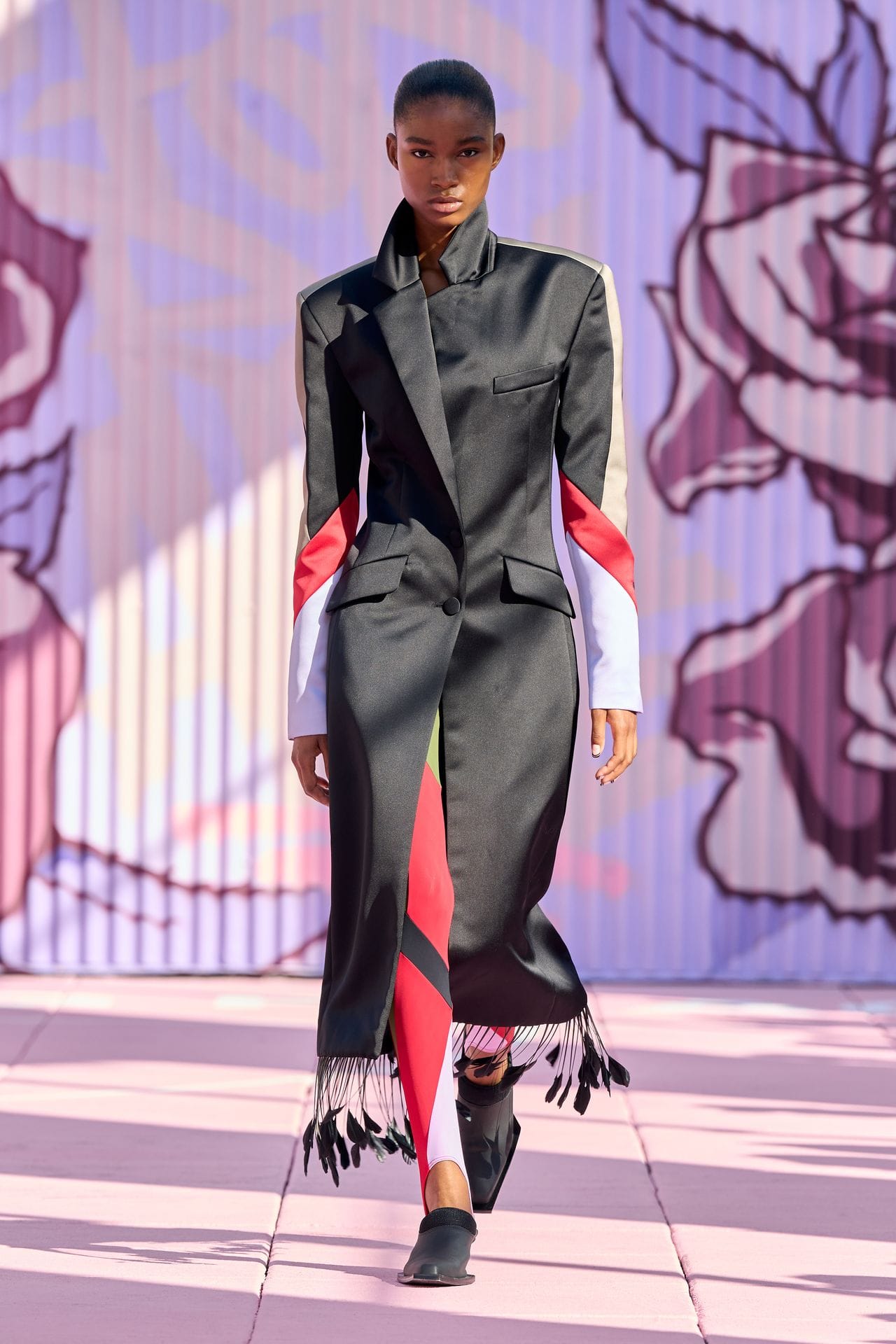
The cultural lens here is equally complex. Abloh's Off-White was inseparable from his identity as a Black creative operating at the highest levels of a predominantly white industry. His work was always in conversation with that tension, using fashion as a platform to interrogate questions of access, representation, and cultural ownership. Kamara, who is also Black and also navigating similar industry dynamics, has the opportunity to continue that conversation—but he also has the freedom to redefine what it means. His collection doesn't announce its politics the way Abloh's often did, but it doesn't need to. The act of a Black designer inheriting and evolving a Black founder's legacy is itself a statement about who gets to shape the future of luxury.
What's striking about the Fall 2026 collection is how much it resists nostalgia. Kamara isn't trying to recreate Abloh's greatest hits or mine the archives for easy references. He's building something new on the foundation Abloh left behind, which is both the hardest and most honest way to honor a legacy. It's the approach Dries Van Noten's design team took after the founder's departure—acknowledging the past without being paralyzed by it.
The real test will come in the next few seasons. One collection can be a statement of intent; three or four collections will reveal whether Kamara has a coherent vision for Off-White's future or if he's still finding his footing. The market will also have its say. If the pieces sell, if the brand maintains its cultural relevance, if Off-White can attract a new generation of customers without alienating the loyalists who loved Abloh's work—then Kamara's approach will be vindicated. If not, the pressure to either return to the Abloh formula or pivot even more dramatically will intensify.
For now, the Fall 2026 collection suggests that Off-White's future is not about choosing between Abloh's legacy and Kamara's vision. It's about finding a way to hold both at once—honoring the past while building something sustainable, commercially viable, and creatively compelling. That white shirt that opened the show wasn't a rejection of Abloh's ethos. It was a signal that Off-White can be more than one thing, more than one voice, more than one moment. Whether the industry is ready for that version of the brand is the question Kamara is now asking.
For more, see Balmain’s maximalist identity and the front-row celebrity economy.