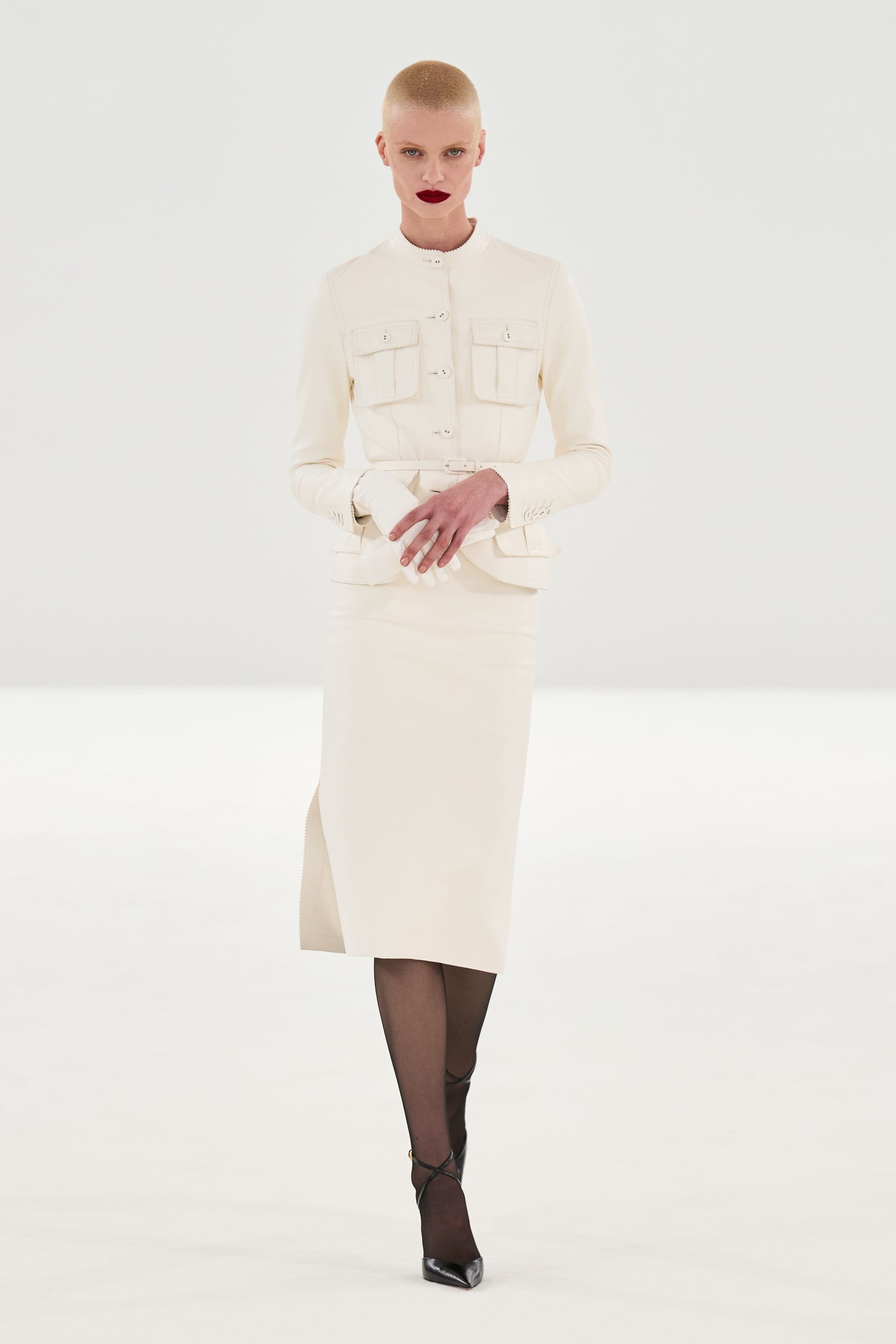
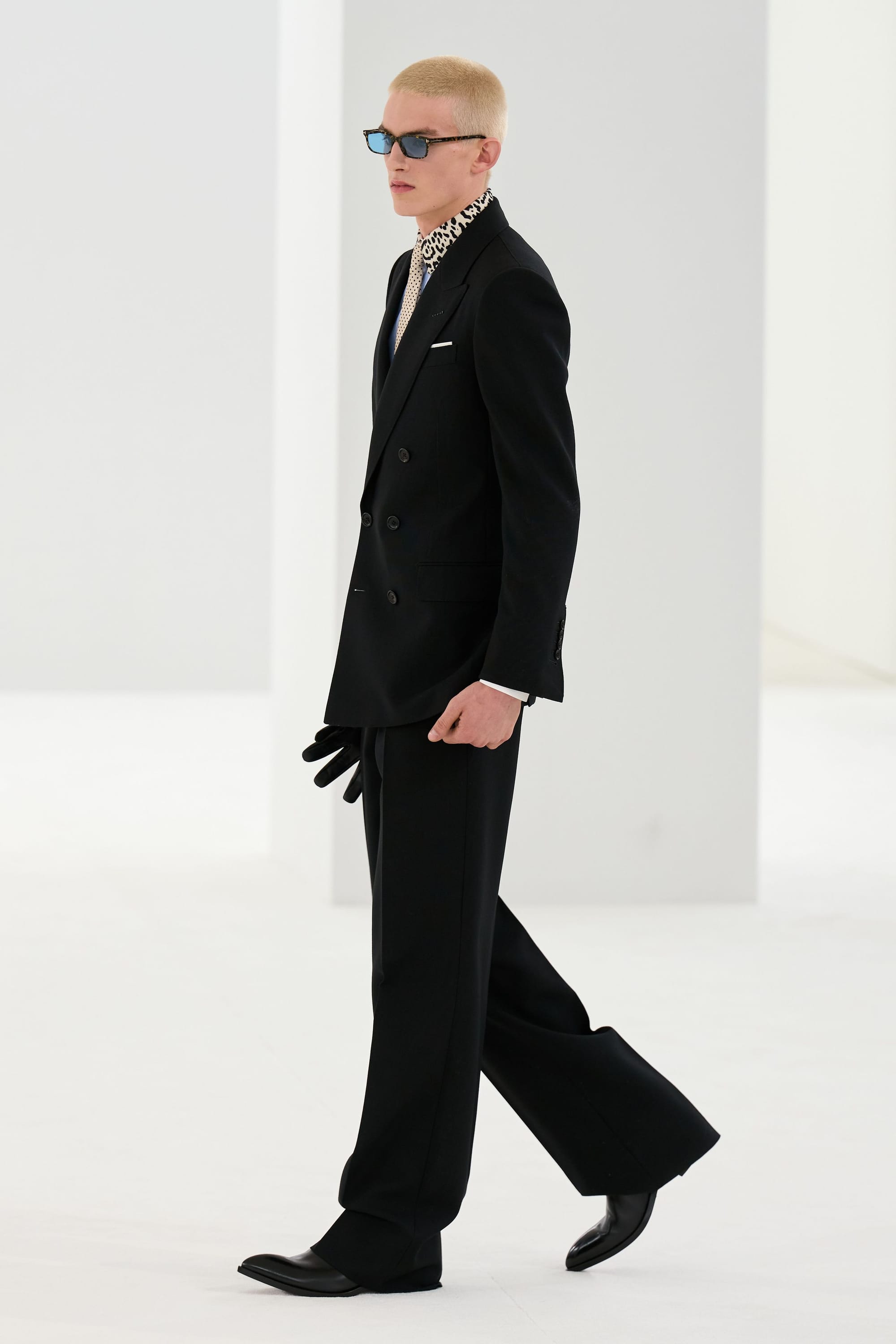
The Tom Ford Fall 2026 show opened with a sharply tailored blazer in deep navy, nipped at the waist, paired with wide-leg trousers that pooled just slightly at the ankle. It was polished. It was expensive-looking. It was exactly what you'd expect from a Tom Ford runway—which is precisely the problem. The collection, presented during Paris Fashion Week, marked the brand's first major runway moment since its founder's full departure from creative oversight, and every look felt like it was working overtime to prove it still belonged in the conversation.
Tom Ford the brand has been operating without Tom Ford the designer since Estée Lauder acquired it in 2022, but this collection is the first to arrive without even the residual glow of his involvement. What's left is a house that knows its codes—sleek tailoring, plunging necklines, high-gloss leather, razor-sharp accessories—but doesn't seem to know why those codes mattered in the first place. The Fall 2026 collection delivers on every visual marker of Tom Ford-ness, but it does so with the confidence of a brand that's checking boxes rather than making statements.
The business strategy here is legible: when a designer-founder exits, the safest move is to lean hard into brand equity. Don't reinvent. Don't pivot. Give the customer what they expect, what they've been conditioned to want, and hope the muscle memory of the brand name does the rest of the work. It's the same playbook Saint Laurent has been running since Hedi Slimane's departure, and it's what happens when a brand realizes its value is tied more to a logo than a vision.
But Tom Ford the brand has a unique problem: its founder wasn't just a designer���he was the product. His persona, his mythology, his carefully constructed image of effortless glamour and unapologetic sexuality were inseparable from the clothes. When you bought Tom Ford, you weren't just buying a blazer or a handbag. You were buying into the Tom Ford lifestyle, the Tom Ford fantasy, the Tom Ford gaze. Without him, the brand is left selling the aesthetic without the authorship, and that's a much harder proposition in a luxury market that increasingly rewards personality over polish.
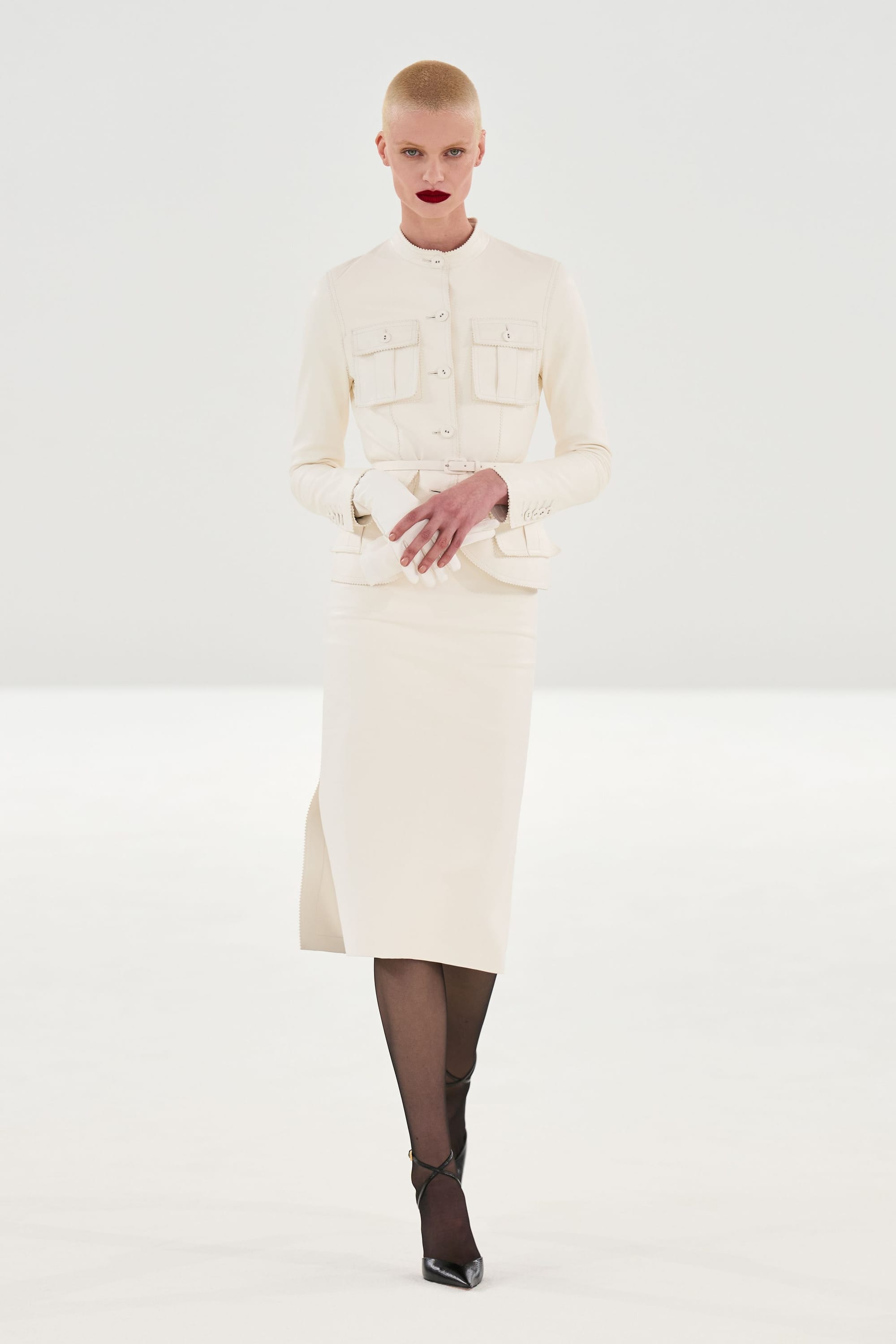
The Fall 2026 collection includes all the expected elements: tailored suiting in black, charcoal, and deep jewel tones; evening dresses with plunging necklines and body-conscious silhouettes; outerwear in buttery leather and shearling; accessories that gleam with hardware and high shine. The craftsmanship is there. The production value is there. But the point of view—the thing that made Tom Ford feel like an event rather than just another luxury label—is conspicuously absent. These are clothes that look like Tom Ford, but they don't feel like anything in particular.
This is the challenge facing every designer-less luxury brand right now: how do you maintain cultural relevance when the culture was built around a singular vision? Dior has managed it by treating each creative director as a distinct chapter in an ongoing narrative. Diane von Furstenberg has done it by anchoring the brand to a single iconic piece that transcends any one designer's tenure. But Tom Ford the brand doesn't have that luxury. Its identity was never about a single garment or a house code that predated its founder. It was always about Tom Ford himself—his taste, his references, his ability to make glamour feel modern rather than nostalgic.
Without that, the brand is left in an awkward position: too tied to its founder's aesthetic to reinvent itself, but too dependent on his persona to simply continue as if nothing has changed. The Fall 2026 collection tries to split the difference, delivering a runway that feels like a greatest-hits compilation rather than a new chapter. It's competent, it's commercial, and it's completely risk-averse.
The market will likely reward that strategy in the short term. Tom Ford's customer base isn't looking for disruption—they're looking for continuity, for the reassurance that the brand they've invested in will continue to deliver the same level of polish and prestige. But in the long term, this approach has a ceiling. Luxury brands that operate on autopilot eventually become heritage brands, and heritage brands that can't articulate why they still matter become archive brands. The Fall 2026 collection suggests Tom Ford is heading in that direction faster than Estée Lauder might have anticipated.
There's also a larger pattern at work here: the luxury industry's ongoing struggle to reconcile designer-driven branding with corporate ownership structures. When a conglomerate acquires a designer brand, it's buying intellectual property, manufacturing infrastructure, and distribution channels—but it's also buying a reputation that was built on a single person's vision. That vision can be replicated for a while, especially if the design team is strong and the brand codes are clear. But eventually, the absence becomes visible. The clothes still look right, but they stop feeling necessary.
The contrast with Dries Van Noten's post-founder evolution is instructive. That brand has managed to maintain its identity by treating the founder's departure as an opportunity to clarify what the house stands for beyond any single creative voice. Tom Ford, by contrast, seems paralyzed by the question of what it is without its namesake. The Fall 2026 collection doesn't attempt to answer that question—it just keeps restating it with every look.
Tom Ford Fall 2026 is what happens when a brand realizes it's been selling a person, not a product, and now has to figure out what to do without that person. The collection doesn't fail—it's too well-executed to fail—but it doesn't succeed either. It simply exists, delivering exactly what's expected and nothing more. For a brand that built its reputation on making glamour feel urgent and modern, that might be the most telling thing about this collection: it doesn't feel urgent at all. It feels like a brand trying very hard to convince you it still knows what it's doing, and that effort is visible in every look.
The question now is whether Tom Ford can evolve past its founder's shadow or whether it will become another cautionary tale about the limits of designer-less luxury. The Fall 2026 collection doesn't answer that question—it just makes it more urgent.