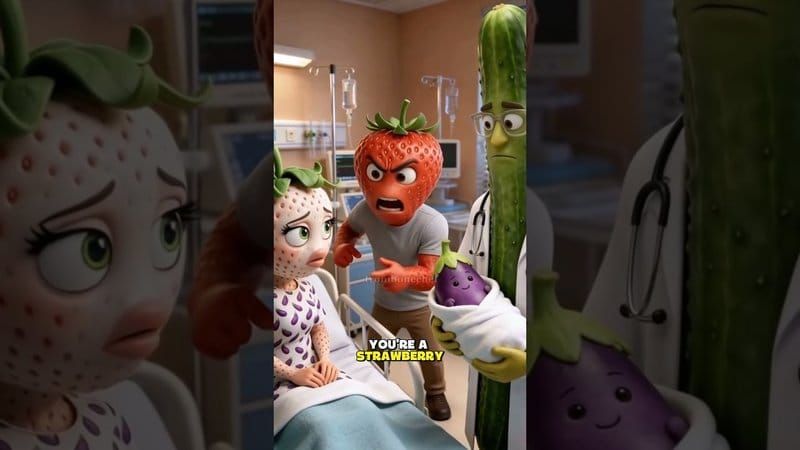
A strawberry cheats on her husband with an eggplant. The baby comes out as an eggplant. Millions of people are crying about it.
The videos are everywhere—AI-generated fruit characters caught in melodramatic love triangles, complete with betrayal, paternity reveals, and emotional confrontations. According to Know Your Meme, the format has exploded across TikTok and Instagram, racking up millions of views as users share, remix, and genuinely emotionally invest in the romantic lives of anthropomorphized produce. The format is absurd. It's also perfectly engineered.
What AI content farms have stumbled into—or more likely, algorithmically optimized their way toward—is the exact formula daytime soap operas perfected decades ago: high-stakes emotional conflict, clear moral binaries, and narrative beats simple enough to follow without sound. The strawberry is the wronged spouse. The eggplant is the homewrecker. The baby is the proof. You don't need dialogue when the structure does all the work. Soap operas ran on this logic for 70 years because it's efficient storytelling that triggers emotional response with minimal cognitive load. AI fruit dramas are just the same engine running on a different platform.
The production values are irrelevant—actually, the lack of production values might be the point. These videos cost nearly nothing to generate. No actors, no sets, no crew, no rights negotiations. Just prompts fed into image generators and animation tools, churned out at scale. The algorithmic advantage is brutal: a human production team might spend weeks developing a soap opera episode. An AI content farm can produce 50 fruit infidelity scenarios in an afternoon, test them all, and double down on whichever one the algorithm rewards. It's the same microdrama production model that's already reshaping entertainment, just stripped down even further.
The emotional investment is real, which is the part that makes people uncomfortable. Comments sections are full of users genuinely distressed about the strawberry's marriage, debating whether the eggplant knew she was married, expressing relief when the wronged fruit finds happiness. It reads like parody until you remember that soap opera fans had the same reactions to fictional characters for decades—and no one questioned whether that emotional response was valid. The medium is different. The parasocial attachment mechanism is identical.
What makes this moment significant isn't that AI can generate content—it's that AI content farms have reverse-engineered emotional engagement by studying what already works and scaling it past the point of human production constraints. Soap operas were expensive to produce, which limited how many could exist. AI fruit dramas have no such limit. The format can spawn infinite variations, test them in real time, and optimize for whatever metric the platform rewards: watch time, shares, comments, emotional reaction.
The bigger pattern here is that algorithmic content has started to converge on the same narrative structures humans have always responded to—not because AI understands storytelling, but because the optimization process naturally surfaces what triggers engagement. Betrayal, justice, resolution. The strawberry gets her closure. The eggplant faces consequences. The audience gets catharsis. It's the same three-act structure that's powered everything from Greek tragedy to General Hospital, now rendered in AI-generated produce and delivered in 60-second loops.
This is what happens when the algorithm becomes the showrunner. It doesn't care about artistic intent or narrative innovation. It cares about what keeps people watching. And what keeps people watching, it turns out, is the same thing that always has: characters they can root for, villains they can hate, and emotional stakes simple enough to process in the three seconds before they swipe to the next video. Soap operas figured that out in the 1950s. AI content farms just figured out how to produce it cheaper, faster, and at a scale that makes human-produced melodrama look like a rounding error.
The uncomfortable truth is that this works. Not despite the absurdity, but because of it. The fruit characters are just abstract enough to bypass cynicism while still triggering the emotional frameworks we bring to any narrative. A strawberry can't manipulate you with a PR strategy the way a human influencer can. The melodrama is too ridiculous to feel exploitative. But the engagement metrics don't lie—millions of people are watching, sharing, and emotionally investing in AI-generated produce dramas because the formula is sound and the barrier to entry is gone.
The question isn't whether this trend will fade—it will, like every other viral format. The question is what happens when every content farm on the internet realizes that decades of soap opera research and development are now available as training data, and the cost of production has dropped to near zero. Daytime TV spent billions refining emotional manipulation into a science. AI just got the instruction manual for free.