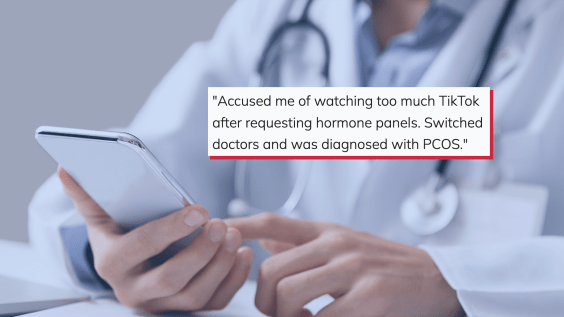
A patient walks into a doctor's office with a list of symptoms they've researched. The doctor glances at the notes, then delivers the diagnosis: "You've been watching too much TikTok." Not a medical assessment. Not a differential diagnosis. Just platform stigma dressed up as clinical judgment.
This is happening with enough frequency that patients are now sharing their experiences on The Daily Dot — creating a public record of how medical professionals use the phrase "TikTok informed" as a conversational scalpel to cut off patient advocacy before it begins. The accusation isn't about the accuracy of the information. It's about the source. And the subtext is clear: if you learned it on TikTok, you're not a patient advocating for yourself — you're a hysteric who needs to be managed.
The irony is that TikTok has become one of the most effective platforms for medical education precisely because traditional healthcare institutions failed to meet patients where they are. Doctors, nurses, and specialists use the platform to explain complex conditions in under 60 seconds. Patients with rare diseases find communities that took years to locate through traditional channels. People who spent decades being dismissed by medical professionals finally get language for what they're experiencing. The platform didn't create patient advocacy — it just made it visible and scalable.
But visibility is exactly what makes institutions uncomfortable. A patient who arrives informed is a patient who takes longer to see, who asks follow-up questions, who might push back on a diagnosis that doesn't fit. In a system where the average primary care visit lasts 15 to 20 minutes and physicians are seeing 20+ patients a day, an informed patient is a scheduling problem. Dismissing them as "TikTok informed" is faster than engaging with what they're actually saying.
The phrase does specific rhetorical work. It collapses the distinction between misinformation and patient research. It implies that any information gathered outside a clinical setting is inherently suspect. It transforms the act of preparation — something patients are constantly told to do — into evidence of irrationality. And it does all of this while maintaining plausible deniability. The doctor isn't saying you're wrong. They're just saying you got your information from the wrong place.
This is the same institutional logic that for decades dismissed women's pain as psychosomatic, that told Black patients their symptoms were exaggerated, that assumed fat patients' health problems would disappear with weight loss. The language changes — "hysterical" becomes "TikTok informed" — but the function remains the same: dismiss the patient, protect the system, move on to the next appointment.
What makes the current moment different is that patients now have infrastructure to document these dismissals in real time. The same platform that medical professionals are using to discredit patient research is also the platform where patients are building a public archive of medical gaslighting. The power dynamic hasn't shifted — doctors still control access to diagnosis, treatment, and prescription — but the information asymmetry has narrowed. Patients know what questions to ask. They know what tests to request. They know when they're being dismissed.
And institutions hate it. Because an informed patient base is harder to manage than one that defers to authority by default. The medical system in the United States is not designed for patient autonomy — it's designed for efficiency, liability management, and throughput. Patients who slow that process down, who ask for second opinions, who request specific tests, are friction in a system that runs on compliance. Calling them "TikTok informed" is a way to reassert control without addressing the underlying question: why are patients turning to social media for information their doctors won't provide?
The answer is structural. Medical education doesn't prioritize patient communication. Appointment times are too short for meaningful dialogue. Insurance reimbursement models penalize thoroughness. And the power imbalance between doctor and patient is so entrenched that many physicians genuinely believe that skepticism from a patient is disrespect rather than self-advocacy. The system is working exactly as designed — and what it's designed to do is move people through as quickly as possible while minimizing institutional liability.
But here's what the institutions are missing: the patients who are being dismissed as "TikTok informed" are also the patients who are learning to navigate algorithmic systems, who understand how information spreads, who know how to build community around shared experience. They're not going to stop researching. They're not going to stop advocating. They're just going to get better at recognizing when they're being dismissed — and they're going to find doctors who don't use platform stigma as a substitute for clinical engagement.
The medical professionals who are using "TikTok informed" as a pejorative are betting that patients will internalize the shame and stop asking questions. That's a losing bet. Because the same platform they're using to discredit patient research is also teaching patients that dismissal is a red flag, not a diagnosis. And the patients who are being told they've "watched too much TikTok" are learning that the problem isn't their research — it's a system that would rather blame the platform than address why patients don't trust their doctors in the first place.
The real question isn't whether patients are "TikTok informed." It's whether medical institutions are willing to meet patients where they are — or whether they'll keep using platform stigma as a shortcut to avoid accountability. Right now, the evidence suggests the latter. And patients are taking notes.