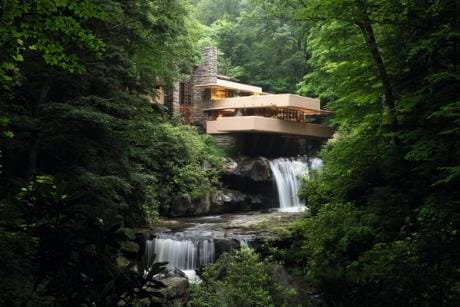
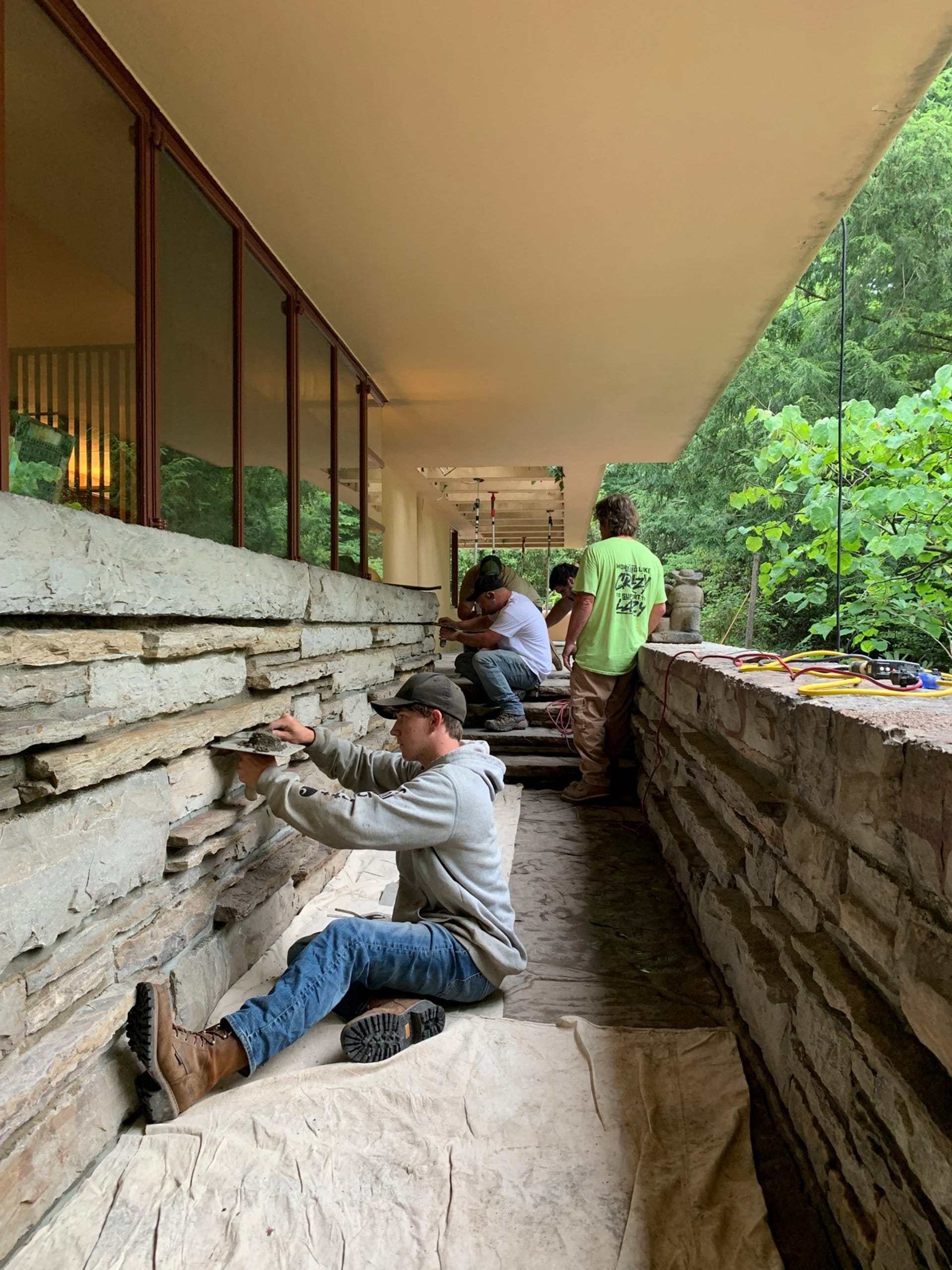
Fallingwater has been leaking since 1937. The Frank Lloyd Wright masterpiece—built over a waterfall in rural Pennsylvania, cantilevered dramatically into space, photographed endlessly as the pinnacle of American modernist architecture—has spent nine decades failing at the most fundamental job a building has: keeping water out. Now, according to The Art Newspaper, a $7 million conservation project has finally addressed the endemic structural and waterproofing issues that have plagued the house since construction. The fix took nearly a century. The admission that it needed fixing took even longer.
The Fallingwater conservation effort focused on two fronts: mitigating Wright's original engineering miscalculations and preparing the structure for climate change. Both are telling. The first acknowledges that Wright's vision prioritized aesthetics over physics—those iconic concrete terraces were never adequately reinforced, and the building's relationship to the waterfall that made it famous also made it perpetually damp. The second admits that even a $7 million intervention can't make the house work as designed—it can only buy time against worsening environmental conditions.
This is the dirty secret of architectural preservation: the buildings we worship as masterpieces often don't work. Wright's Guggenheim Museum in New York has struggled with climate control since it opened. Mies van der Rohe's Farnsworth House floods regularly. The Getty Center in Los Angeles—designed by Richard Meier and completed in 1997, not 1937—has battled leaks and HVAC failures for years. These aren't anomalies. They're the norm. Iconic architecture frequently sacrifices function for form, and the preservation industry has spent decades pretending otherwise.
The $7 million price tag at Fallingwater is instructive. That's more than twice what Wright's client, Edgar Kaufmann, originally paid to build the house in the 1930s, adjusted for inflation. Preservation costs for landmark buildings routinely exceed original construction budgets because they're not just maintaining structures—they're compensating for foundational design flaws that were baked in from the beginning. The work isn't restoration. It's remediation.
This puts institutions like the Western Pennsylvania Conservancy, which owns Fallingwater, in an impossible position. Admitting that Wright's design was structurally unsound undermines the cultural mythology that makes the house worth preserving in the first place. But pretending the building works as intended means lying to visitors and donors about why millions of dollars in repairs are necessary. The compromise is the language of "conservation" and "climate adaptation"—technical terms that obscure the reality that the house has been broken since day one.
The broader art and architecture world has the same problem. Major museums and cultural institutions are filled with buildings designed by star architects whose visions exceeded their engineering competence—or who simply didn't care whether the building functioned as long as it photographed well. The best art museums in Los Angeles include several whose climate control and gallery layouts were compromised by architectural ego. Visitors experience these spaces as cultural landmarks. Staff experience them as expensive maintenance nightmares.
Fallingwater's conservation project also highlights a larger tension in how we value architectural heritage. The house is a National Historic Landmark and a UNESCO World Heritage site. Its significance is unquestionable. But significance doesn't make a building livable, and preservation doesn't make it sustainable. The Western Pennsylvania Conservancy has essentially committed to perpetual intervention—monitoring, repairing, and adapting the structure indefinitely. Fallingwater isn't preserved. It's on life support.
The climate adaptation component of the project adds another layer of irony. Wright designed Fallingwater to be in conversation with nature—the waterfall, the forest, the landscape. That conversation is now a structural threat. Increased rainfall, temperature fluctuations, and shifting seasonal patterns are accelerating the damage that Wright's design already invited. The house was built to commune with the environment. Now the environment is what's killing it. The $7 million fix buys time, but it doesn't solve the fundamental incompatibility between Wright's vision and the physical realities of a building that sits directly over running water in a region experiencing more extreme weather every year.
The real question isn't whether Fallingwater can be saved—it's whether the preservation model that treats architectural icons as sacred objects is sustainable. The answer, increasingly, is no. Buildings like Fallingwater will require escalating financial commitments, more invasive interventions, and eventually a reckoning about whether maintaining a structure that never worked is worth the cost. That reckoning will be uncomfortable. It will require admitting that some of the 20th century's most celebrated architects built beautiful, dysfunctional monuments. And it will force cultural institutions to choose between the mythology of genius and the reality of engineering failure. Fallingwater's $7 million fix doesn't end the problem. It just makes the cost of denial more visible.