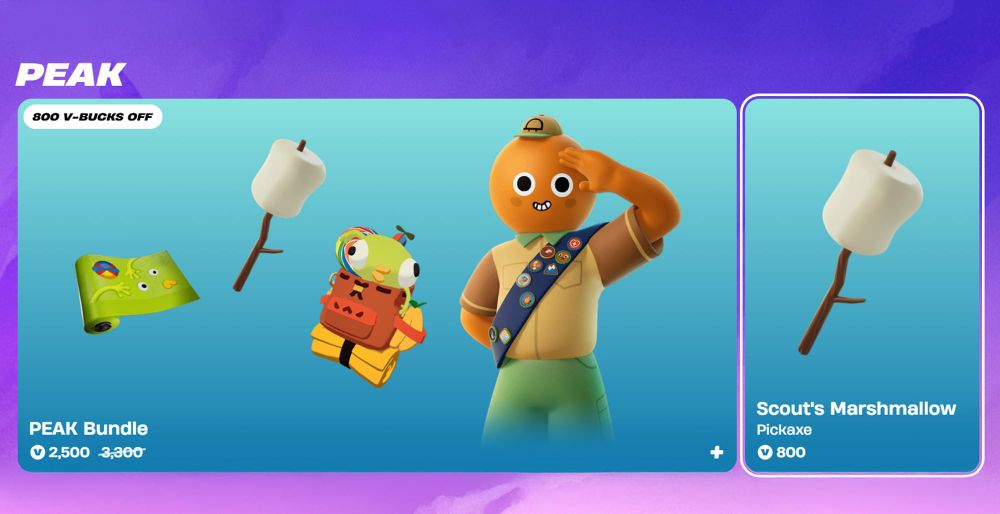
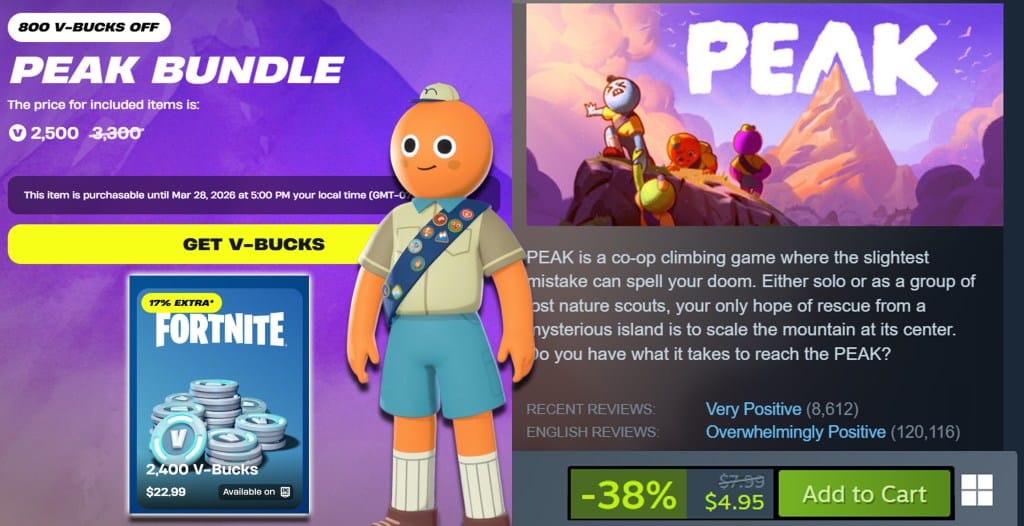
Fortnite's new Peak collaboration launched this week with skins priced at roughly $30 in V-Bucks. Peak, the indie climbing game the skins are based on, costs $10. The math is simple: Epic is charging three times more for the advertisement than the product being advertised costs.
This isn't a pricing error. It's platform economics working exactly as designed. Fortnite isn't selling access to Peak — it's selling the social capital of wearing Peak in a space where 200 million monthly players can see it. The skin isn't a game asset. It's a billboard you pay to wear.
The pricing gap makes sense once you stop thinking about Fortnite as a game and start thinking about it as real estate. Epic has built the most valuable virtual space in gaming — a place where brands, musicians, and now indie game developers pay for visibility. The difference is that most collaborations involve massive IP holders like Marvel or Nike, entities with the leverage to negotiate favorable terms and the scale to justify the investment. Peak is a small indie game from a small studio. It has no negotiating power. Epic sets the price, takes the cut, and Peak gets exposure it couldn't buy any other way.
What's fascinating is that the pricing works. Players will pay $30 for a skin in a free-to-play game but balk at spending $10 on a premium indie title. That preference isn't irrational — it reflects where players actually spend their time. Fortnite is the social space. Peak is the thing you play alone for a few hours and move on. The skin has lasting social utility. The game doesn't.
This is the same dynamic that makes Bugs Bunny's Fortnite debut worth more to Warner Bros. than another theatrical short. Fortnite isn't a distribution platform for games — it's a cultural aggregator where being present matters more than being played. Peak benefits from the collab not because Fortnite players will go buy the game, but because the skin puts Peak into the same visual vocabulary as Halo, Street Fighter, and Star Wars. That's worth the unfavorable economics.
The pricing also highlights how thoroughly gaming's economy has decoupled from traditional value structures. A $60 AAA game offers 40 hours of content. A $30 Fortnite skin offers zero gameplay and infinite social visibility. By every traditional metric, the skin is a worse deal. But traditional metrics don't account for the fact that games are now judged by their capacity to generate shareable moments, not their minute-to-minute gameplay depth. A Fortnite skin is a better investment than most full games because it lives in the space where your friends are.
This isn't unique to gaming. The same logic applies to why legacy media is hiring creator economy executives and why Hollywood treats TikTok as more valuable than box office. Attention economics reward presence in the right spaces over quality in the wrong ones. A mediocre TikTok on the right FYP is worth more than a great film no algorithm surfaces. A Fortnite skin in the right lobby is worth more than the game it references.
Epic has built a business model where the product being sold isn't the game — it's access to the audience. Every collaboration is a transaction where IP holders pay (either in revenue share or unfavorable pricing terms) for the privilege of being visible in Fortnite's ecosystem. The more unequal the pricing, the clearer the power dynamic. Marvel can negotiate. Peak can't. But both pay, because the alternative is irrelevance.
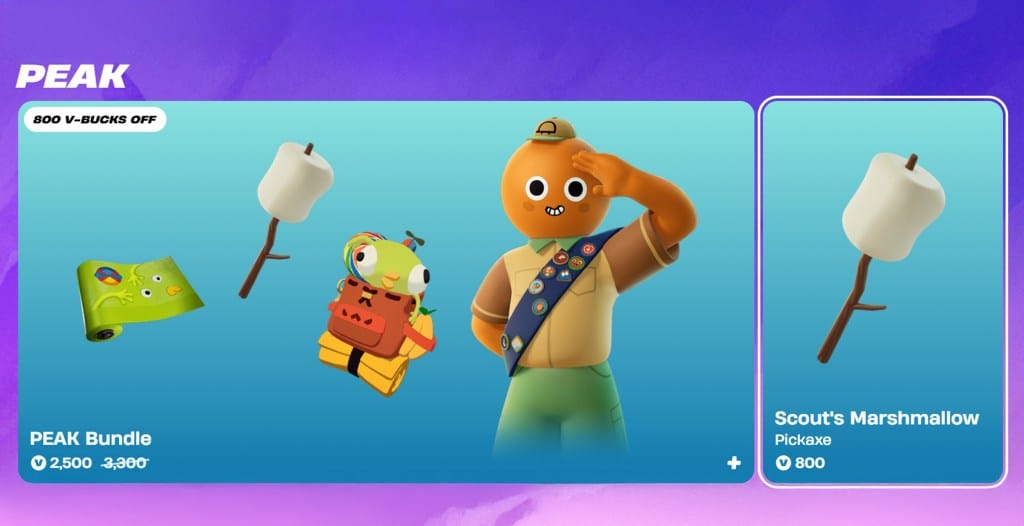
The Peak collab won't change Fortnite's pricing model. If anything, it's proof the model works. Players are paying $30 for skins that advertise $10 games because the skin has more utility than the game. That's not a market failure. That's the market working exactly as platforms designed it to. The only question is how long indie developers will keep paying for exposure in someone else's empire before they realize the economics don't scale in their favor.