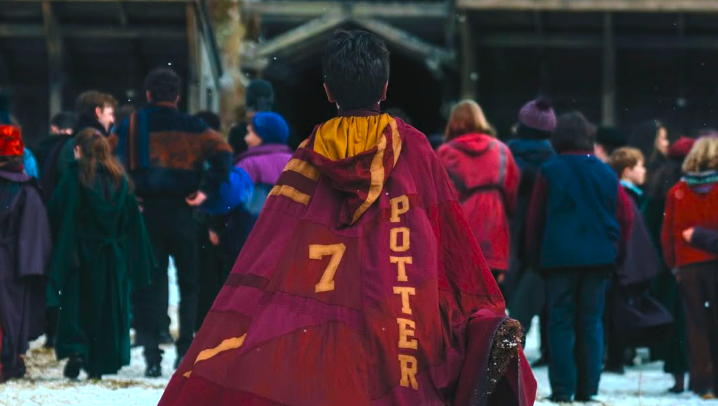
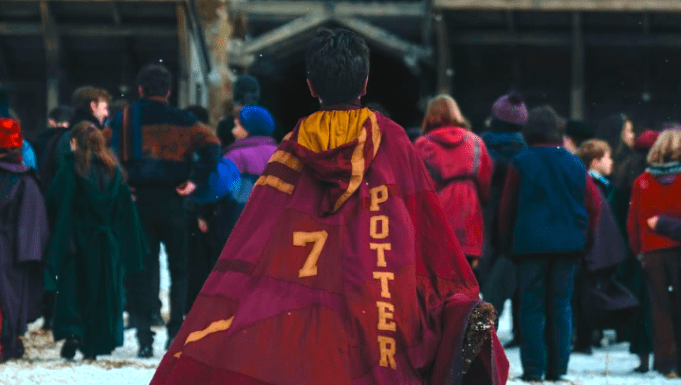
HBO released the first image from its Harry Potter series: a young wizard in a Gryffindor cloak striding toward what appears to be the Quidditch pitch. It's the kind of image designed to reassure fans that HBO is taking this seriously — production design intact, visual fidelity to the source material maintained, no obvious red flags. But the image also confirms what the franchise has been dancing around since the project was announced: this is actually happening, and Warner Bros. Discovery is betting that audiences want to watch the same story again, told slower, with different faces.
The Harry Potter films never left the culture. They stream constantly. They air on cable. TikTok is full of Sorting Hat discourse and Marauders-era fan theories. The original cast — Daniel Radcliffe, Emma Watson, Rupert Grint — are still young enough that their faces ARE Harry, Hermione, and Ron for an entire generation. HBO's series isn't filling a void. It's attempting to create one retroactively by arguing that the films, despite their commercial dominance and cultural permanence, were somehow incomplete. The pitch is that a multi-season TV format will allow for deeper adaptation of J.K. Rowling's novels — more subplots, more character development, more Hogwarts. But that pitch assumes audiences are hungry for a slower, more faithful version of a story they already know by heart.
This is a different calculation than the one Hulu faced with its canceled Buffy revival, which at least had the courtesy to position itself as a continuation rather than a replacement. HBO's Harry Potter is a straight reboot — same timeline, same story, new actors. It's a strategy that only makes sense if you believe the Potter IP is valuable enough to survive direct comparison with its own most successful iteration. And Warner Bros. Discovery clearly does believe that, because the studio is treating this series as a tentpole for Max's entire content strategy. CEO David Zaslav has repeatedly cited Harry Potter as one of the crown jewels WBD inherited in the merger, and the company has spent the past two years methodically building out the franchise's presence across gaming, theme parks, and now prestige television.
The risk isn't that the show will be bad. The risk is that it will be good — competent, well-acted, handsomely produced — and still feel redundant. Streaming has conditioned audiences to expect that every major IP will be strip-mined for content, but it hasn't yet proven that audiences actually want to rewatch the same stories in different formats. Prime Video is betting that Jack Ryan is valuable enough to move from streaming to theaters, but that's at least a different medium with different stakes. HBO is asking Potter fans to sit through seven seasons of material they've already experienced in eight films, and the only meaningful difference is pacing.
The casting of Dominic McLaughlin as Harry Potter is itself a test case. He's a newcomer, which is both necessary and risky — necessary because no established actor could survive the comparison to Radcliffe, risky because the role requires someone who can anchor a decade-long series without the safety net of prior audience goodwill. HBO has been careful to emphasize that the show will be a faithful adaptation, which is another way of saying it won't take the creative risks that might justify its existence. The safest version of this project is also the least interesting: a well-executed retread that delivers exactly what fans expect and nothing they didn't know they wanted.
What makes this gamble particularly revealing is that it's happening at a moment when streaming platforms are expanding into formats they once ignored — game shows, animation, international co-productions — because the traditional prestige TV model is no longer sustainable at scale. HBO is moving in the opposite direction, doubling down on the most expensive possible version of IP exploitation: a multi-season drama with blockbuster-level production values and no clear creative reason to exist beyond the fact that Warner Bros. owns the rights.
The image of Harry in his Gryffindor cloak is designed to make this feel inevitable — of course there's a new Harry Potter, of course HBO is the right home for it, of course this will work. But inevitability isn't the same as necessity. The films worked because they arrived at the right cultural moment and executed at the highest level. The series will have to prove it deserves to exist in the shadow of that success, and one carefully composed photograph of a kid walking toward a Quidditch pitch isn't evidence of a compelling answer. It's just evidence that the machine is running.
The show premieres in 2027. By then, the Potter films will be old enough to feel like classics rather than recent releases, which might be the only advantage HBO has: enough distance that younger viewers see the TV series as their entry point rather than a replacement. But that's a long game, and it requires betting that the franchise's cultural dominance will outlast the audience's attachment to the version that made it dominant in the first place. The first image suggests HBO is committed to playing it safe. Whether safe is enough remains the question the next two years will answer.