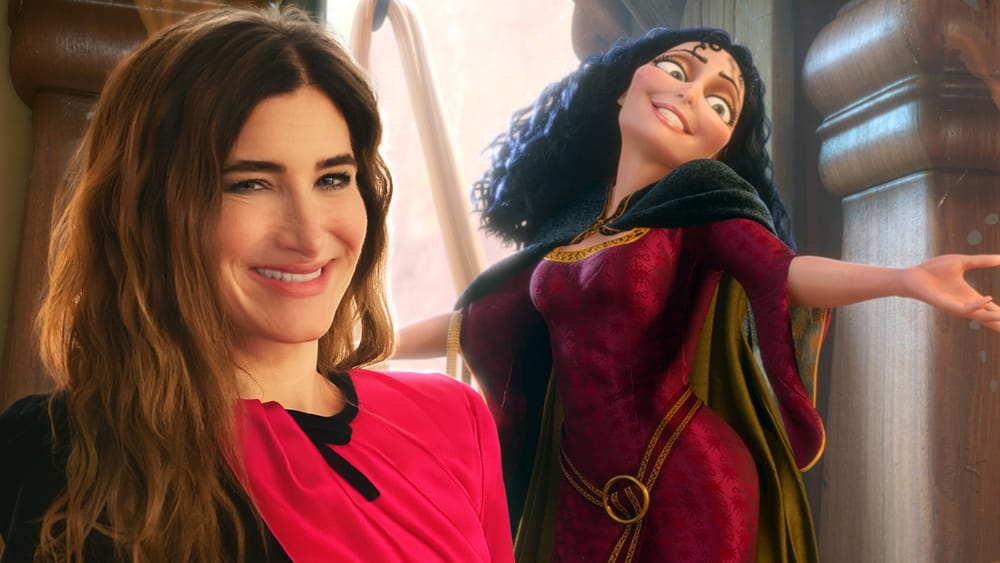
Kathryn Hahn confirmed to Deadline that she will play Mother Gothel in Disney's live-action Tangled remake, opposite Teagan Croft as Rapunzel. The announcement arrives without fanfare — no press release, no studio statement, just Hahn casually naming the role in conversation. For a casting decision this central to a major Disney IP tentpole, the low-key confirmation is revealing. Disney doesn't need to sell Kathryn Hahn to audiences anymore. Her name carries its own weight.
That weight comes from prestige television, not blockbuster franchises. Hahn built her career on character work in critically acclaimed limited series: WandaVision, The White Lotus, Tiny Beautiful Things, Agatha All Along. She has three Emmy nominations and zero franchise leads on her résumé. She is not a box office draw in the traditional sense. She is something Disney has decided is more valuable right now: an actor whose presence signals quality rather than spectacle.
This is the casting strategy Disney has refined across its live-action remake slate over the past five years. The studio is no longer chasing A-list movie stars to anchor these projects. It is hiring actors with Emmy credibility, critical acclaim, and cultural cachet earned in prestige TV. Halle Bailey in The Little Mermaid. Rachel Zegler in Snow White. Now Kathryn Hahn in Tangled. The throughline is not marquee power — it is the perception of artistic legitimacy.
The business logic is transparent. Disney's live-action remakes face a credibility problem that traditional tentpoles do not. These films are not original IP. They are not even sequels. They are adaptations of beloved animated films that already exist in a format many audiences consider definitive. The value proposition is not "see something new." It is "see something you already know, but different." That pitch requires cultural permission — a reason for the remake to exist beyond Disney's need to monetize its catalog.
Prestige TV actors provide that permission. Their casting reframes the project as an artistic interpretation rather than a corporate product. Hahn's Mother Gothel is not just a villain; it is a character study performed by an actor known for emotional nuance and psychological depth. The remake is not just a retread; it is an opportunity to see what a two-time Emmy nominee does with a role originally voiced by Donna Murphy. The framing shifts from "why does this need to exist" to "what will this version reveal."
This strategy also insulates Disney from the backlash that has plagued some of its recent remakes. Casting traditional movie stars invites comparisons to their previous work and raises questions about whether they are right for the role. Casting prestige TV actors invites comparisons to their award-nominated performances and raises expectations about the quality of the script. The former is a risk. The latter is a selling point. If the film underperforms, the narrative becomes "great actors, weak material" rather than "miscast star, doomed project."
The shift also reflects the collapse of the traditional movie star economy. Box office draw is no longer a reliable metric of cultural influence. Streaming has decoupled star power from ticket sales. An actor can be enormously famous, critically acclaimed, and culturally influential without ever opening a $100 million movie. Hahn is a perfect example. She is one of the most recognizable actors working in television. She has meme status, critical acclaim, and a fan base that spans demographics. But she has never carried a theatrical release. Disney is betting that her cultural capital translates to audience interest even without the traditional box office résumé.
The Mother Gothel casting also signals how Disney is thinking about villains in its live-action remakes. The studio has learned that the most successful of these films are the ones that give the villain as much depth as the hero — sometimes more. Maleficent reframed the villain as the protagonist. Cruella turned her into an antihero. Hahn's casting suggests Tangled will lean into Mother Gothel's psychological complexity rather than flattening her into a one-dimensional antagonist. That approach requires an actor who can carry emotional ambiguity. Hahn has built her career on it.
What remains to be seen is whether this strategy translates to box office success. Prestige TV actors bring critical credibility, but they do not guarantee ticket sales. The live-action remakes that have performed best — The Lion King, Aladdin, Beauty and the Beast — leaned on nostalgia and spectacle more than casting innovation. Tangled will test whether Disney can sell a remake on the strength of its creative choices rather than the familiarity of its IP. If Hahn's Mother Gothel becomes the reason audiences show up, Disney will have proven that Emmy credibility is the new box office insurance. If it doesn't, the studio will have to reckon with the limits of prestige as a marketing strategy.