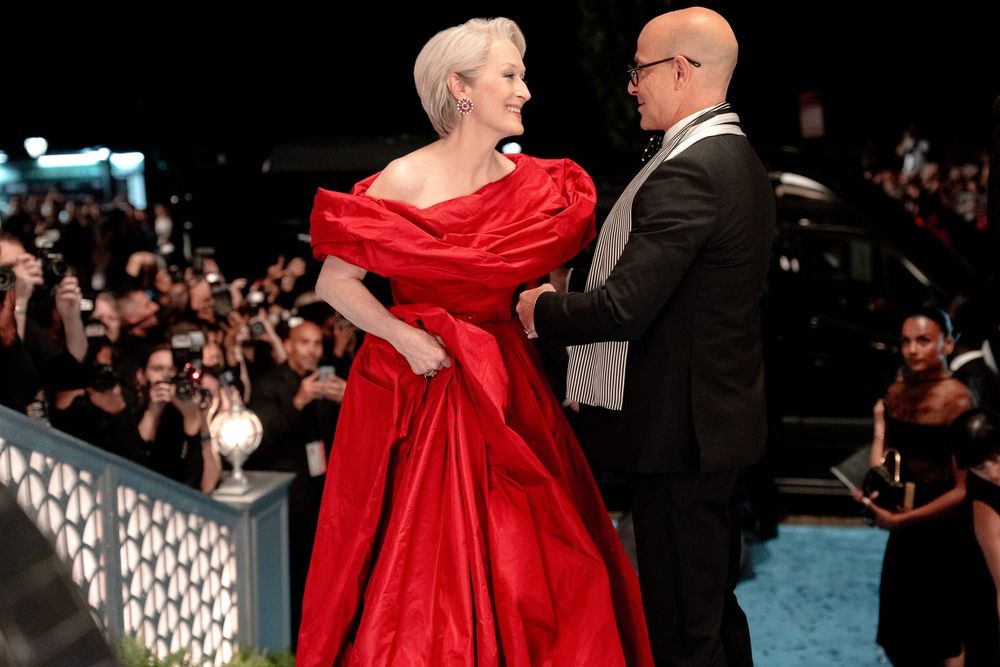
Meryl Streep stood at Stanley Tucci's Hollywood Walk of Fame ceremony and said something that sounded like a compliment but landed like an admission: Tucci, she said, has an "elegance to his heterosexuality." She added, according to Variety, "It is sometimes harder for straight men."
The phrasing is careful, almost apologetic—as if acknowledging that a straight man can be warm, emotionally literate, and aesthetically attuned without defaulting to aggression or ironic detachment requires its own vocabulary. And maybe it does. Because Hollywood has spent decades rewarding a specific version of masculinity: the stoic action hero, the wise-cracking antihero, the tortured genius who mistakes emotional unavailability for depth. Tucci, by contrast, has built a career on being present, engaged, and genuinely interested in the people around him—whether he's playing a fashion editor in The Devil Wears Prada, a game-maker in The Hunger Games, or simply making pasta on Instagram during a pandemic.
Streep's comment, though well-intentioned, exposes the problem: we still don't have a neutral way to describe men who aren't performing dominance. "Elegant heterosexuality" is what you say when "kind" or "thoughtful" feels insufficient—or when you're trying to preemptively defend against the assumption that any man who doesn't lead with machismo must be compensating for something. It's a linguistic workaround for a culture that still treats emotional intelligence in men as an anomaly worth remarking on.
The fact that this happened at a Walk of Fame ceremony—Hollywood's most visible ritual of institutional validation—makes it even more pointed. Tucci has worked steadily for decades, earning respect across genres and mediums. He's directed films, written memoirs, hosted a CNN travel series that became a cultural touchstone during lockdown. He's collaborated with some of the industry's most exacting directors and actors. And yet the most notable thing Streep could say about him, in front of a crowd that included John Krasinski and Matt Damon, was that he's managed to be a straight man without being insufferable about it.
This isn't about Tucci, who by all accounts is exactly as warm and competent as his public persona suggests. It's about what it means that Streep felt the need to frame his decency as a gendered achievement. The implication is that heterosexual men face some unique challenge in being likable—that the default setting for straight masculinity is so deeply entrenched in posturing that anyone who opts out deserves special recognition. Which might be true. But it's also a low bar.
Hollywood has always struggled with this. The industry celebrates "sensitive" male performances when they're packaged as dramatic breakthroughs—method actors who cry on cue, characters who learn to be vulnerable after trauma. But men who are simply kind, collaborative, and present without making it a character arc? Those performances don't win Oscars. They don't generate think pieces. They're just... fine. And "fine" doesn't sell tickets or build brands. Celebrity friendships that center emotional labor without drama are rarely treated as culturally significant—unless they're between women, in which case they're dissected for signs of competition or resentment.
Tucci's Walk of Fame star, shared in a rare joint ceremony with Emily Blunt, is a recognition of longevity and craft. But Streep's tribute suggests that his real accomplishment, in Hollywood's eyes, is managing to be a straight man who doesn't make everyone around him exhausted. That's not elegance. That's baseline decency. The fact that it still reads as exceptional in 2026 is the story.
What makes this particularly telling is that Streep herself has spent decades navigating an industry that punishes women for the same traits it rewards in men—assertiveness, ambition, refusal to perform constant warmth. She knows how gendered expectations shape careers. And yet even she defaults to a framework that treats non-toxic masculinity as a special category, rather than the standard. It's a reminder that even the most perceptive observers of Hollywood's power dynamics are still working within its vocabulary.
The question isn't whether Tucci deserves the praise—he does. The question is why we're still praising men for clearing a bar that shouldn't exist in the first place. And why, in an industry that prides itself on storytelling, we still don't have better language for describing men who manage to be fully human without making it a performance. Hollywood's A-list has spent the last few years recalibrating what public presence looks like—less exposure, more control, fewer apologies. Maybe the next recalibration is learning to describe decency without making it sound like an outlier.