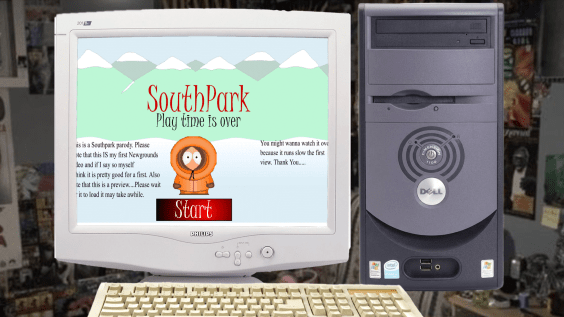
"Back when the internet was new and people made stuff for the fun of it." That's how The Daily Dot describes the ethos behind Newgrounds Roulette, a tool that's been making the rounds this week for doing something deceptively simple: it shuffles through Flash animations uploaded to Newgrounds between 2000 and 2010, serving up random clips from an era when the web was weirder, slower, and infinitely less monetizable.
The tool itself is bare-bones—a single button, a video player, no algorithm trying to predict what you want to see next. Click, watch a crude stick-figure fight set to nu-metal. Click again, land on an absurdist parody of a cereal commercial. Click once more, stumble into someone's earnest attempt at anime fan fiction rendered in choppy 12fps glory. It's a time capsule, but the reason it's gone viral isn't because people miss the content. Most of it is, objectively, not good. The reason it resonates is because it represents an internet that no longer exists: one where making something weird and uploading it to Newgrounds was the point, not the first step in a monetization funnel.
Newgrounds was never designed to make creators rich. There was no ad revenue split, no brand deals waiting on the other side of virality, no analytics dashboard showing you which demographic engaged most with your stick-figure violence. You made a Flash animation because you wanted to see if you could, or because you thought it was funny, or because you were 16 and had unsupervised access to a computer. The platform's entire structure rewarded experimentation over optimization. The front page wasn't algorithmically curated—it was voted on by users, which meant genuinely strange, niche work could surface alongside more polished projects. There was no engagement metric telling you to make your videos shorter, punchier, more platform-friendly. You just made the thing and put it out there.
That freedom is what the internet traded away when it professionalized. Platforms like TikTok, YouTube, and Instagram have turned creation into labor, complete with best practices, optimal posting times, and content strategies. The algorithm doesn't reward weirdness—it rewards consistency, virality, and content that keeps users scrolling. Creators don't make things for fun anymore; they make things that perform. Even independent artists and filmmakers now talk about their work in terms of "engagement" and "reach," because that's the only way to justify the time investment in an attention economy that treats creativity as unpaid R&D for the platform's ad business. Legacy media is still trying to catch up, but the shift has already happened: the internet is a job now, not a playground.
Newgrounds Roulette's viral moment is less about nostalgia for Flash animation and more about mourning what that era represented. It's the same impulse driving the recent wave of early-web aesthetics—Geocities recreations, Y2K fashion, the Gyaru Bulbasaur meme turning Pokémon into a format for cultural remixing rather than a childhood memory to passively consume. People aren't longing for slower internet speeds or lower video quality. They're longing for a version of online creativity that didn't require a business plan.
The irony is that Newgrounds still exists. The site never went away. It's still hosting new work, still running on the same user-voting system, still a place where you can upload a deeply strange animation and not worry about whether it'll appease an algorithm. But the culture around it has shifted. The internet's center of gravity moved to platforms where visibility is tied to monetization, and even creators who remember the Newgrounds era now operate within systems that demand constant output, audience growth, and brand-safe content. You can still make weird stuff for fun—but the platforms that dominate online culture have made it nearly impossible to be seen unless you're playing by their rules.

What Newgrounds Roulette offers is a window into an internet that prioritized making over marketing. Every random click is a reminder that people used to create things without worrying about whether they'd go viral, get sponsored, or build a personal brand. They just made stuff, uploaded it, and moved on. That version of the web didn't scale, didn't generate billions in ad revenue, and didn't survive the professionalization of online culture. But its absence is exactly why a tool that does nothing but shuffle through old Flash animations feels, in 2026, like a radical act.
The question isn't whether we can go back to that era—we can't, and the infrastructure that made it possible (Flash, decentralized platforms, an internet not yet dominated by a handful of tech giants) is gone. The question is whether the current generation of creators will build new spaces that reward weirdness over virality, or whether the algorithmic internet has so thoroughly colonized the culture that making something just for the sake of it now feels like a luxury only hobbyists can afford. Newgrounds Roulette went viral because it reminded people of a time when the internet didn't feel like work. That nostalgia isn't going away—but neither is the system that killed what people are nostalgic for.