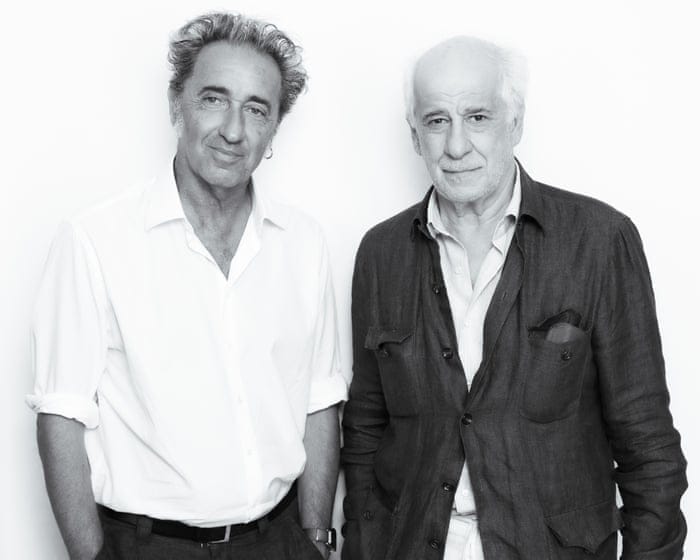
The publicist drags the table and chairs onto the cramped sixth-floor balcony of a Venice hotel because Paolo Sorrentino and Toni Servillo like to smoke. They're men of old Europe—rigid, courtly, serenely unreconstructed—and they've made seven films together across more than two decades. The interview lasts two minutes outdoors before the rain comes in sideways and everyone retreats inside. According to The Guardian, the publicist had asked ahead of time whether the recording device would pick up what they say or just the noise of the wind. It's a small logistical concern that accidentally captures something larger: in an industry increasingly shaped by algorithmic prediction and data-driven greenlight decisions, Sorrentino and Servillo's creative partnership operates on something far less quantifiable—trust, instinct, and a mysterious energy that neither man can fully articulate.
Their latest collaboration, La Grazia, is a drama about a president at the end of his career. Early reviews are calling it Sorrentino's finest work since The Great Beauty, the 2013 film that won the Oscar for Best Foreign Language Film and established him as one of Europe's most visually ambitious auteurs. That La Grazia reunites him with Servillo—the actor who has anchored nearly every major Sorrentino project—signals that the director has found something rare in contemporary cinema: a collaborator whose presence doesn't just elevate the work but makes certain kinds of storytelling possible in the first place.
What makes the Sorrentino-Servillo partnership worth examining now isn't just its longevity or its artistic output. It's that it represents a model of filmmaking that the streaming era has spent the last decade trying to replace. Streaming platforms operate on the premise that audience behavior can be predicted, that creative decisions can be optimized, and that IP with built-in recognition beats auteur-driven original work every time. Sorrentino and Servillo have spent 20 years building films around the opposite premise: that the most compelling work emerges from relationships that can't be reverse-engineered, that the best performances come from actors who understand a director's rhythms so intimately they can anticipate the unspoken, and that loyalty—between collaborators, between filmmaker and audience—is a creative asset, not a sentimental indulgence.
In the interview, Sorrentino and Servillo discuss ageing, loyalty, and the mysterious energy that has bound them for more than two decades. What they don't say explicitly—but what becomes clear in the subtext—is that their partnership has survived precisely because it operates outside the metrics-driven logic that now governs most of the industry. They don't make films based on what algorithms suggest audiences want. They make films because they've found a creative shorthand that allows them to take risks most directors and actors can't afford.
This is the business strategy embedded in auteur cinema that streaming platforms have consistently undervalued: the long-term creative partnership as competitive advantage. When a director and actor work together repeatedly, they develop a shared vocabulary that speeds up production, reduces the need for extensive rehearsal, and allows for more ambitious storytelling because both parties trust the other's instincts. Sorrentino doesn't need to explain every narrative choice to Servillo. Servillo doesn't need extensive direction to understand the emotional register Sorrentino is chasing. That efficiency isn't just creatively satisfying—it's economically valuable. It allows films to be made faster, with fewer takes, and with a level of creative risk that would be harder to justify with a less familiar collaborator.
But the streaming model has largely dismissed this logic in favor of a different calculus: cast the biggest name available, maximize the potential audience reach, and move on to the next project. The result is a film industry increasingly populated by one-off collaborations between directors and actors who have never worked together before and likely never will again. There's nothing inherently wrong with that approach—some of the greatest films in history were made by people meeting for the first time—but it does eliminate a specific kind of creative possibility. It eliminates the Sorrentino-Servillo model, where the seventh film together can do things the first film couldn't because the relationship itself has become part of the storytelling toolkit.
The cultural pattern here extends beyond just Sorrentino and Servillo. Across the film industry, the most critically acclaimed and culturally durable work of the last two decades has disproportionately come from directors who work with the same collaborators repeatedly. Wes Anderson and his rotating ensemble. Paul Thomas Anderson and Jonny Greenwood. Christopher Nolan and his brother Jonathan, cinematographer Hoyte van Hoytema, and composer Hans Zimmer. These aren't just creative friendships—they're strategic partnerships that allow for a level of ambition and risk-taking that would be harder to justify in a one-off project with unfamiliar collaborators.
What makes the Sorrentino-Servillo partnership particularly instructive is that it exists almost entirely outside the American studio system and the streaming ecosystem that has largely replaced it. Sorrentino's films are European co-productions, funded through a patchwork of national film funds, international sales, and festival presales. They're not designed to be algorithmically recommended to millions of subscribers. They're designed to be the kind of work that a specific audience will seek out because they trust the filmmaker's vision. That's a fundamentally different business model—one that depends on loyalty rather than reach, on depth of engagement rather than breadth of distribution.
The accountability lens here is worth sharpening. The streaming platforms have spent the last decade arguing that their model democratizes access to content and gives audiences more choice. Both of those things are true. But what the platforms rarely acknowledge is what gets lost in that exchange: the infrastructure that allows for long-term creative partnerships, the patience required to let a director and actor develop a shared language over multiple projects, and the willingness to fund work that doesn't have an obvious audience but might find one over time. Sorrentino and Servillo's partnership exists because European film financing still allows for that kind of patience. It's not clear the American system does anymore.
La Grazia arrives at a moment when the film industry is undergoing one of its most significant structural shifts in decades. The theatrical window is collapsing. Streaming platforms are pulling back on spending. International co-productions are becoming more common as a hedge against domestic market volatility. In that context, the Sorrentino-Servillo model looks less like a romantic throwback and more like a pragmatic response to an industry that no longer rewards long-term thinking. If you can't count on studio backing, if you can't rely on streaming budgets, then building a network of trusted collaborators who can work efficiently and take creative risks together becomes not just an artistic preference but a survival strategy.
The interview itself—conducted on a rain-soaked balcony, interrupted by weather, shaped by the fact that both men like to smoke—feels like a small encapsulation of what makes their partnership work. It's not polished. It's not optimized for virality. It's two people who have spent 20 years making films together, sitting down to talk about ageing and loyalty and the things that have to stay private between them. As Servillo tells The Guardian, "Our bond is private. Some things have to stay between us." That's the opposite of how the entertainment industry operates now, where every collaboration is documented, every behind-the-scenes moment is content, and every creative decision is subject to audience feedback before the work is even finished.
What Sorrentino and Servillo have built together over seven films is a reminder that some of the most valuable creative partnerships are the ones that resist easy explanation, that operate on instinct rather than data, and that depend on the kind of trust that can only be built over time. The streaming era has given audiences more access to more content than ever before. But it has also made it harder for the kinds of long-term creative partnerships that produce The Great Beauty and La Grazia to exist. The question isn't whether the Sorrentino-Servillo model can survive in the current industry—it's whether the industry can afford to keep losing the kind of work that only becomes possible when two people spend 20 years learning how to make films together.
For more, see the best music documentaries streaming now and the best art house cinemas in LA.