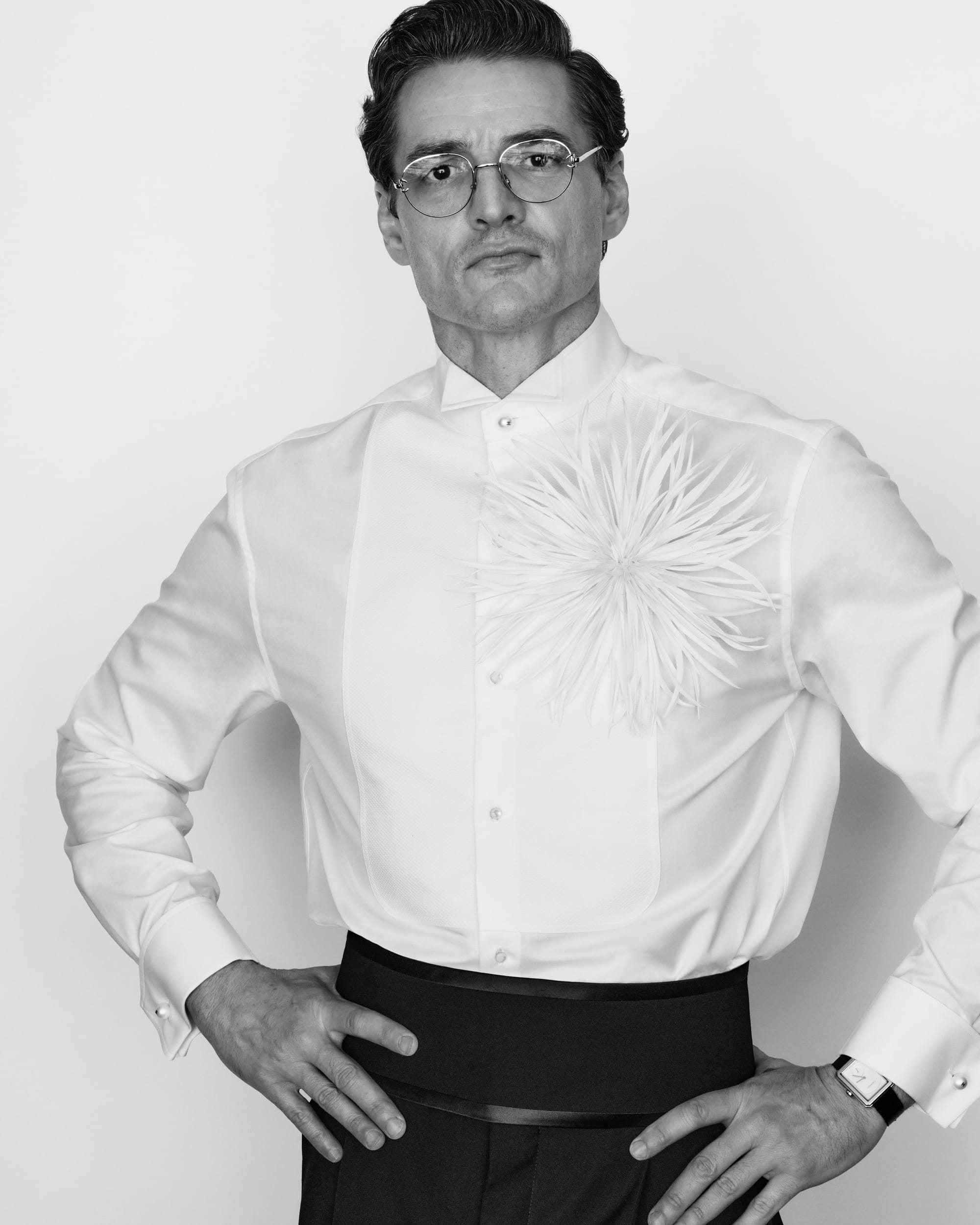
Chanel dressed Pedro Pascal for the Oscars in a custom tuxedo with no jacket. Just a crisp white shirt, black trousers, a bow tie, and the kind of confidence that comes from knowing the look works because the house spent real money making sure it would. Pascal told GQ he loved that the look "doesn't take itself too seriously," which is a generous way of describing what happens when a luxury house finally treats menswear like a business line instead of a marketing expense.
The jacketless tuxedo is not new. What's new is Chanel making it custom for a male actor at an event where every other house is fighting for the same real estate. That's not styling — that's infrastructure. Custom red carpet pieces for men signal that Chanel is building menswear the way it built womenswear: through relationships, through craft, through the kind of investment that pays off in brand equity rather than immediate sales. Pascal's look wasn't borrowed from a showroom. It was made for him, which means Chanel has the atelier capacity, the client relationship, and the strategic patience to play the long game in a category it has historically treated as an afterthought.
Chanel's menswear has always existed in the shadow of its womenswear empire. The house built its reputation on Coco Chanel's vision for women's fashion, and every subsequent creative director has reinforced that primacy. Menswear was a footnote — small collections, limited distribution, minimal investment. But the luxury market has shifted. Men's fashion is no longer a secondary category. It's a growth engine. Brands that ignored menswear are now scrambling to build credibility in a space where younger consumers, particularly in Asia and the Middle East, are driving demand. Chanel's decision to dress Pascal in custom for the Oscars is a signal that the house understands the assignment. It's not trying to launch a men's line overnight. It's building the relationships and the infrastructure that will make menswear a legitimate revenue stream over the next decade.
The Oscars red carpet is brand strategy theater. Every look is a negotiation between celebrity, stylist, and house. The actor gets the visibility. The stylist gets the portfolio moment. The house gets the association. But custom pieces are a different calculation. They cost more to produce, require more lead time, and carry more risk if the look doesn't land. Chanel made that bet on Pascal because the house is betting on menswear as a category, not just on one red carpet moment. The same logic applies to red carpet strategies at film premieres, where houses use custom looks to build long-term relationships with actors who will wear the brand beyond a single event.
Pascal's look also benefits from the fact that jacketless formalwear is having a moment. The traditional tuxedo is still the default, but younger actors and musicians are increasingly opting for variations that feel less rigid. The jacketless tux works because it's still formal — the bow tie, the pleated shirt, the tailored trousers — but it's also loose enough to read as personal style rather than costume. That balance is exactly what Chanel has always done well in womenswear: making clothes that feel like an extension of the person wearing them rather than a brand statement. Applying that same philosophy to menswear is smart. It's also overdue.
The broader luxury market is watching. Chanel is not the only house trying to figure out how to build menswear credibility. Dior's Fall 2026 collection made a similar bet on menswear as a category that can carry the same cultural weight as womenswear. But Dior has been investing in menswear for years under Kim Jones. Chanel is still building. The difference is that Chanel has the brand equity to make up for lost time. A custom Oscars look for Pascal is not just a red carpet win. It's a proof of concept. If Chanel can dress male actors at the same level it dresses female actors, the house can justify the investment in menswear infrastructure — more atelier capacity, more retail space, more marketing spend.
The risk is that Chanel treats this as a one-off rather than a strategy. Custom red carpet pieces are expensive. They require relationships with stylists, actors, and publicists. They require a creative team that understands how to dress men without defaulting to womenswear codes. And they require patience. Menswear credibility is not built in a season. It's built over years of consistent investment, consistent visibility, and consistent quality. Pascal's look is a good start. But it's only a start if Chanel follows through. The next test is whether the house dresses more male actors in custom pieces at the next major event. If it does, menswear is a strategy. If it doesn't, Pascal's look was just good PR.
The luxury market's appetite for menswear is only growing. Chanel's decision to invest in custom red carpet pieces for male actors is late, but it's not too late. The house has the resources, the brand equity, and the creative infrastructure to build menswear into a legitimate category. Pascal's jacketless tuxedo is evidence that Chanel is finally treating menswear like it matters. The question is whether the house is willing to keep investing after the red carpet photos fade.