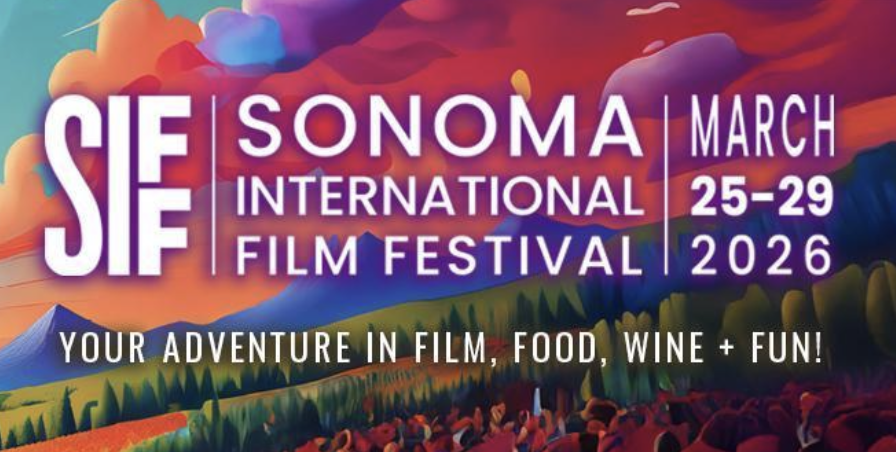
Maude Apatow's feature directorial debut Poetic License will open the 29th annual Sonoma International Film Festival on March 25. The announcement came this week alongside a lineup that includes new work from Steven Soderbergh, Julian Schnabel, and Lucrecia Martel—directors who don't need a regional festival in California wine country to validate their careers. And yet here they are, scheduled for screenings between vineyard tours and panel discussions at the Sebastiani Theatre. According to Deadline, the March 25-29 festival will host premieres and competition screenings across multiple venues in Sonoma County, drawing the kind of talent that would have been unthinkable for a festival of this size a decade ago.
What Sonoma's lineup reveals is how much the distribution model has shifted for mid-budget independent films. Regional festivals like Sonoma aren't vanity stops anymore—they're strategic infrastructure. When the streamers aren't buying and theatrical windows keep shrinking, filmmakers need sustained festival runs to build word-of-mouth, secure smaller distribution deals, and justify their existence to financiers. A California premiere at Sonoma, followed by a handful of other regional stops, can generate the kind of incremental press and audience that a single-weekend Sundance slot no longer guarantees.
The math has changed. Sundance used to be the place where bidding wars happened and distribution deals got signed before the credits rolled. Now it's where films go to be seen by industry insiders who may or may not have the budget to acquire them. The streamers that once drove that acquisition frenzy have pulled back. Netflix is more selective. Amazon is restructuring. Apple wants prestige, not volume. The result is a growing class of films—well-made, director-driven, too expensive to be microbudget but too small to be studio tentpoles—that need a different path to audiences.
Regional festivals have become part of a longer, slower distribution strategy. They're not about the big sale anymore. They're about building momentum across months instead of days. A film that premieres at Telluride, plays Sonoma in the spring, and hits a handful of other regional stops by summer can generate sustained coverage, local press, and audience word-of-mouth that adds up to something bigger than a single high-profile premiere. It's the difference between a sprint and a marathon, and for films without built-in marketing budgets, the marathon is the only option.
The parallel to the death of monoculture is direct. Just as audiences have fragmented into niche communities that build cultural momentum slowly rather than through single viral moments, independent films now find their audiences through accumulated regional attention rather than one explosive premiere. The infrastructure that replaced the old studio system isn't centralized—it's distributed across dozens of mid-sized festivals that each serve specific regional audiences and press ecosystems.
For Apatow, the Sonoma premiere offers something more valuable than a bidding war: a chance to be seen at all. She's making her first feature outside the protective radius of her father's industry capital, and while the Apatow name opens doors, it doesn't guarantee distribution. A festival like Sonoma gives her film a platform, an audience, and a news hook. It's a way to enter the conversation without needing to dominate it. The fact that Soderbergh and Schnabel are also on the slate suggests they understand the same calculus. They don't need Sonoma's prestige, but they need its infrastructure.
What's notable is how little these established directors seem to resent the shift. There's no public hand-wringing about having to "do the circuit" the way emerging filmmakers do. That acceptance signals something important: the regional festival strategy isn't a failure state anymore. It's just how mid-budget independent film works now. The old hierarchy—where established directors got automatic distribution and emerging ones had to fight for it—has collapsed into a system where everyone except the very top tier is building their audience one market at a time.
The business logic is straightforward. Regional festivals offer filmmakers something the old model no longer does: time. Time to build an audience. Time to generate press. Time to prove that a film deserves to exist beyond its premiere weekend. In an environment where theatrical windows are collapsing and streaming libraries are bloated with unseen titles, obscurity is the real threat. A festival circuit that stretches across months and regions becomes insurance against disappearing entirely.
Festivals in wine country or college towns aren't competing with Telluride for prestige. They're competing with the void. The question isn't whether a film can generate buzz at Sundance—it's whether it can stay visible long enough to find the audience that will actually pay to see it. Regional festivals provide that extended visibility at relatively low cost. They're not gatekeepers in the traditional sense. They're scaffolding.
The Sonoma lineup is a signal that this shift is now structural, not situational. When established directors like Soderbergh and Schnabel are using regional festivals as part of their release strategy, it's not because they've lost clout—it's because the industry has lost infrastructure. The old gatekeepers aren't buying the way they used to, and the new ones haven't fully replaced them. In the gap, regional festivals have become essential. They're not the destination anymore. They're the route.
What remains to be seen is whether this model is sustainable for the festivals themselves. Sonoma can attract big names now because filmmakers need them. But regional festivals operate on tight budgets, rely heavily on volunteer labor, and depend on local sponsorships that can evaporate quickly. If the current distribution crisis persists—and there's no reason to think it won't—these festivals will face increasing pressure to professionalize, expand, and compete for the same pool of films. Some will succeed. Others will fold. The ones that survive will become permanent fixtures in how independent film reaches audiences. The ones that don't will leave gaps that other regions will rush to fill.
For now, Sonoma's March lineup represents a moment of equilibrium. Filmmakers need festivals. Festivals need films. The system works because both sides have run out of better options. That's not romantic, but it's functional. And in an industry where functional infrastructure is increasingly rare, functional might be enough.
For more, see the best art house cinemas in LA and iPic’s premium theater bankruptcy.