Alan Ritchson's War Machine racked up 39.3 million views in its first three days on Netflix, making it the platform's most-watched title during the week of March 2-8, according to Variety. Season 4 of Bridgerton came in second overall, pulling 13.1 million views for the second consecutive week. The numbers position War Machine as Netflix's latest action tentpole success — a sci-fi vehicle built around a recognizable lead, delivered directly to 260 million global subscribers without a theatrical window, a press tour, or a box office weekend to define its cultural footprint.
Netflix has spent years refining this exact formula: cast a recognizable but not-quite-A-list actor in a high-concept action film, spend enough on production value to make it feel theatrical, and let the algorithm do the distribution work. It's a strategy that generates massive viewership numbers and keeps subscribers engaged. War Machine's 39 million views in three days is legitimately impressive by any metric. But here's what those numbers don't show: whether anyone outside the Netflix ecosystem knows the movie exists, whether Ritchson's star power increased in any measurable way, or whether anyone will remember War Machine in six months.
The theatrical model built action stars through a specific alchemy: opening weekend box office, global press tours, magazine covers, and a shared cultural conversation that happened in real time. When Keanu Reeves opened The Matrix in 1999, the film's $27.7 million opening weekend was a public event. When Dwayne Johnson transitioned from wrestling to action hero, his box office numbers were reported like sports scores. The theatrical release created a legibility around star power — a way to measure, in dollars and ticket sales, whether an actor could carry a movie. Streaming doesn't offer that. Netflix's viewership metrics are self-reported, inconsistently defined, and impossible to verify. A "view" counts if someone watches two minutes. There's no way to know if 39 million people finished War Machine, liked it, or even remember watching it.
Ritchson is an interesting test case for this dynamic. He's built a career on being a recognizable face in genre projects — Reacher on Amazon Prime, Fast X in theaters — without quite breaking through to household-name status. War Machine positions him as a leading man in a big-budget action vehicle, but the Netflix model doesn't give him the infrastructure to capitalize on that. There's no press tour generating GQ profiles. No opening weekend to create momentum. No international rollout to build anticipation. The movie appears in the Netflix queue, gets watched by tens of millions of people, and then disappears into the content library. Ritchson's career benefits from the exposure, but the platform doesn't build him into a star the way a theatrical franchise would.
This isn't a problem for Netflix. The platform doesn't need stars — it needs content that keeps subscribers from canceling. War Machine does that job. It's a high-concept, effects-driven action film that satisfies the algorithm's preference for genre fare and gives Netflix something to promote in its weekly Top 10 emails. The 39 million views mean the film succeeded at its primary function: keeping people inside the Netflix ecosystem. But that success doesn't translate into cultural capital for Ritchson, and it doesn't create the kind of star-making moment that theatrical action films used to deliver.
The broader pattern here is that streaming has effectively decoupled viewership from stardom. Netflix can generate massive audiences for its films, but those audiences don't coalesce into the kind of shared cultural experience that builds stars. Streaming platforms have figured out how to create hits, but they haven't figured out how to replicate the theatrical model's ability to turn actors into bankable commodities. That's partly by design — platforms benefit from keeping audiences focused on the service rather than individual talent — and partly a structural limitation of the medium. Without box office numbers, without a theatrical window, without a press cycle that extends beyond a few Instagram posts, there's no mechanism to build the kind of star power that used to define action cinema.
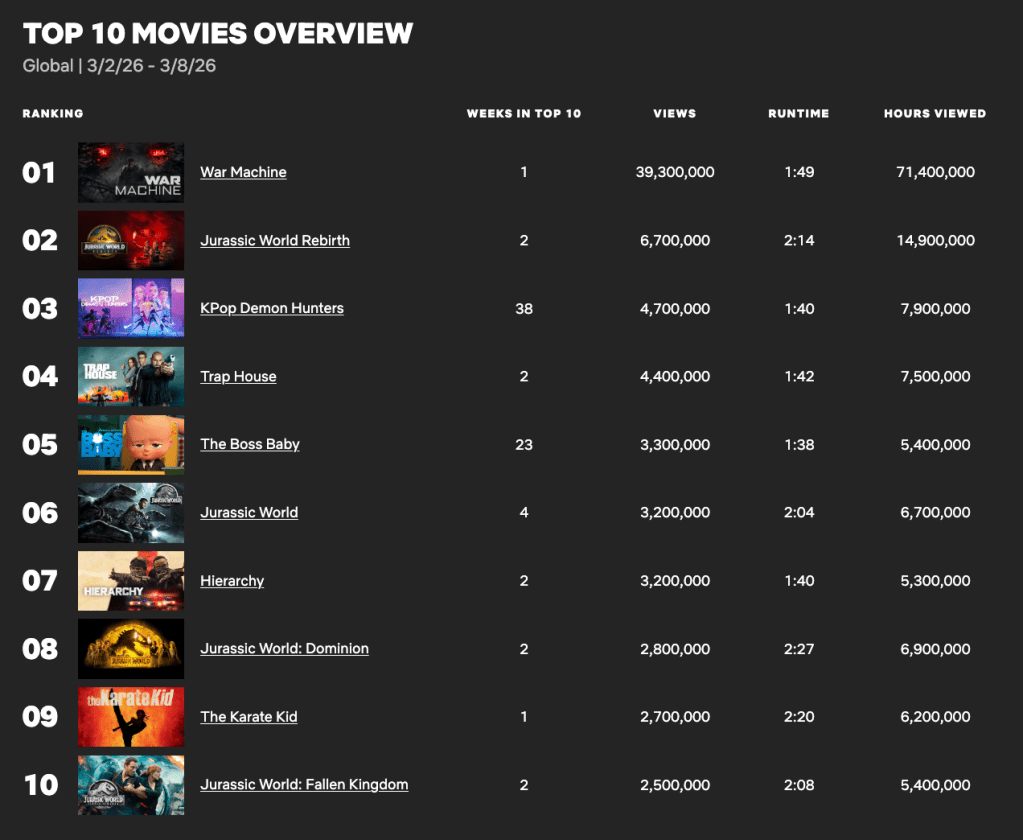
War Machine's 39 million views are real. The film found an audience. But Netflix's action strategy, for all its efficiency and scale, still can't replicate what theaters used to do: turn a good opening weekend into a career-defining moment. Ritchson will get more work from this. He'll probably headline another Netflix action film. But he won't become the next Keanu Reeves or Dwayne Johnson, because the infrastructure to build that kind of stardom doesn't exist on streaming platforms. The views are there. The stars aren't.

What happens when the most-watched action films in the world can't make action stars? Netflix is about to find out — and so is every actor who signs on to be the next big thing in a medium that doesn't build big things anymore.