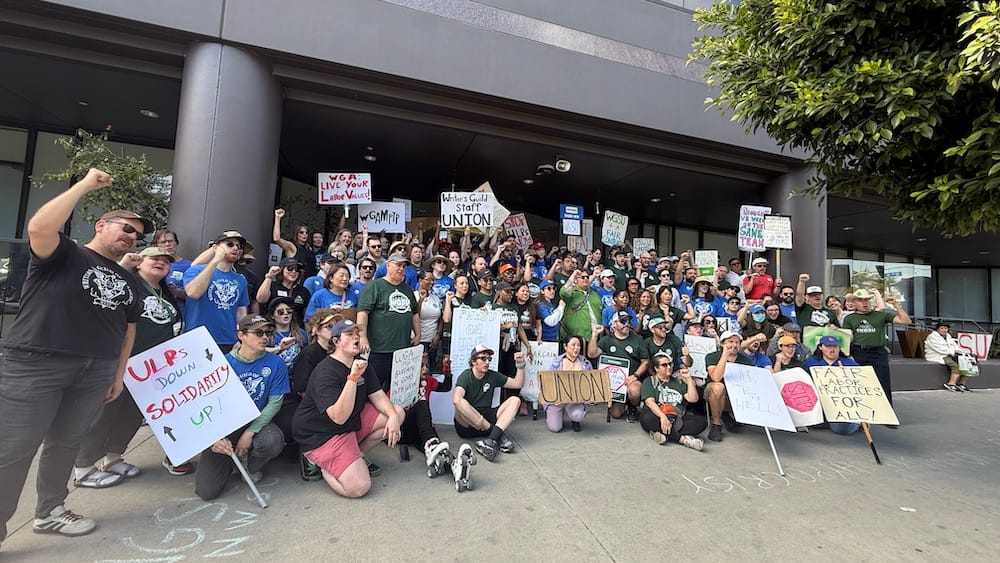
The Writers Guild of America West staff union delivered what it's calling a "strike-ending" contract proposal to executive director Ellen Stutzman on Thursday. The proposal arrives six weeks into a work stoppage by the people who help negotiate writers' contracts — and who apparently can't get their own employer to sit down and negotiate theirs.
The WGSU's new proposal follows a failed attempt last weekend to bring WGA West leadership back to the bargaining table. According to Deadline, the guild's management didn't respond. So the staff union shifted tactics: instead of waiting for leadership to show up, they sent over terms designed to end the strike outright. The message is blunt — "enter a fair deal…and reunite," as the union put it — but the subtext is blunter. Six weeks in, the guild that spent 2023 positioning itself as labor's most effective champion can't resolve a labor dispute with its own employees.
The WGA West staff strike has always carried a specific irony, but it's moved past ironic and into structural. This is the organization that successfully extracted new streaming residuals and AI protections from studios in 2023. The same leadership that held the line for 148 days against some of the most powerful corporations in entertainment is now six weeks into a standoff with people who work down the hall. The guild's staff aren't asking for anything writers didn't fight for themselves: fair pay, job security, and a seat at the table. But while the WGA can leverage an entire industry shutdown to win writers' demands, its own employees have no equivalent pressure point. They can stop answering phones and processing grievances, but the guild doesn't need to release a fall TV schedule.
What makes this messier is that Hollywood labor organizing has spent the last three years building momentum on the idea that solidarity works. The 2023 writers' and actors' strikes succeeded in part because they framed their fight as part of a larger labor movement — not just writers and actors, but everyone getting squeezed by streaming economics and algorithmic cost-cutting. That framing worked. It built public support, kept picket lines active, and forced studios to concede on issues they'd refused to negotiate for years. But solidarity as a tactic only holds if the organizations leading the fight actually practice it internally. When a union that just won historic contract gains can't settle a dispute with its own staff, it starts to look less like a labor victory and more like a power transfer that didn't trickle down.
The WGA West isn't the first entertainment labor organization to face internal organizing. CBS News 24/7 writers walked out over digital contracts that treated streaming work as less valuable than broadcast. SAG-AFTRA has faced internal criticism over how its leadership prioritizes film and TV members over voice actors and stunt performers. But the WGA West staff strike is happening at a moment when the guild's credibility as a labor leader is at its peak. The 2023 strike didn't just win contract gains — it reset expectations across Hollywood about what workers could demand and what management would have to concede. That's why this internal dispute matters beyond the specifics of the WGSU's contract. If the guild that just proved labor organizing works can't make it work for its own people, the lesson Hollywood takes away isn't that the WGA West is hypocritical. It's that labor power is situational, not structural — and that even the most successful unions are still better at fighting external enemies than addressing internal inequities.
The "strike-ending" framing of the new proposal suggests the WGSU knows this is becoming a reputational problem for both sides. Six weeks is long enough that the strike is no longer an internal HR matter — it's a public contradiction. The guild can't credibly advocate for writers' labor protections while its own staff are on strike over the same issues. And the staff can't keep walking out indefinitely without risking the very infrastructure that makes the guild functional. A prolonged strike doesn't just hurt the WGA West's operations; it undermines the broader argument that unions are the solution to Hollywood's labor crisis. If unions can't treat their own employees fairly, why should writers trust them to negotiate better deals with studios?
What happens next will clarify whether the WGA West sees this as a genuine labor issue or a PR inconvenience. If management comes back to the table and negotiates in good faith, the strike ends and the guild's labor credentials stay intact. If leadership keeps stalling, the contradiction becomes permanent. The WGA West either believes in the principles it fought for in 2023, or it believes in them selectively. There's no middle ground when your own employees are the ones holding the picket signs.

Hollywood's labor movement has spent three years proving that collective action works. The WGA West staff strike is testing whether that belief survives contact with the organizations that are supposed to be leading it. The answer isn't academic. It's whether the people who negotiate writers' contracts can sit down and negotiate their own — and whether the guild that shut down an industry to win fair treatment can extend the same courtesy to the people who work for it.