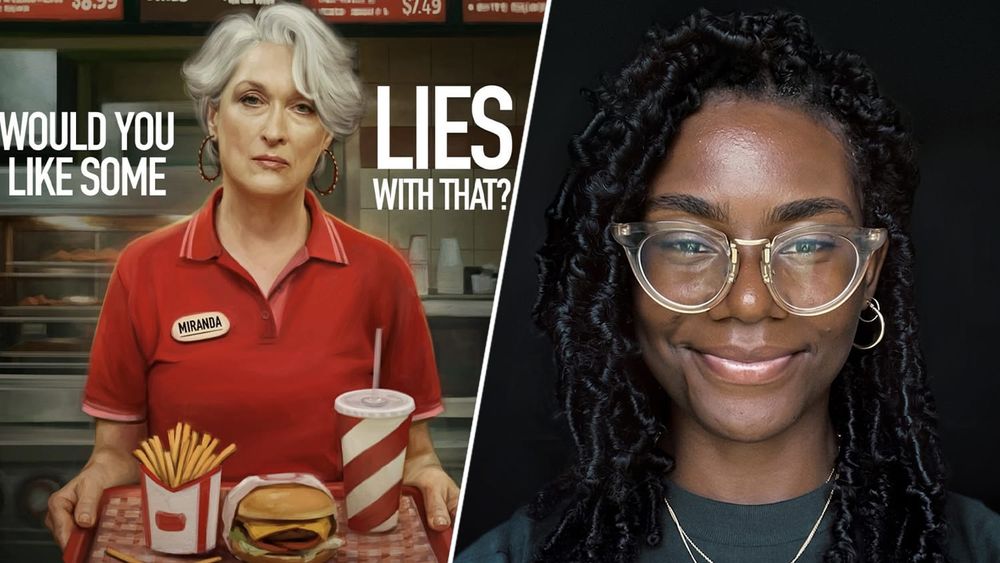
The image is small. It flickers across a screen inside the world of The Devil Wears Prada 2: Meryl Streep's Miranda Priestly, behind the counter of a fast-food joint, captioned, "Would you like some lies with that?" The colors are flat. The proportions are slightly wrong in the way only generative AI gets them slightly wrong. The composition has the off-balance, slightly nauseating geometry of something a meme account would post at 2 a.m. Within hours of the sequel hitting theaters this weekend, the internet had its verdict. Lazy. Of course Disney slopped this together with Midjourney. Of course.
Then Alexis Franklin posted the time-lapse.
The image had been painted, brush by brush, in Procreate. By a real person. With a real career. The director, David Frankel, had hand-picked her for the job. The thing that looked like the cheapest art on the internet had taken hours of skilled labor and a deliberate aesthetic strategy. That is the joke. And it is sharper than the discourse around it.
The artist Frankel called
Franklin is a self-taught digital painter based in Dallas, Texas. Her Instagram — 129,000 followers and counting — is a quiet master class in what digital tools can do when you treat them like oil. She works in Procreate and Photoshop, layering brushwork that takes four to six hours per portrait, and her style is consciously borrowed from classical painting traditions: the visible mark of the brush, the restrained palette, the human eye finding the right edge. She started, like most artists, with pencil and watercolor. She got her first drawing tablet at eighteen. Everything since has been worked out alone.
Her commissions reflect that quiet ascent. She painted Anita Hill for TIME. She illustrated the cover of Alexandria Ocasio-Cortez's biography, Take Up Space. She has worked with Apple, Sports Illustrated, O Magazine, and a roster of New York Times bestselling authors. Her whole reputation is built on the quality digital art most often lacks: presence. The hand of the maker. The unmistakable sense that someone chose this.
So when Frankel called for The Devil Wears Prada 2, the brief had a wicked little twist in it. He didn't want her best painting. He wanted her worst.
A "logo state of mind"
The brief, as Franklin later described it on Twitter: a meme. A throwaway image. Something that needed to read in half a second of screen time as obviously fake, obviously cheap, obviously the kind of thing the internet manufactures by the millions to humiliate people who used to be untouchable. She delivered exactly that, and she explained the choice with the precision of a couture seamstress explaining why one stitch lies flat where another stands proud:
I deployed a "logo" state of mind.
That, in her own words, is the strategy. The image needed to be immediately readable as doctored and fake. So she stripped out the brushwork. She suppressed the painterly tells that her audience had spent years rewarding her for. She made it look smooth, dumb, viral, instantly forgettable. She made it look like the thing it is mocking. That is not laziness or capitulation. That is craft inverted on itself for a punchline.
It also explains why the painting fooled almost everyone. People who know her work — and 129,000 people do — assumed she had nothing to do with this. People who don't know her work assumed AI had everything to do with it. The painting succeeded by passing through the world unrecognized as art. A trompe l'oeil for the algorithmic age.
The conceptual ouroboros
Now count the layers, because they are stacked unusually high.
The Devil Wears Prada 2 is, as several reviewers have noted, a film about the death of legacy print media. Anne Hathaway's Andy Sachs, now a celebrated investigative journalist, gets laid off via text message in the opening minutes. Runway, the Vogue analogue Miranda Priestly built into a publishing fiefdom, is being circled by a tech billionaire who laughs like Jeff Bezos. McKinsey-style consultants want to "right-size" the magazine. AI-style memes — the kind that proliferate on social platforms when an institutional figure trips and the algorithm rewards the dunk — are weaponized against Miranda inside the diegesis. They are the visible symptom of what is killing her world.
So now consider what Frankel did. He commissioned a digital painter — one whose entire practice resurrects the texture of oil paint inside Procreate — to produce an image that looks like it came from the AI generator that is killing both her profession and the magazines the film is mourning. Three masquerades stacked on top of each other: digital pretending to be analog, pretending to be cheap automated digital. Each masquerade is a working artist's deliberate decision. The film is using a hand-painted image to represent the inhuman, while standing on the shoulders of an actual human's hand.
There is a long, quiet tradition behind this. Painters have been imitating photography since the 1840s, when daguerreotypes started shifting what realism even meant. The hyperrealists of the 1970s painted oil canvases that mimicked Polaroids. Each generation, the dominant new medium seduces artists in the older ones, and the imitation becomes a kind of argument: we still see better than the machine, and we will prove it by painting what the machine does. What is new in 2026 is the bleak reverse. Looking like a hand could not have made it is no longer the goal. Now, in certain contexts, looking like AI is what visually communicates "this image is supposed to be cheap." The flat affect, the slight distortion, the algorithmic uncanny — those are the new shorthand for "social media garbage." Franklin's task was to be fluent enough in slop to deploy it without committing to it. She did. The image works because she withheld every instinct that makes her work hers.
What the discourse missed
The dominant takes about this story have been bleak, and not without reason. The bar is in hell. Companies want flowers for paying people. We've normalized an industry where employing humans is a brand differentiator. All true. All reasonable. The internet has been so thoroughly trained to assume the worst about how images get made that the appearance of a real artist's name in a credit reads, now, as resistance.
But the read that flattens this story into another data point about The State of AI misses what is actually happening on the canvas. A skilled artist made a deliberate aesthetic choice and described it with sharper language than most critics could muster. The director went out of his way to commission a painter when he could have generated a million variations for free. The studio paid for the labor. None of that is a moral victory dressed up as art. It's a craft decision that happens to also be a moral victory.
It also, quietly, mirrors the film's larger argument. The Devil Wears Prada 2 is about a generation of editors and journalists insisting that taste — the slow, expensive, human work of looking at things and deciding what is good — still has a place inside an industry that prefers algorithms because algorithms are cheaper. Frankel could have proven the opposite point with a Midjourney render. Instead, he proved his own point with a painter. The form matched the thesis. That is, by a long way, the most coherent decision in the production.
Give Alexis Franklin her flowers
Franklin spent her weekend, in her own words, "flooded with comments of relief" that the painting was made by a real person. She added that she thinks "these companies should get their flowers when they hire an artist."
She is right. And so does she.
The fast-food meme of Miranda Priestly is small and disposable inside a two-hour film. It vanishes in seconds. But the decision behind it is unusually layered for a $75-million-opening sequel about magazine editors: a working painter, paid by a Hollywood studio, asked to produce a piece that succeeds only by hiding her own skill, inside a film whose larger plot argues that human skill is the thing worth saving. The fact that the painting passed unrecognized as art is, in this case, the highest possible compliment to its maker. The fact that it has now been recognized — that her name is in print, that her time-lapse has been watched hundreds of thousands of times, that Tinsel and a half-dozen other publications are now writing about her work instead of debating prompts — is the soft, ordinary, much-too-rare ending these stories should always have.
Hollywood hired an artist. The artist did her job, then some. The film is better for it. None of that should be a story. All of it is.
That, more than the meme, is the joke worth telling.
Alexis Franklin's work can be seen at alexisfranklinart.com and on Instagram at @alexis_art. The Devil Wears Prada 2 is in theaters now.