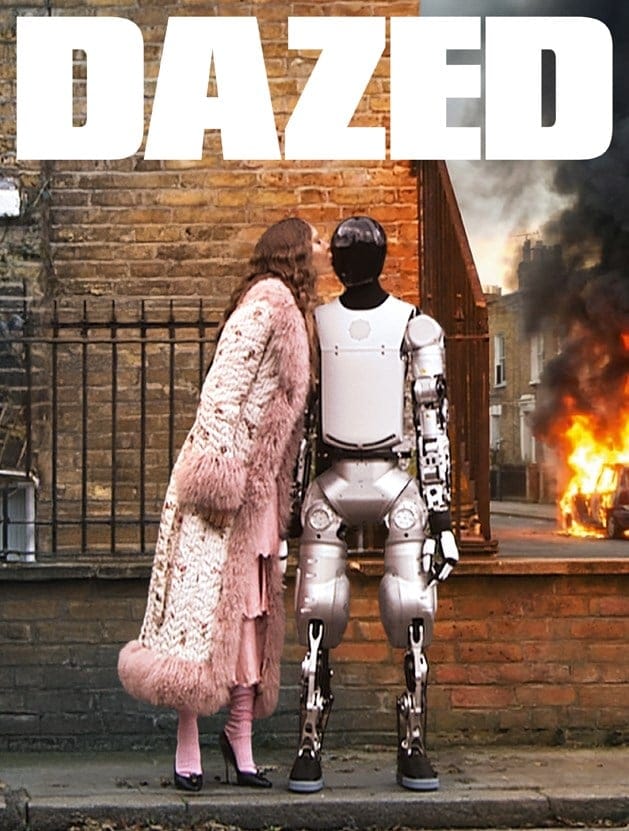
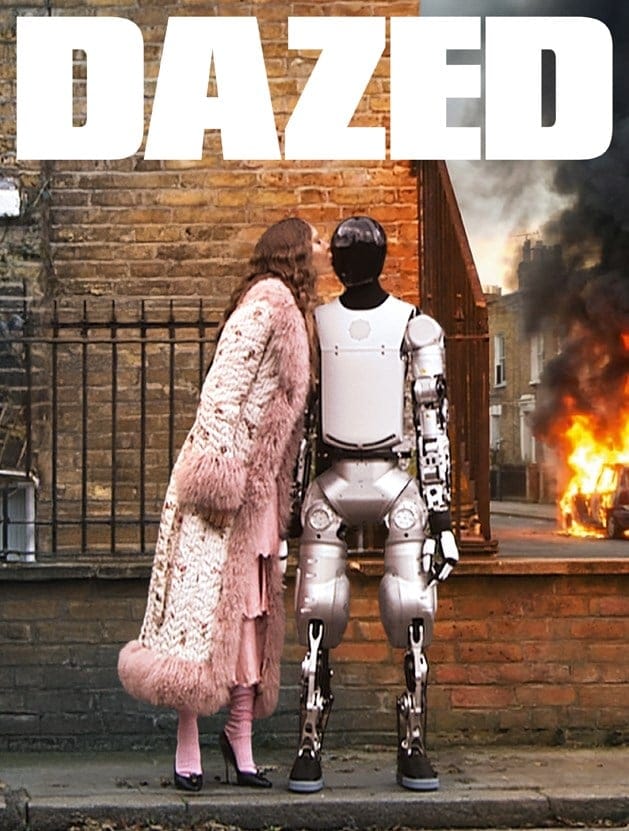
Model Angelina Kendall leans into the frame of HMND Alpha, a humanoid robot with visible mechanical joints and a face designed to read as intentionally non-human. Her hand rests near its shoulder. The composition suggests intimacy—not in a campy, sci-fi way, but in the visual grammar fashion has always used to sell aspiration. Another frame shows them mirroring each other's posture, bodies angled in symmetry. The robot isn't a prop. It's been styled, lit, and art-directed with the same care as Kendall herself.
This is the core of Dazed Digital's latest fashion editorial, a 17-image gallery shot by photographer Aris Jerome with set design by Afra Zamara. The magazine offers minimal editorial context—just credits and a title that leans into the romance metaphor. But the images do the work. They stage the kind of encounter that fashion has always loved: the uncanny meeting the aspirational, technology framed as desire object. What's notable is the tone. The shoot doesn't position this pairing as dystopian satire or futurist commentary. It's styled as if human-robot intimacy is already normal, already marketable, already part of the visual vocabulary we use to sell things.
Fashion editorials are speculative by nature—they don't document culture, they audition futures. What Dazed is auditioning here is a world where AI companions and humanoid robots aren't novelty or threat, but aesthetic infrastructure. The robot has been art-directed into desirability, which is how fashion has always naturalized the unnatural. Make it beautiful first, and the questions come later—if they come at all.
This tracks with where the broader visual culture is headed. As AI-generated faces and virtual influencers become normalized in advertising, and as companies like Realbotix and Hanson Robotics push further into consumer-facing humanoid design, the question isn't whether robots will be part of how we imagine intimacy and companionship—it's how that integration will be sold to us. Dazed's answer: through the same visual language that's always made the future feel inevitable.
Fashion has always been good at this kind of ideological heavy lifting. Collections like Anrealage's Fall 2026 tech-forward experiments or Viktor & Rolf's conceptual provocations use the runway to normalize ideas before they've fully arrived in consumer consciousness. The difference here is that Dazed isn't presenting this as avant-garde. The editorial doesn't frame the robot as experimental or disruptive. It frames it as already integrated, already part of the emotional and aesthetic territory.
The visual strategy mirrors what luxury brands have been doing with technology for years. When Courrèges builds collections around space-age futurism, the brand isn't asking whether we want a technologically mediated future—it's showing us what we'll wear when we get there. Dazed's editorial operates on the same logic. The robot isn't positioned as a question mark. It's positioned as a fait accompli, a design object that's already earned its place in the visual ecosystem.
The shoot arrives at a moment when the cultural conversation around AI and robotics is fracturing. On one side, there's the panic narrative—AI replacing jobs, eroding authenticity, threatening human connection. On the other, there's the seamless integration narrative, where AI tools and virtual companions are positioned as enhancements rather than replacements. Fashion, as an industry, has chosen its side. It's betting on the aesthetics of integration, not resistance. The same logic that made Paris Hilton's bathtub skincare promo feel like personal brand infrastructure is at work here: if you can make something look aspirational, you can make it feel inevitable.
What Dazed doesn't do—and this is the move worth noting—is interrogate the dynamic it's staging. There's no accompanying essay, no critical framing, no acknowledgment of the labor politics or ethical questions embedded in humanoid robotics and AI companionship. The editorial simply performs the integration. It presents the robot as a character in a fashion narrative, no different from any other model or muse. That absence of critique is itself editorial positioning. It suggests that the conversation is already over, that the aesthetics have won.
The timing matters. The shoot lands as the fashion industry grapples with how to position technology without alienating audiences who remain skeptical of AI's role in creative work. But rather than hedging or qualifying, Dazed commits fully to the integration narrative. The editorial doesn't offer viewers an exit ramp or a critical distance. It offers only one interpretation: this is beautiful, this is aspirational, this is where we're headed.
That confidence is strategic. Fashion editorials don't succeed by asking permission—they succeed by presenting a reality so fully realized that questioning it feels like missing the point. The same dynamic that makes runway shows feel authoritative even when they're selling ideas that haven't yet found a market is at work here. The editorial's visual coherence—the careful styling, the considered compositions, the deliberate intimacy—creates a closed system where the premise doesn't need defending because it's already been executed with such conviction.
This is how cultural shifts get naturalized: not through argument, but through repetition and visual saturation. The more we see images like these—robots styled into tenderness, AI companions framed as partners—the less strange they feel. The editorial doesn't need to convince anyone that human-robot intimacy is desirable. It just needs to make it look normal enough, beautiful enough, that the idea stops feeling like science fiction and starts feeling like an inevitability we're already living with.
The real work happening in these images isn't in the styling or the set design. It's in the refusal to treat the subject as requiring explanation. By presenting human-robot intimacy with the same visual language used for any other aspirational pairing, Dazed is doing what fashion does best: making the unfamiliar feel like it's already part of the world you want to live in. The shoot doesn't argue for this future. It just shows you what it looks like, and trusts that seeing it is enough.