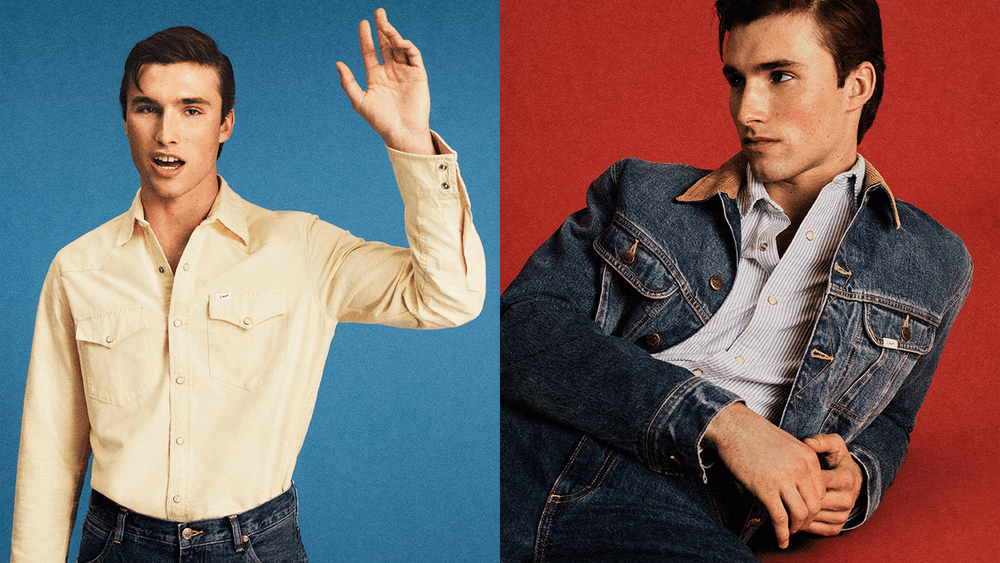
J.Crew and Lee just released their first collaboration—a capsule collection that pairs J.Crew's prep sensibility with Lee's 135-year denim heritage. According to GQ, both brands are "riffing on heritage details and adding subtle tweaks to the classics." The collection includes Western shirts, denim jackets, and workwear-inspired pieces that split the difference between Ivy League and rodeo.
What makes this partnership notable isn't the product—it's the admission. J.Crew spent decades building its identity on East Coast prep: Oxford shirts, chinos, blazers, and the kind of polish that suggested you summered in the Hamptons. Denim was always present, but it was never the story. Workwear was acknowledged, but sanitized. The brand's aesthetic DNA came from Ralph Lauren's aspirational WASP fantasy, not from the American West.
Now J.Crew is partnering with Lee—a brand born in Kansas in 1889, built on utilitarian workwear, and synonymous with cowboy culture—to produce a collection that leans into Western codes. The shift isn't subtle. It's a brand that once sold the fantasy of East Coast leisure now chasing the aesthetic of ranches, rodeos, and wide-open plains. American fashion's regional identity crisis has never been more visible.
This isn't J.Crew's first flirtation with Americana workwear—the brand has sold denim jackets and chambray shirts for years. But partnering with Lee makes the strategy explicit. It's one thing to sell your own version of Western-inspired pieces. It's another to bring in a heritage denim brand with actual cowboy credibility to co-sign your pivot. J.Crew isn't just borrowing the aesthetic—it's licensing the authority.
The timing aligns with a broader cultural shift. Cowboy aesthetics have moved from niche to mainstream over the past five years, driven by country music's pop crossover, Yellowstone's ratings dominance, and a broader nostalgia for pre-digital American imagery. Brands that once avoided Western codes as too regional or too working-class are now racing to claim them. J.Crew's Lee collaboration is just the most visible example of heritage prep brands realizing that cowboy sells better than country club in 2025.
The collaboration also highlights how heritage brands are using partnerships to access aesthetics they can't authentically claim on their own. J.Crew could have designed its own Western collection without Lee's involvement. But doing so would have felt like costume—prep kids playing cowboy. Partnering with Lee provides cover. It transforms the collection from appropriation into collaboration, from trend-chasing into heritage dialogue. The product might look the same either way, but the narrative protection is worth the partnership.
What's missing from the collaboration is any acknowledgment of the class tensions embedded in this aesthetic shift. Cowboy culture has always been working-class—rooted in labor, utility, and necessity. Prep culture has always been aspirational—rooted in leisure, exclusivity, and inherited wealth. J.Crew's version of cowboy, predictably, strips out the labor and keeps the look. The collection will likely retail at prices that would make an actual ranch hand laugh. It's cowboy aesthetics for people who have never touched a saddle.
Still, the collaboration works as a business strategy. J.Crew has spent the past decade trying to reclaim relevance after years of overexpansion and brand dilution. Partnering with Lee gives the brand access to a growing market segment—Western-inspired fashion—without abandoning its prep roots entirely. The collection can be marketed as a fusion, a meeting of two American heritage traditions. Whether that fusion feels authentic or opportunistic depends on how much you care about the difference.
The real question is whether this partnership represents a genuine shift in J.Crew's identity or just a seasonal trend play. If the Lee collaboration is a one-off capsule, it's a safe bet—a way to test the Western market without fully committing. If it's the first step in a broader repositioning, J.Crew is making a larger wager: that American fashion's center of gravity has moved from the East Coast to the West, and that prep brands need to follow or risk irrelevance. Either way, the collaboration reveals how far heritage brands will go to stay current—even if it means admitting they were wrong about what "classic American style" actually looks like.