
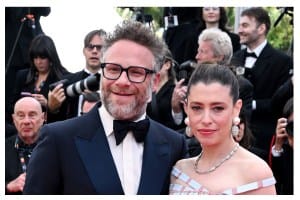
Seth Rogen didn't equivocate. Asked about AI's role in Hollywood, the actor-writer called AI-generated content "stupid dog shit" and said anyone using AI in their writing "shouldn't be a writer." Speaking to Deadline while promoting his latest project with wife Lauren Miller Rogen, Rogen delivered the kind of unambiguous stance that's been conspicuously absent from most Hollywood discourse on artificial intelligence.
It's worth noting what Rogen didn't say. He didn't call AI a "tool" that requires human oversight. He didn't frame it as an inevitable evolution of the creative process. He didn't hedge with "it depends on how you use it." He said it's garbage—and that using it disqualifies you from the job.
That clarity matters. For the past two years, Hollywood's conversation about AI has been dominated by careful hedging. Studio executives speak in measured tones about "augmentation" and "efficiency." Tech evangelists insist AI is just another tool, like a typewriter or Final Draft. Even some writers have publicly entertained the idea that AI could handle "the boring stuff"—outlines, first drafts, punch-up—freeing human creativity for higher-order work.
Rogen's position is different. It's not about whether AI can technically generate something that resembles a script. It's about whether that process has anything to do with writing as a craft, a discipline, or a form of labor worth protecting. His answer: it doesn't.
The dividing line in Hollywood's AI debate isn't between technophobes and early adopters. It's between people who see writing as a skill that can be mechanized and people who see it as a practice that requires human judgment, taste, and revision. Rogen is firmly in the latter camp—and his language reflects it. "Stupid dog shit" isn't a technical critique. It's a quality judgment. It's saying: even if the output looks like a script, it's not doing what a script is supposed to do.
This argument has precedent. SAG-AFTRA's 2023 contract negotiations included specific protections against AI-generated performances and synthetic likenesses. The WGA's 2023 deal established that AI cannot be credited as a writer and that companies cannot use AI-generated material to undermine writers' compensation. Those weren't theoretical protections. They were responses to studios already testing how far they could push automation.
Rogen's statement lands in a moment when that testing has only accelerated. Studios are quietly experimenting with AI-generated dialogue for background characters, AI-assisted punch-up, and AI-generated "coverage" that summarizes scripts for executives who don't have time to read them. None of this is public-facing. None of it is marketed as "AI content." It's infrastructure—invisible until someone names it.
What Rogen is naming is the stakes. If writing becomes a process that can be automated, then writers become expendable. If scripts can be generated by feeding prompts into a language model, then the skill, experience, and creative judgment that define professional writing lose their market value. The question isn't whether AI can produce something that looks like a script. It's whether that output is worth anything—and whether the people who produce it deserve to be called writers.
Rogen's answer is no. And he's not alone. The argument that AI-generated writing is fundamentally different from human writing—not just in quality but in kind—has been gaining traction among working writers, directors, and actors who understand that their jobs depend on the industry valuing human creativity over algorithmic efficiency. Artist Valerie Veatch has argued that AI's logic is rooted in extraction and displacement, not collaboration. Judy Greer has pointed out that the threat AI poses to older women in Hollywood is just the latest version of a displacement that was already happening.
The broader pattern is clear: Hollywood's AI conversation has been polite for too long. Executives frame automation as progress. Tech companies promise efficiency. Writers are told to adapt or become obsolete. Rogen's refusal to play along—his willingness to call AI writing what it is, bluntly and without qualification—cuts through that noise.
It also exposes the uncomfortable reality that the industry has been avoiding. If AI-generated writing is "stupid dog shit," then studios using it are knowingly choosing garbage over human creativity. If writers who use AI "shouldn't be writers," then the industry's quiet acceptance of AI tools is a tacit endorsement of lowering standards. Rogen's language forces the issue: either AI writing is legitimate, or it's not. There's no middle ground where it's "good enough for now" or "fine for certain projects."
This is where the creative labor debate gets concrete. It's not about whether AI will "take all the jobs"—that's a distraction. It's about whether the jobs that remain will be worth having. If studios normalize AI-generated scripts, they normalize a version of "writing" that doesn't require craft, revision, or human judgment. That doesn't just devalue writers. It devalues writing itself.
Rogen's position isn't Luddism. It's a defense of standards. It's saying: if you can't write without a machine doing it for you, you're not a writer. That's not a technological argument. It's a professional one. And it's the argument Hollywood needs to hear—delivered without the careful hedging that's allowed AI evangelists to reframe automation as inevitable progress.
The real question now is whether Rogen's clarity will shift the conversation or remain an outlier. Hollywood's economic incentives favor automation. Studios are under pressure to cut costs, speed up production, and maximize output. AI promises all three. But it also promises a version of Hollywood where writing is a commodity, not a craft—where scripts are generated on demand, not developed through revision and collaboration.
Rogen's bet is that audiences can tell the difference. That "stupid dog shit" writing produces stupid dog shit movies and TV shows. That quality still matters, even in a cost-cutting era. Whether the industry agrees remains to be seen. But at least now, someone's willing to say it out loud.