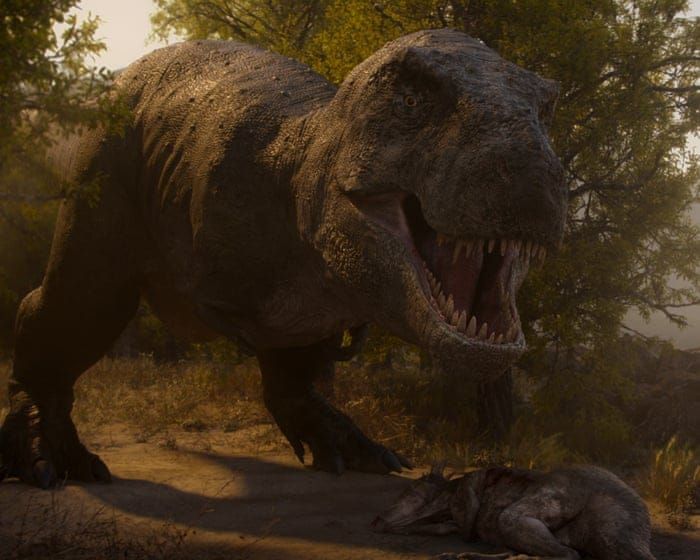
A lone pachycephalosaurus father is fighting off a younger rival, their skulls cracking against each other in slow-motion detail, when a Tyrannosaurus rex leaps through the undergrowth and bites the interloper clean in two. The family scurries away to safety. Morgan Freeman's voice glides over the carnage like warm honey, so smooth and unbothered that The Guardian suggests you could use the show as a relaxation aid. That's not a bug in Steven Spielberg's The Dinosaurs—it's the entire production strategy.
Freeman's casting in The Dinosaurs reveals something the entertainment industry has known for decades but rarely says out loud: his voice is the most reliable form of prestige insurance money can buy. When a project needs to signal seriousness, cultural weight, or intellectual credibility, Freeman's narration is the shortcut. It worked for March of the Penguins. It worked for The Story of God. It works here, even when the show itself—spectacular CGI dinosaurs doing familiar predator-prey dynamics—offers little that hasn't been done a hundred times before.
This is not a critique of Freeman's talent. His voice is extraordinary: authoritative without being condescending, warm without being saccharine, capable of making even a T-rex ambush feel like a bedtime story. The issue is what his ubiquity in this role signals about how prestige documentary television operates. When you hire Morgan Freeman to narrate, you're not just hiring a voice—you're hiring a brand that tells audiences this content is worth their time before they've seen a single frame.
The problem, as The Guardian's review makes clear, is that this shortcut is starting to feel like a crutch. Big-budget dinosaur documentaries now look so close to real wildlife footage that the novelty has worn off. The visual effects are impressive, but they're no longer surprising. What's left is the same story beats we've seen in every nature doc: lone males fighting for status, predators interrupting at the last second, families surviving against the odds. The only thing distinguishing The Dinosaurs from its competitors is the voice telling you it matters.
This dynamic mirrors a larger trend in premium documentary content: the increasing reliance on celebrity narrators to differentiate projects that are otherwise visually and narratively interchangeable. David Attenborough built a career on this model, but his voice was paired with groundbreaking natural history filmmaking that justified the gravitas. Freeman's recent work—and the work of narrators like him—often functions as the prestige layer on top of content that doesn't need a prestige layer. It needs a sharper editorial perspective or a more original framing.
What makes Freeman's casting in The Dinosaurs particularly telling is that Spielberg, of all filmmakers, doesn't need the insurance. His name alone carries enough cultural weight to launch a dinosaur documentary. But even Spielberg's team understood that in a crowded market of big-budget prehistoric content—where Apple TV+ has Prehistoric Planet and Netflix has its own slate of dino docs—you need an auditory signal that cuts through the noise. Freeman's voice is that signal, the same way a celebrity front row signals brand value at Paris Fashion Week.
The real tell is that Freeman's narration is so soothing it risks undermining the drama the show is trying to create. When a dinosaur gets bitten in half and the voiceover sounds like it's describing a sunset, the tonal mismatch becomes the story. The voice is doing so much heavy lifting to maintain the show's prestige credentials that it flattens the emotional stakes. You're not watching dinosaurs fight for survival—you're listening to Morgan Freeman tell you a story about dinosaurs fighting for survival. The distinction matters.
What The Dinosaurs reveals is that prestige television has a Morgan Freeman problem. Not because he's overexposed—though he is—but because his voice has become a substitute for the editorial confidence that used to define premium documentary content. When a show doesn't know how to make itself feel important, it hires a voice that already does. The strategy works in the short term. But in the long term, it trains audiences to associate prestige not with the quality of the storytelling but with the celebrity of the person telling it. And that's a model that only works until the next generation of narrators—or the next technological shift—makes the voice itself obsolete.