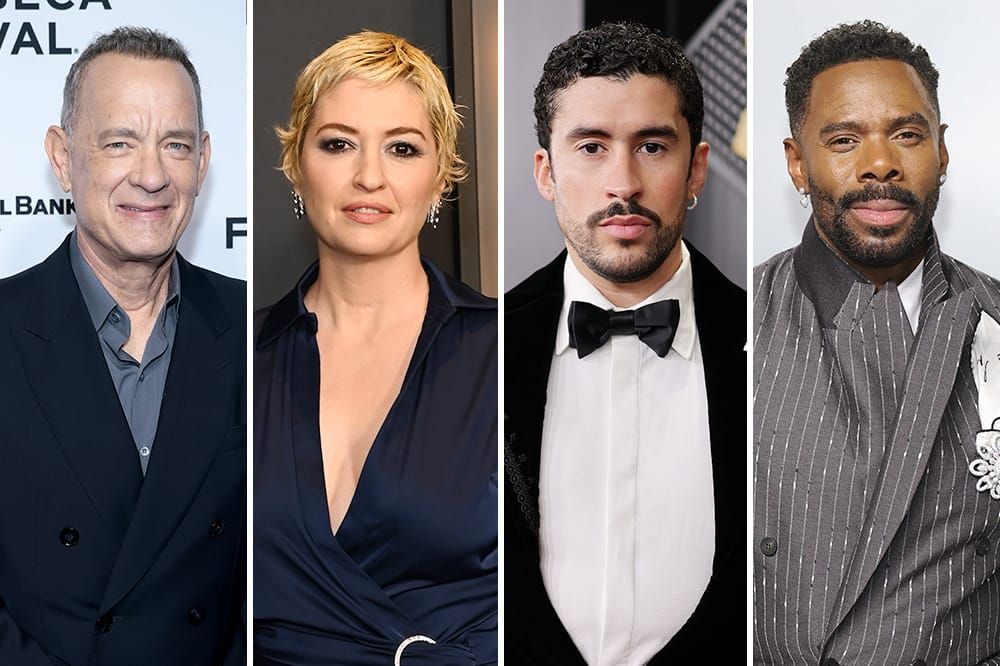
Tom Hanks and Marielle Heller last worked together on A Beautiful Day in the Neighborhood in 2019, which earned Hanks an Oscar nomination for playing Fred Rogers. Seven years later, the director-star team is reuniting for a baseball dramedy that's already sparked a bidding war among multiple studios, with Sony reportedly leading the pack, according to Variety. The project is an adaptation of a short story titled "The Combacker," and while plot details remain under wraps, the casting rumors — Bad Bunny and Colman Domingo are reportedly in talks — suggest a character ensemble rather than a franchise tentpole.
What's notable isn't just the reunion itself, but the fact that Hanks — one of the last true A-list movie stars with the power to greenlight projects on name alone — is choosing a sports dramedy over the kind of IP-driven franchise work that has dominated studio slates for the past decade. Disney's structural struggles have made it clear that franchise fatigue is real, and Hanks's choice signals that top-tier talent is starting to bet on character work again. This isn't a Marvel cameo or a legacy sequel. It's a director with a specific vision and an actor with enough industry capital to make studios compete for the privilege of financing it.
The sports movie has always been a reliable mid-budget genre, but it's been largely absent from the A-list conversation in recent years. Studios have been too busy chasing the next Fast & Furious installment or superhero universe expansion to invest in the kind of character-driven sports dramas that used to anchor their slates. But the pendulum is swinging back. Romance adaptations have become Hollywood's most reliable counter-programming strategy, and sports dramas — which share the same emotional stakes and character-focused storytelling — are positioned to follow the same trajectory. Hanks and Heller are betting that audiences are ready for something that doesn't require homework or a Disney+ subscription to understand.
The reported casting of Bad Bunny and Colman Domingo adds another layer to the project's appeal. Bad Bunny has proven he can carry a film with Cassandro, and Domingo is coming off an Oscar nomination for Rustin. If the deal closes, this isn't a vanity project — it's a legitimate ensemble with crossover appeal across demographics and markets. That's the kind of package that makes studios open their checkbooks, especially when the alternative is another $200 million gamble on a franchise sequel that might not break even overseas.
The bidding war itself is also worth noting. Multiple studios competing for a mid-budget character drama is not the norm in 2026. It suggests that the risk calculus is shifting. Studios are starting to realize that a $50 million investment in a Hanks-Heller collaboration might be a safer bet than a $250 million franchise gamble that requires global box office dominance just to break even. The math is simple: lower risk, lower reward, but also lower catastrophic failure potential. That's the kind of thinking that used to define the studio system before IP became the only currency that mattered.
Heller's track record also matters here. A Beautiful Day in the Neighborhood was a critical and commercial success, grossing $68 million worldwide on a modest budget. It was the kind of film that played well with older audiences and awards voters — exactly the demographic that studios have been ignoring in favor of the 18-34 crowd. But that demographic still buys tickets, and they're underserved. Heller and Hanks are building a brand around serving them, and studios are finally noticing.
The timing is also strategic. Streaming platforms are starting to experiment with theatrical releases for their IP, which means the theatrical window is becoming more competitive again. A character-driven sports drama with A-list talent is exactly the kind of project that can hold its own against franchise noise. It's counter-programming, but it's also a statement: not every movie needs to be a universe-builder to justify its existence.
If Sony closes the deal, it will be a signal that at least one major studio is willing to invest in the kind of mid-budget adult dramas that used to be the industry's bread and butter. And if the film succeeds — critically, commercially, or both — it could open the door for more A-list talent to take similar bets. Hanks and Heller aren't just making a baseball movie. They're making a case that character-driven storytelling still has commercial value, even in an industry that's spent the last decade pretending it doesn't.