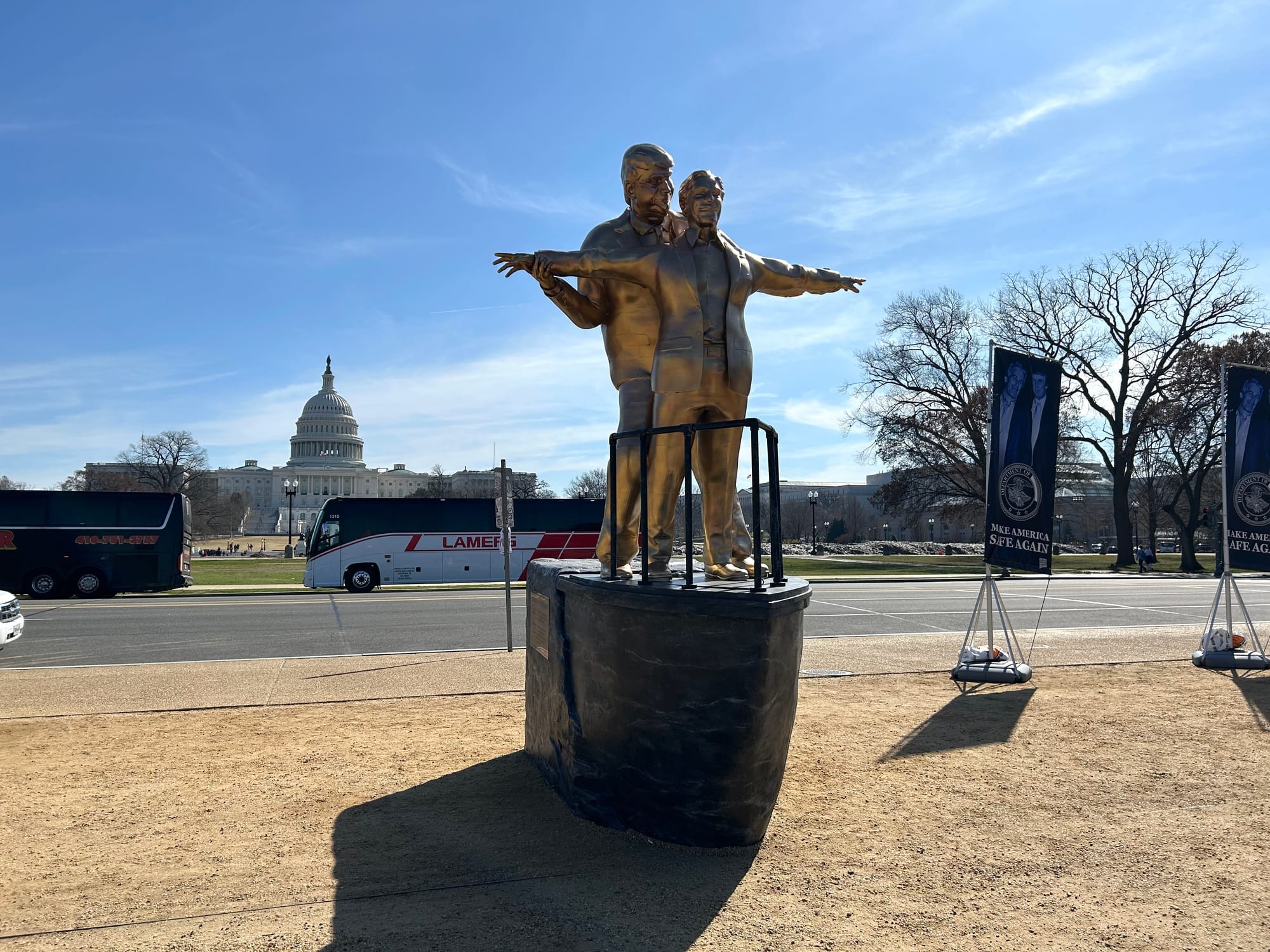
An anonymous sculpture appeared on the National Mall this week depicting Donald Trump and Jeffrey Epstein locked in the iconic embrace from Titanic — Trump as Kate Winslet's Rose, arms outstretched, Epstein as Leonardo DiCaprio's Jack, holding him from behind. The timing is deliberate: the installation follows the release of previously withheld court documents detailing abuse allegations against Trump. The sculpture was photographed, shared widely on social media, and reported by Hyperallergic, then presumably removed by authorities. The whole cycle — placement, documentation, virality, removal — unfolded exactly as these things always do.
Guerrilla political art has become its own exhausted genre. The anonymous artist, the public space violation, the media documentation, the social media amplification, the inevitable removal — it's a script at this point. The shock value is built into the format, not earned by the work itself. The Trump-Epstein sculpture doesn't reveal anything the viewer didn't already know or suspect. It doesn't add nuance, context, or a perspective the news cycle hasn't already supplied. It just restates the obvious in three dimensions and waits for the internet to do the rest.
This isn't a critique of the sculpture's message. The connection between Trump and Epstein is well-documented, and the newly released court documents add legal weight to what was already public knowledge. The problem is that the sculpture doesn't do anything with that information beyond illustrating it. The Titanic reference is clever in the way a good meme is clever — it's visual shorthand for doomed romance, for spectacle before collapse. But memes are designed for rapid consumption and shareability. Sculpture, even temporary guerrilla sculpture, used to aspire to more.
The anonymous artist model compounds the problem. Anonymity can protect vulnerable voices or allow work to speak without the distraction of celebrity. But in political guerrilla art, anonymity has become a branding strategy. It signals rebellion without requiring accountability. It invites speculation — is it Banksy? Is it a collective? — that generates more press than the work itself might earn. The Trump-Epstein sculpture will be remembered, if at all, not for its artistic merit but for the fact that it happened. The documentation becomes the art object. The sculpture is just the prop.
This dynamic mirrors the broader problem with political art in the social media era: virality has replaced impact. A sculpture on the National Mall guarantees attention. It will be photographed from every angle, shared across platforms, discussed in comment sections and cable news segments. But attention is not the same as persuasion, and provocation is not the same as insight. The people who see the Trump-Epstein sculpture and nod in agreement already believed what it's saying. The people who see it and feel offended were never going to be moved by a piece of anonymous public art. The sculpture doesn't change minds. It just gives people something to point at.
Compare this to earlier waves of political art that carried real risk. When Gran Fury wheat-pasted AIDS activism posters in the 1980s, they were filling an information void the mainstream media refused to address. When the Guerrilla Girls called out museum gender disparities, they were naming a structural problem the art world preferred to ignore. Those interventions had a target and a demand. The Trump-Epstein sculpture has a punchline. It's commentary as performance, not as catalyst.
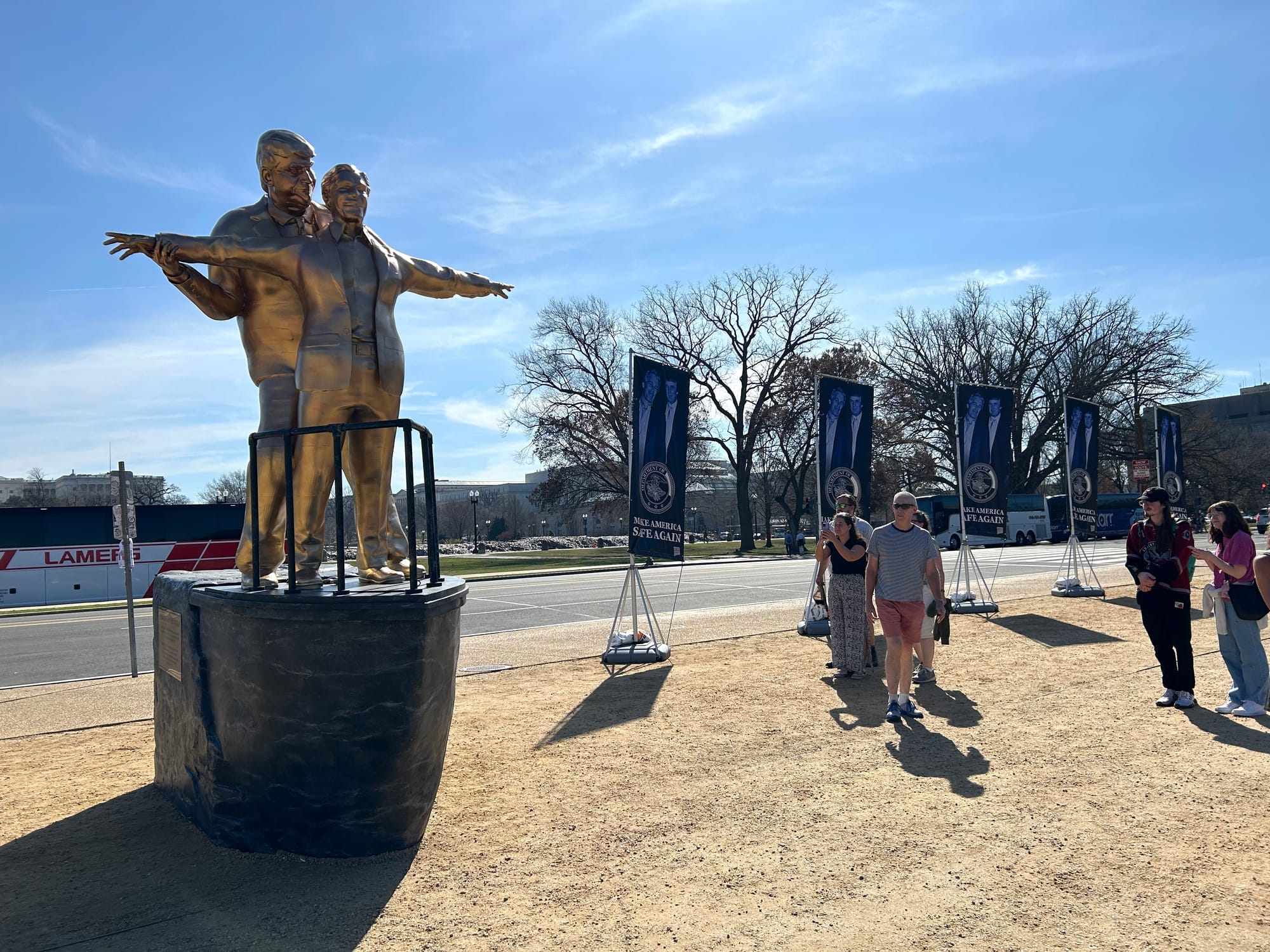
The National Mall as a site compounds the issue. It's public space, yes, but it's also heavily surveilled, heavily trafficked, and designed for spectacle. Placing unauthorized art there guarantees removal, which guarantees documentation, which guarantees the work will live on as image rather than object. The sculpture's physical lifespan was always going to be measured in hours. Its digital lifespan will be indefinite. That's not subversion — it's just understanding how the attention economy works.
The larger pattern here is that guerrilla political art has become a content vertical. It follows a template: identify a public figure or institution, create a visual metaphor that requires no explanation, place it somewhere it doesn't belong, document it, let the internet do the rest. The format is so established that it's lost the element of surprise that made early examples feel urgent. When every protest sculpture follows the same playbook, the playbook itself becomes the message. And the message is: we're all performing resistance for an audience that's already decided what it thinks.
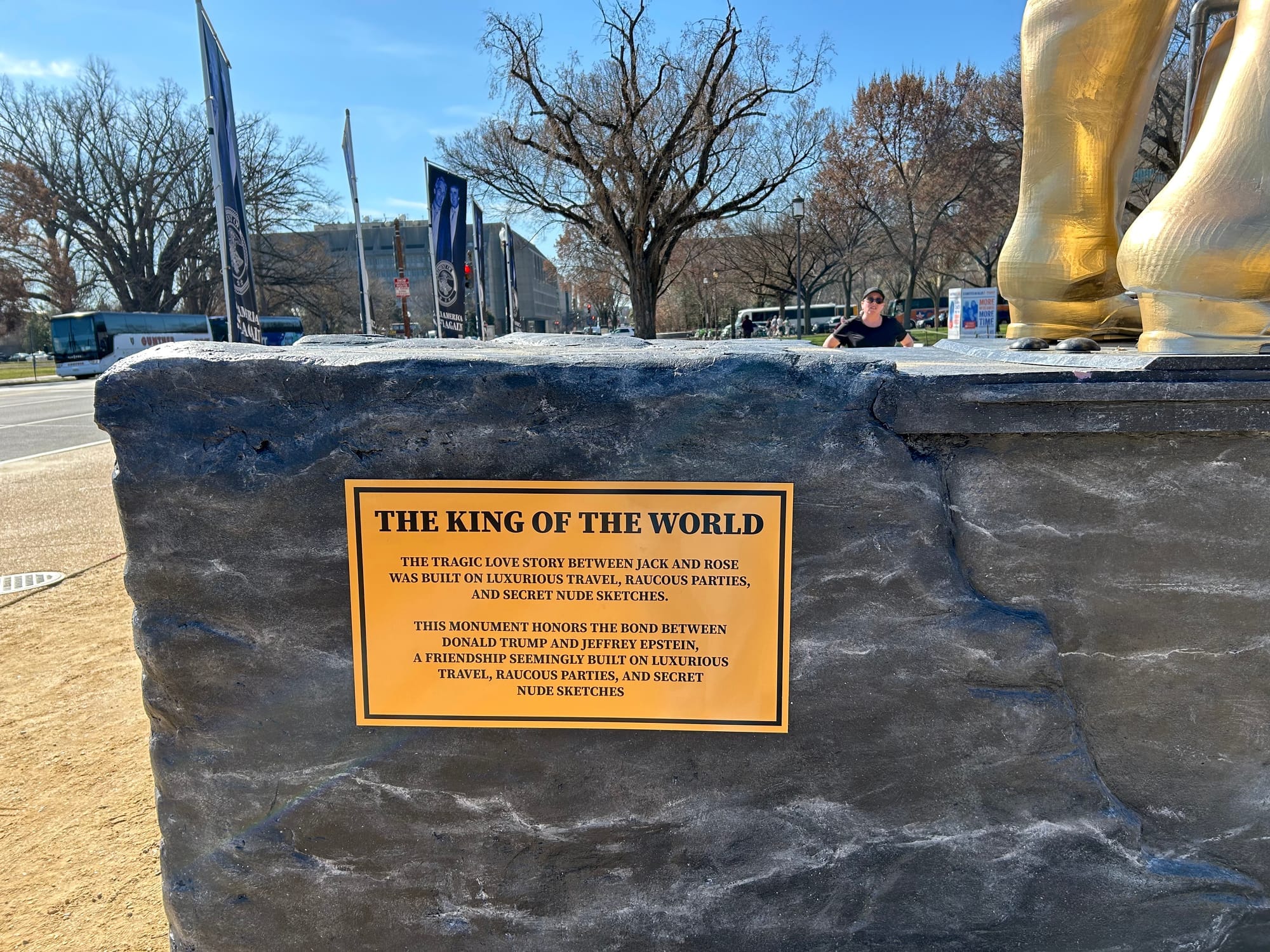
What's missing is the harder work — the art that doesn't just illustrate a position but complicates it, that doesn't just signal allegiance but demands something of the viewer. The Trump-Epstein sculpture will circulate, get screenshotted, maybe end up in a museum as documentation of a moment. But it won't shift the conversation. It won't make anyone uncomfortable who wasn't already uncomfortable. It's protest as aesthetic, politics as meme. And that might be the most predictable thing about it.