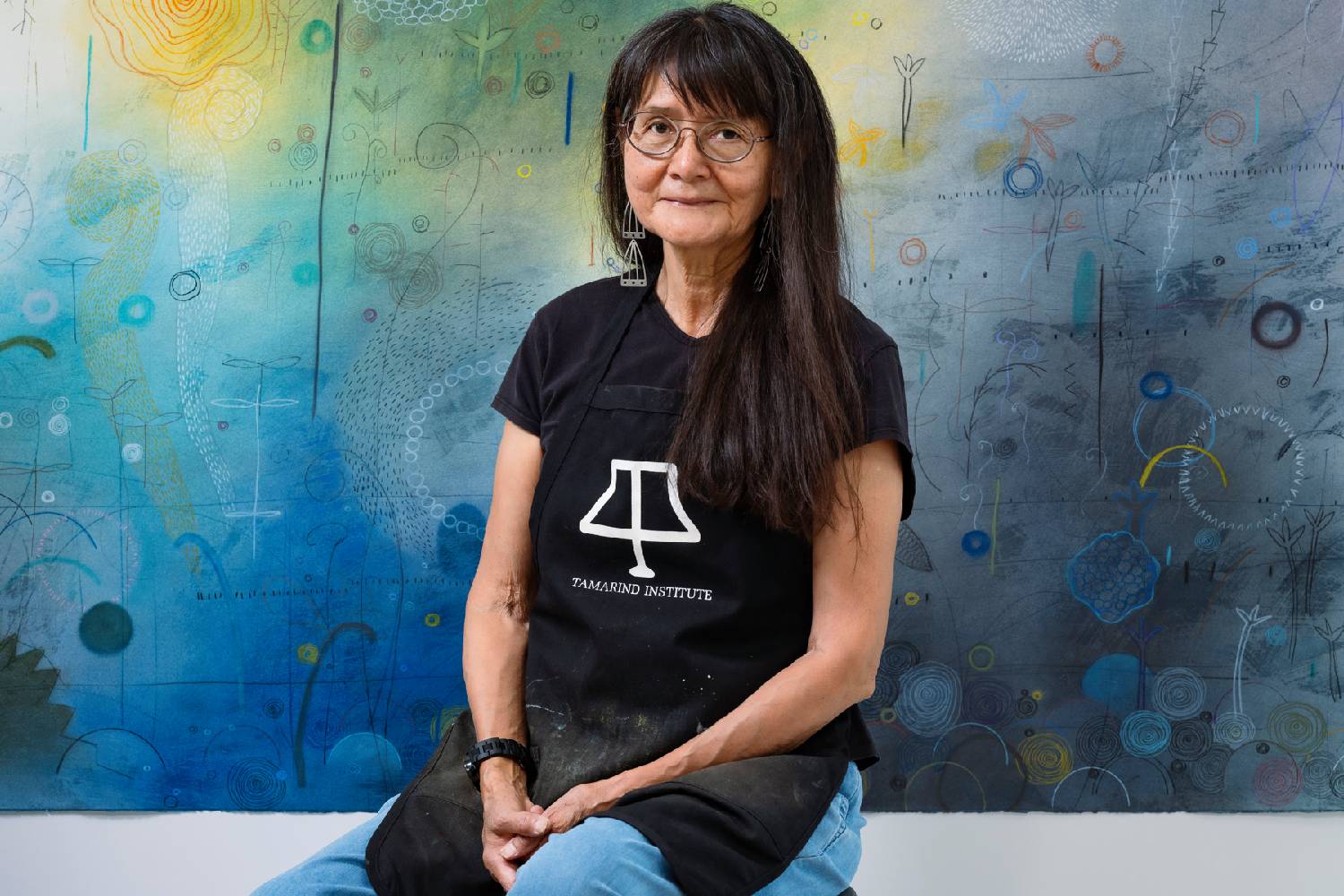
White Cube will show Emmi Whitehorse's painting Father Sky meets Mother Earth (2025) at its Art Basel Hong Kong booth later this month. The work — acrylics, pastels, graphite, chalk, and charcoal smeared by hand into layered, ethereal compositions — employs the visual language of iconography inspired by Native symbols that Whitehorse has spent decades developing. The international powerhouse mounted its first solo exhibition of the artist at its Paris gallery last fall and will now co-represent her alongside New York's Garth Greenan Gallery, the smaller operation that's been championing her work for years.
This is how the art world's power structure actually works. The mega-galleries — White Cube, Gagosian, Hauser & Wirth — wait for smaller galleries to do the hard, expensive work of building an artist's institutional credibility, then step in once the market risk has been mitigated. Whitehorse, an enrolled member of the Navajo Nation, has participated in the 2024 Venice Biennale and shown at the Whitney Museum of American Art, the Barnes Foundation, and the National Gallery of Art. She has work in the collections of the Brooklyn Museum, Crystal Bridges Museum of American Art, and the Denver Art Museum. That's the kind of résumé that makes a blue-chip gallery feel comfortable writing the check.
Garth Greenan Gallery did the foundational work. They mounted solo exhibitions. They placed her in institutional group shows. They built the narrative around her practice — meditative landscape paintings guided by the Navajo philosophy of Hózhó, or balance, that strive to find equilibrium between nature and humanity. "My paintings tell the story of knowing land over time—of being completely, microcosmically within a place," Whitehorse told the Observer in 2024. That's the kind of quote that gets used in press materials for years. Greenan built the infrastructure. White Cube is now scaling it.
This isn't unique to Whitehorse. The pattern repeats across the contemporary art market, particularly with artists from historically underrepresented communities. Smaller galleries take the financial risk of representing artists whose work challenges the market's traditional tastes or who don't fit the demographic profile that blue-chip collectors have historically favored. They spend years — sometimes decades — building institutional relationships, placing work in museum collections, securing critical attention. Then, once the artist's market value becomes undeniable, a mega-gallery steps in with a co-representation deal that gives them access to the artist's future production while the smaller gallery retains some stake in the career they built.
The co-representation model sounds equitable on paper. Both galleries benefit. The artist gets access to White Cube's global infrastructure, its collector base, its presence at the world's most important art fairs. Garth Greenan Gallery maintains its relationship with the artist and continues to participate in her rising market. But the power dynamics are clear. White Cube controls the most valuable real estate — Art Basel Hong Kong, the Paris gallery, the collector dinners where seven-figure sales happen. Greenan gets to stay in the room, but White Cube is running the meeting.
Whitehorse's trajectory also reveals how long it takes for Indigenous artists to break into the upper echelons of the contemporary art market, even with significant institutional validation. She was born in 1957. She received her M.A. in printmaking in 1982. She co-founded the Grey Canyon Group with the late Jaune Quick-to-See Smith in the late 1970s, a collective of Native American artists whose explicit aim was to carve out space for Native art that defied stereotypes and existed beyond traditional craft practices. That was nearly 50 years ago. She's been making rigorous, conceptually sophisticated work for decades. White Cube is coming to the table in 2025.
The art world has spent the past several years publicly committed to diversifying its roster of represented artists, its collector base, its institutional programming. Museums have mounted major exhibitions of Indigenous artists. Collectors have started paying attention. But the infrastructure that determines who gets access to the highest levels of the market — the mega-galleries, the top-tier fairs, the private sales that happen before anyone else sees the work — remains largely unchanged. The same galleries that built their empires on a narrow definition of whose work qualifies as blue-chip are now expanding that definition, but only after smaller galleries proved the market exists.
This summer, Whitehorse's work will be included in "Earth: Works by Contemporary Indigenous North American Artists from Tia Collection" at the Yorkshire Sculpture Park in the U.K., running from June 13 through April 18, 2027. That's the kind of institutional programming that signals sustained interest, not a momentary trend. White Cube is betting that the market for Indigenous contemporary art is durable enough to justify the investment. The smaller galleries already knew that. They've been saying it for years. The question is whether the mega-galleries' arrival expands the market for all Indigenous artists or just consolidates it around the few names that have already been validated by institutions. The answer will determine whether this moment represents genuine structural change or just another example of capital following where the groundwork has already been laid.
For more, see Jamie Gentry’s moccasin exhibition bridging Indigenous craft and contemporary art and Frieze LA and the art market.