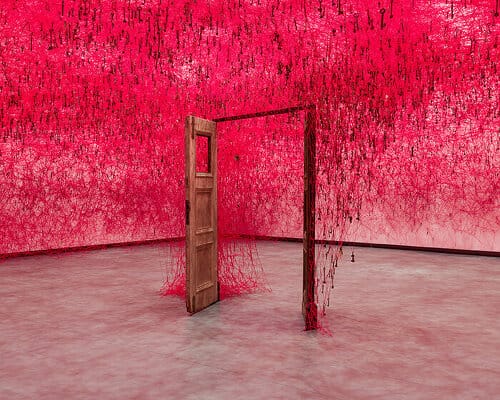
Walk into the Hayward Gallery right now and you'll find yourself inside a room where red thread stretches floor to ceiling in a dense, intricate web. Chiharu Shiota's installation fills the space so completely that the air itself seems to have texture. The thread isn't decorative—it's structural, architectural, a material that holds memory and tension in equal measure. Across the gallery, Yin Xiuzhen has constructed entire environments from worn clothing: jackets, shirts, trousers that once carried the shape of bodies now reconfigured into landscapes, shelters, and monuments. The garments still hold their creases, their stains, their evidence of use.
This is not accidental curatorial adjacency. Hayward Gallery's pairing of Shiota and Yin Xiuzhen is a deliberate institutional statement about what installation art has become—and what museums are finally willing to recognize it as. For decades, installation art occupied an ambiguous position in the art market and museum hierarchy: too immersive to be easily collected, too labor-intensive to be casually reproduced, too materially specific to translate cleanly across institutional contexts. But Shiota and Yin's work shares a common thread that goes beyond aesthetic resonance. Both artists build worlds from materials that carry cultural and economic weight—thread, fabric, clothing—and both insist that the labor of making is inseparable from the meaning of the work itself.
Shiota's thread installations are famously time-consuming. Each web can take weeks to construct, with the artist and her assistants threading thousands of meters of yarn through space, creating structures that are simultaneously fragile and immovable. The thread becomes a drawing in three dimensions, but it's also a record of human labor—every knot, every intersection, every span represents a decision and a gesture. The work is not about the thread. It's about what the thread does: how it divides space, creates pathways, holds tension, accumulates weight. Shiota has said her installations are about memory and connection, but they're equally about the physicality of making something that didn't exist before.
Yin Xiuzhen's clothing installations operate in a parallel register. She collects worn garments—often from specific communities or individuals—and transforms them into sculptural forms that reference architecture, geography, and collective memory. The materials are never neutral. Clothing carries the residue of bodies, the marks of use, the evidence of economic systems that produce fast fashion and discard it just as quickly. When Yin constructs a cityscape from discarded jackets or a shelter from old shirts, she's not just making a sculpture. She's making visible the labor and the lives embedded in the material itself. The clothing is both medium and subject, both form and content.
What makes the Hayward's pairing significant is that it frames these practices not as outliers but as central to contemporary art's most urgent questions. Installation art has always been about space and experience, but Shiota and Yin's work insists that materiality is political. The choice to work with thread, with clothing, with objects that carry the trace of human labor, is a choice to foreground the processes and systems that most art institutions have historically erased. Museums love to talk about craft and technique, but they've been slower to acknowledge that the materials themselves—and the labor required to transform them—are part of the critical apparatus.
The institutional recognition matters because it signals a shift in how museums are valuing work that resists easy commodification. Shiota's installations can't be rolled up and shipped in a crate. Yin's clothing environments require careful sourcing, construction, and maintenance. Both artists' work demands spatial commitment, time, and resources that go beyond hanging a painting or installing a sculpture. For years, that made installation art a risky bet for museums operating under budget constraints and tight exhibition schedules. But the Hayward's commitment to showing both artists in depth suggests that institutions are beginning to understand installation art not as a logistical challenge but as a form that offers something painting and sculpture can't: a way to make the politics of making visible.
There's a business logic here, too. Installation art has become one of the most Instagram-friendly forms in contemporary culture, which has made it newly valuable to museums trying to attract younger, digitally native audiences. Shiota's thread webs photograph beautifully—immersive, dramatic, visually arresting. Yin's clothing environments offer texture and narrative that translate well to social media. But the Hayward's framing doesn't lean into spectacle. The exhibition design emphasizes the materiality and the labor, not just the visual impact. That's a curatorial choice that respects the work's intellectual and political stakes rather than reducing it to content.
The pairing also highlights a geographic and cultural dimension that Western institutions have been slow to center. Shiota is based in Berlin but was born in Japan; Yin Xiuzhen is based in Beijing. Both artists work within and against the legacies of Western modernism and conceptual art, but their material practices are informed by cultural traditions that value craft, process, and the social life of objects in ways that European and American art history has often marginalized. The Hayward's decision to show them together acknowledges that installation art's most compelling practitioners are often working outside the traditional centers of the art market—and that their material politics offer a corrective to the market's preference for portable, collectible, easily valued objects.
What's at stake in this kind of institutional recognition is not just visibility but legitimacy. For decades, installation art has been treated as ephemeral, experimental, less serious than painting or sculpture. But Shiota and Yin's work proves that installation art can be as rigorous, as intellectually demanding, and as materially sophisticated as any other form. The labor required to construct these environments is not incidental—it's the point. The choice to work with thread and clothing is not aesthetic whimsy—it's a deliberate engagement with the politics of making, the economics of materials, and the social histories embedded in everyday objects.
The Hayward's exhibition arrives at a moment when the art world is grappling with questions about sustainability, labor, and the ethics of production. Fast fashion, supply chain transparency, and the environmental cost of material consumption are no longer niche concerns—they're central to how we think about culture and economy. Yin Xiuzhen's clothing installations make those questions unavoidable. Shiota's thread webs, meanwhile, insist that the act of making is never neutral, never just formal. Every installation is a record of time, labor, and decision-making that can't be separated from the work's meaning.
The real question is whether other institutions will follow the Hayward's lead. Installation art requires commitment—spatial, temporal, financial. It requires museums to value process and materiality as much as they value finished objects. It requires curators to think beyond the logic of the market and the pressures of blockbuster attendance. But if the Hayward's pairing of Shiota and Yin Xiuzhen proves anything, it's that installation art's material politics are not a niche concern. They're a lens through which we can see the labor, the systems, and the histories that most art tries to obscure. And that's not just worth showing—it's worth building entire exhibitions around.
For more, see the best art museums in Los Angeles and how to start an art collection on a budget.