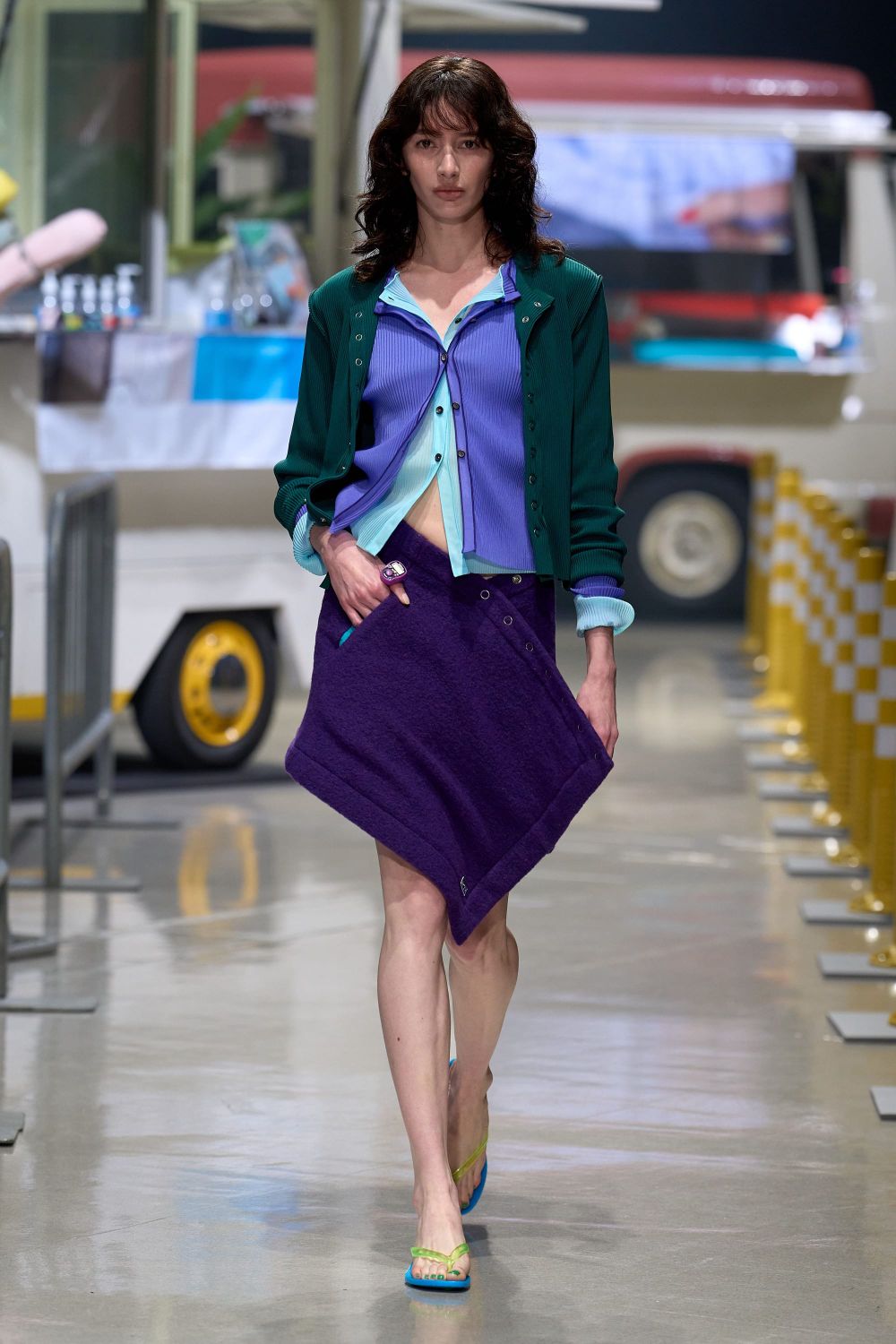
Japanese minimalism has a commercial problem: it photographs beautifully, travels poorly, and gets copied immediately. Kotohayokozawa's Fall 2026 collection, shown at Tokyo Fashion Week, suggests designer Kotoha Yokozawa has figured out how to build around that tension rather than fight it.
The collection centers on structured outerwear — coats with exaggerated collars, tailored blazers with asymmetric closures, oversized trenches in muted grays and blacks. The silhouettes are architectural without being costume-y, wearable without being safe. There's a clear technical vocabulary here: seams placed for structure rather than decoration, fabric weight used as design element, proportion calibrated for movement. It's the kind of craft-forward work that reads as expensive in person and gets flattened into "minimalist" in Instagram squares.
That gap — between how the clothes work in three dimensions and how they translate digitally — is what makes Kotohayokozawa's approach smart. The collection isn't trying to go viral. It's building for the customer who understands that a well-cut coat is worth more than a statement piece that photographs better than it wears. Tokyo Fashion Week has always had designers working in this register, but the economic model is shifting. Where previous generations of Japanese minimalists built their reputations through wholesale partnerships and international stockists, emerging designers are increasingly building direct-to-consumer infrastructure that rewards craft over hype.
Yokozawa's work sits in conversation with designers like CFCL, who use technical fabric innovation as editorial statement, and the broader cohort of Tokyo-based designers who treat minimalism as a business decision rather than an aesthetic posture. The clothes are designed to last multiple seasons, to justify their price point through construction rather than branding, to build customer loyalty through quality rather than algorithmic visibility. It's a model that makes sense in a market where fast fashion has commodified the surface-level signifiers of Japanese minimalism — the neutral palette, the oversized silhouettes, the "quiet luxury" branding — without replicating the craft.
What makes this collection worth watching is how clearly it positions itself against the trend cycle. There's no attempt to chase the maximalist swing that's dominated recent Paris and Milan shows. No ironic references, no nostalgic callbacks, no winks at the audience. Just well-made clothes that assume the customer knows the difference between minimalism as aesthetic and minimalism as philosophy. That confidence — the willingness to build slowly, to prioritize construction over content, to trust that craft will find its audience — is what separates emerging designers who last from those who flame out after a few strong Instagram seasons.
Tokyo Fashion Week has always been the platform where Japanese designers test ideas before taking them global, and the current cohort is testing a specific thesis: that there's a viable business model for designers who refuse to play the virality game. Kotohayokozawa Fall 2026 is evidence that thesis might be correct. The collection won't generate the kind of social media engagement that drives fast sales, but it's building the kind of customer loyalty that sustains a brand long after the algorithm moves on.
The question isn't whether Japanese minimalism still has commercial viability — designers across multiple fashion capitals are proving it does. The question is whether emerging designers can build sustainable businesses around craft-first work in an industry that rewards speed over quality. Yokozawa's Fall 2026 collection suggests the answer is yes, but only if you're willing to ignore the metrics that make most brands panic. The clothes are designed for customers who care more about how a coat fits in year three than how it performs in week one. That's a small audience, but it's a loyal one. And in a market where most fashion brands are competing for the same algorithmic attention, building for a different audience entirely might be the smartest competitive strategy available.
Tokyo's next generation of designers isn't trying to disrupt Japanese minimalism. They're building the infrastructure to make it profitable without compromising what makes it valuable in the first place. Kotohayokozawa Fall 2026 is what that looks like in practice: smart, wearable, technically accomplished clothes that bet on craft outlasting content. Whether that bet pays off depends on whether enough customers still care about the difference.