TALENT FIRST · Part Three of a four-part series on the economics of live performance, and the people the format runs on.
EDITOR’S NOTE
This series began with questions raised by Kenneth W. Welch Jr. and the team at Moxie Media Marketing, drawn from the company’s two-year review of how live-platform ecosystems treat the talent operating inside them. The reporting, sourcing, and conclusions are Tinsel’s own. Mr. Welch has asked to be on record that he stands behind the questions raised here, and behind the standard proposed in the series’ final part.
Here is an honest accounting of what happens to a dollar a fan spends on a live gift, and honesty requires admitting up front that nobody outside the platforms can complete it. The arithmetic runs through several hands, some of which publish their cut and some of which have never disclosed it. The gaps turn out to matter more than the published numbers.
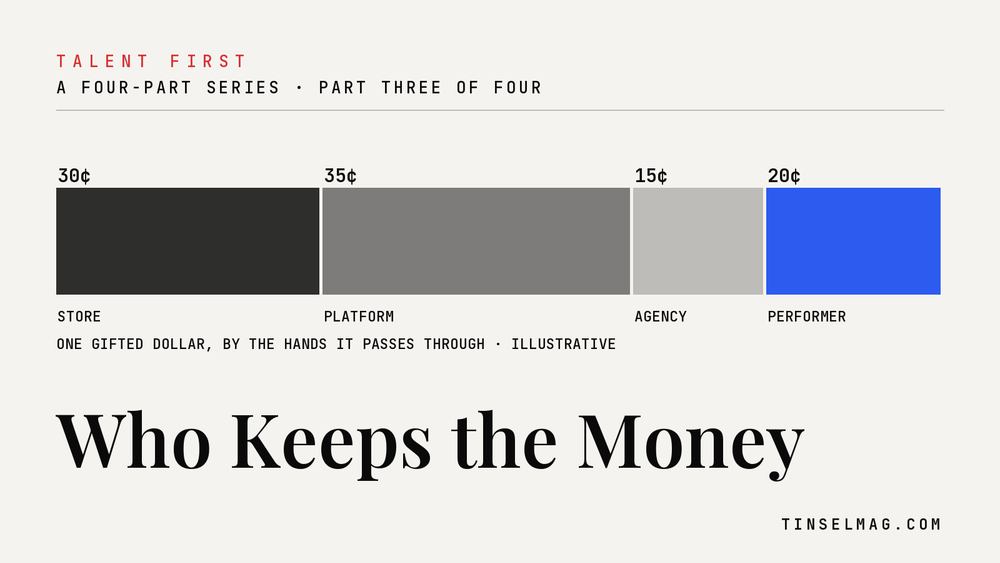
The first cut depends on which door the dollar walks through. Coins bought inside an iPhone or Android app pass through the app stores, which take 30 percent as the standard commission from developers of TikTok's size. Bought through a web browser, the same coins skip that layer entirely, which is why screenshots reported by TechCrunch suggest TikTok has been steering its bigger coin buyers to its website, advertising savings of around 25 percent. So before the money reaches anyone who performed anything, somewhere between zero and thirty cents may already be gone, depending on a checkout choice the viewer barely notices.
The second cut is the platform's, and this is where the ledger goes dark. TikTok converts gifts into an internal unit called diamonds, which creators redeem for cash, and its own Virtual Items Policy states that the conversion rate is set by the company "in its absolute and sole discretion." No fixed percentage appears anywhere in the platform's public terms. Reporting has filled in estimates: Rest of World reported the creator's share of gift revenue at about half, and state consumer-protection filings have alleged a commission of as much as fifty percent of every transaction. Measured end to end, the take looks larger. When BBC investigators ran a controlled test in 2022, during an investigation into livestreams from Syrian displacement camps, $106 in gifts left $33 in the receiving account, a 69 percent reduction, and intermediary fees cut it to roughly $19 from there. The payments-analysis firm FXC Intelligence, working from statutory filings, estimated that users worldwide sent $6.5 billion in gifts in 2023 and creators received about $1.5 billion. TikTok's response to the BBC figure was that its commission is "significantly less than 70 percent." It has never said what the number is. One of the largest gifting economies in the world does not publish what fraction of gift earnings it keeps, and its policy reserves the right to change that fraction at will.
The peers publish more, and the numbers are worth reading closely because they are not all damning. Twitch's default split on subscriptions is 50/50. In 2022 it announced the end of the premium 70/30 deals a group of top streamers had held, capping their better rate at the first $100,000 from mid-2023, and its president explained the economics in a sentence worth reading twice: "we can't run this service unless you make money. That's not a drawback; it's by design." After a year of backlash it built the better rate back as a program, and since late 2023 streamers who sustain enough paid subscriptions can earn their way to 60/40 and 70/30 tiers. The split improves with scale, which is to say it improves for the people who need it least. On the tipping side, a viewer pays about $1.40 for 100 Bits and the streamer receives $1.00. YouTube, to its credit, discloses a majority split: creators receive 70 percent of net revenue from memberships, Super Chat, and Super Stickers. The qualifier is in the word net: on an iPhone, by YouTube's own terms, the 70 percent is calculated after the App Store's cut comes off the top, which by plain arithmetic leaves the creator roughly 49 cents of the fan's dollar. Meta pays one cent per Star, and what the viewer paid for that Star varies by bundle.
Across every platform the published number is the flattering one, and the effective number sits a layer or two beneath it. The clearest example of a layer is the agencies, the third hand in the chain. As Part One documented, TikTok recruits third-party networks to manage and retain live talent, with commissions reported between 10 and 30 percent. Where those commissions come out of the platform's side, they cost the creator nothing directly; where the agency contracts with the creator, they come out of the performer's remainder. Either way, a third party is now paid in proportion to the performer's output, and it behaves accordingly. The quotas from Part One are what that behavior looks like in writing.
Now assemble the chain. A dollar enters through an app store or a browser. The store may take thirty cents. The platform takes an undisclosed share that reporting and litigation place near half and end-to-end measurements place higher. An agency may take a further slice. What reaches the performer, the person whose hours and voice the whole edifice monetizes, plausibly runs from about half the dollar down to a fifth of it, depending on doors and hands, and no one will publish the exact figure. The dollar itself was mined from the other side of the same relationship: the parasocial attachment that live formats cultivate is what opens the viewer's wallet, so the machine draws on both sides of the screen. For contrast, look at the platforms where creators are the paying customer rather than the inventory: Substack states plainly that writers keep 90 percent of their revenue, less card-processing fees. Patreon charges 10 percent. OnlyFans keeps 20 percent, and on that split its creators received about $5.8 billion of the $7.22 billion fans spent in its last reported year, proof at scale that a platform keeping a fifth can still gross billions. That difference is a market position, and the platforms holding the strongest position use it.
Recorded music has been through a version of this argument already. When the UK Parliament's culture committee investigated streaming economics in 2021, it heard that performers receive only a small portion of the revenue their recordings generate, recommended a legal right to a roughly 50/50 split between labels and performers, and delivered its verdict in four words: "streaming needs a complete reset." Creators in the live economy have started asking for their own reset in their own vocabulary: the 2019 FairTube campaign, backed by Europe's largest trade union, demanded published criteria and human accountability; the streamers behind 2021's #ADayOffTwitch showed a coordinated day of rest could pull a platform's concurrent viewership visibly below its normal range; SAG-AFTRA now runs an influencer agreement that lets covered creator earnings count toward union health and pension eligibility. What the advocates converge on is simple and, judged against Substack's or OnlyFans' economics, unradical: a majority of the money to the person the audience came for, and the terms in writing.
The platforms' terms are not in writing, and after three parts of this series the reason should be visible. The current split, opaque where it is worst and improving only under pressure, is what pays for everything else. A business does not renegotiate against itself, which is why the correction is arriving from outside the platforms entirely.
Sources
- TechCrunch, "Screenshots suggest TikTok is circumventing Apple App Store commissions," April 2024
- TikTok, Virtual Items Policy
- Rest of World, "Meet the agents teaching TikTok livestreamers how to earn big tips," September 2022
- Utah Department of Commerce, news release, June 2024
- BBC Eye investigation (October 2022), via Business & Human Rights Resource Centre
- FXC Intelligence, analysis of TikTok gift payments, October 2024
- Twitch, "A Letter from Twitch President Dan Clancy on Subscription Revenue Shares," September 2022; TechCrunch, on the expanded Plus Program, January 2024 and Bits economics, 2016
- YouTube Help, partner earnings overview and Super Thanks terms
- Meta, Facebook Stars
- Substack, About; Patreon, Pricing; Variety, OnlyFans fiscal 2024 financials
- Music Week, on the DCMS Committee streaming report, July 2021
- Digital Platform Observatory, FairTube campaign; The Washington Post, on #ADayOffTwitch, September 2021; OnLabor, on the SAG-AFTRA Influencer Agreement, 2021
Previously: Part One, The Grind Economy; Part Two, What It Costs. Next: Part Four, The Correction.