TALENT FIRST · Part Two of a four-part series on the economics of live performance, and the people the format runs on.
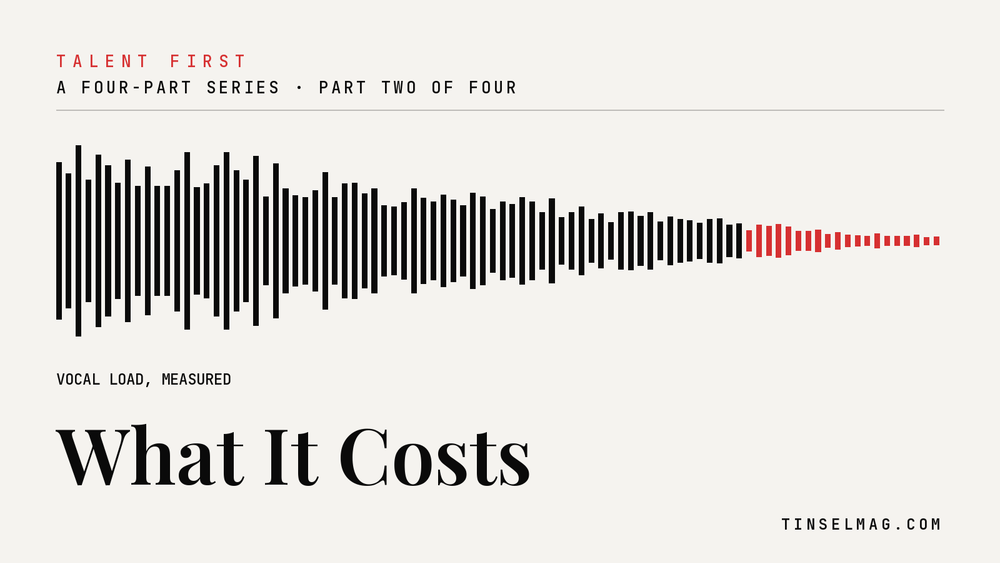
A human voice is a piece of tissue that works by collision. Two folds of muscle and membrane strike each other on the order of a hundred times a second to make sound, and like any tissue that takes repeated impact, they swell, stiffen, and break down with overuse. Researchers at the National Center for Voice and Speech, led by Ingo Titze, have quantified the workload: they measure a speaker's "vocal dose" in the cumulative distance the vocal folds travel in vibration, and derived a working safety benchmark of about 500 meters of tissue travel, which corresponds to roughly seventeen minutes of continuous voicing. It is a modeling benchmark rather than a hard clinical limit, but it puts a number on something performers know by feel.
Recovery has been measured too. In a study that tracked adults after just two hours of sustained voice use, the voice recovered about 90 percent within four to six hours, and did not fully recover for twelve to eighteen. The researchers noted the trajectory resembles the healing curve of a skin wound. A performer who streams six hours today and six hours tomorrow is, in tissue terms, reopening a wound that never finished closing.
Medicine already has a name for what happens when a job demands this and the worker cannot refuse: occupational voice disorder. The evidence base was built on teachers. In the foundational study of more than 2,500 adults, 11 percent of teachers had a current voice problem against 6.2 percent of everyone else, and over half of teachers, 57.7 percent, had experienced one in their lifetime, roughly double the general population's rate. Singers show the same pattern: a meta-analysis across eleven studies put self-reported voice disorders among singers at 46 percent, against a lifetime rate under 30 percent in the general population. These are people using the voice professionally, with training, in structured workdays. The live economy asks for more hours with less structure and, for most of its performers, no training at all.
When the damage arrives, it has familiar shapes: nodules, polyps, and in the acute case a vocal fold hemorrhage, a bleed inside the instrument itself. Clinical protocols list the typical causes as musical performance and sustained loud talking, and note that the injury recurs in roughly one in four patients. The most public cases come from the top of traditional music. Adele canceled her remaining 2011 American dates with a hemorrhage and spent about two months in total vocal silence after surgery. Sam Smith canceled a sold-out Australian tour with a hemorrhage in 2015. Meghan Trainor lost two stretches of the same year to two separate bleeds, and Björk had a polyp removed and stayed silent for three weeks. In every case, the show stopped. Tours were canceled and deposits were burned while the performer rested, because at that level an entire commercial apparatus of labels and promoters loses money if the instrument breaks. The system around a star is built to protect the asset.
The live economy has begun producing its own case file, without the protective apparatus. Two of Japan's most popular streaming performers have been sidelined by diagnosed vocal cord nodules in recent years, one of them, a broadcaster approaching two million subscribers, stepping away for a month in 2022 after attributing the damage to constant streaming, the other put on doctor-ordered rest and rehabilitation twice in one year. No one has yet published a prevalence study of livestreamers' voices; the nearest measurements all point the same direction. A 2026 study of esports players, who likewise spend hours talking over background noise, found one in five with a clinically screenable voice problem, with the odds rising sharply past twenty-one hours of play a week. Among video game voice actors, whose sessions are loud and vocally extreme but at least scheduled, a union survey found 43 percent needed two or more days for the voice to return to normal after a session. A gifting calendar that rewards streaming daily leaves no room for recovery windows of that length, and the tissue does not renegotiate.
The body is only half the ledger. The other half is what clinicians would call load, and creators call the feeling of never being off. The 2018 wave of YouTube burnout put it on record, top creators stepping away in public, one of them telling the Guardian that the most fun job imaginable had "quickly slid into something that felt deeply bleak and lonely." On Twitch, NPR found full-time streamers describing anxiety bordering on panic attacks, with even industry conventions offering only "the illusion of taking a break" before turning into another work weekend. The industry's own surveys land in the same territory: a creator-community startup's 2021 survey found 90 percent of the 150 creators it polled reporting burnout, and an affiliate network's survey of its partners found 78 percent. Those samples are small and self-selected, run by companies with products to sell, and even discounted steeply the direction never changes.
Live performance carries a load that recorded content does not, and research has begun to isolate it. Audiences bond hardest with streamers who respond to them personally and visibly, an effect confirmed experimentally: the individual attention is precisely what the audience is buying. Communication scholars call the work of sustaining thousands of these one-sided intimacies relational labor, and it does not pause when the singing stops. Every hour live is an hour of performing attentiveness to a crowd that took the performer's availability as part of the deal. And the product decays on the same curve as the performer: the sixth hour of any voice is a worse show than the first, so a format that pays for endurance is quietly optimizing away the performances it sells.
The cruelest turn is that rest itself reads as risk. In the same Cornell-led interviews Part One quoted, creators described burnout as something confessed to researchers but hidden from audiences, a workplace injury the workplace cannot hear about. YouTube's leadership met the 2018 wave with data, pointing out that channels that pause come back to more views, on average, and the platform may be right. But no structural change accompanied the reassurance, and Twitch's own chief executive acknowledged last year that streamers who want to change what they do feel they cannot, "because your viewership will go down." A workplace where the workers are afraid to rest, and the management's answer is a statistic rather than a schedule, has told you what it optimizes for.
Other industries counted these costs decades ago and built scaffolding around their performers to carry them. This one externalizes the costs onto the performer and calls the result independence. Why it stays built that way is a question about money, and the money is Part Three.
Sources
- Titze, Svec & Popolo, "Vocal Dose Measures," Journal of Speech, Language, and Hearing Research, 2003
- Hunter & Titze, "Quantifying Vocal Fatigue Recovery," Annals of Otology, Rhinology & Laryngology, 2009
- Roy et al., "Prevalence of Voice Disorders in Teachers and the General Population," JSLHR, 2004
- Pestana, Vaz-Freitas & Manso, "Prevalence of Voice Disorders in Singers: Systematic Review and Meta-Analysis," Journal of Voice, 2017
- University of Iowa Head and Neck Protocols, "Vocal Fold Hemorrhage"
- CBS News on Adele (2012), Sam Smith (2015), and Meghan Trainor (2015)
- Dexerto on Usada Pekora's hiatus, 2022; Siliconera on La+ Darknesss, 2024
- Birol et al., "Prevalence of voice problems and associated risk factors in electronic sports players," BMC Sports Science, Medicine and Rehabilitation, 2026
- Canadian Occupational Safety, ACTRA video game voiceover survey (conducted 2021, reported 2022)
- The Guardian, "The YouTube stars heading for burnout," 2018
- NPR, "Burnout turned Twitch streamers' dreams... into nightmares," 2022
- Tubefilter, on the Vibely creator burnout survey, November 2021; Awin, "78% of influencers admit to suffering burnout," August 2022
- Wulf, Schneider & Queck, Cyberpsychology, Behavior, and Social Networking, 2021
- Baym, Playing to the Crowd, NYU Press, 2018
- Cornell Chronicle, on Nguyen & Duffy, New Media & Society, July 2026
- YouTube Official Blog, Susan Wojcicki's letter to creators, November 2019
- The Game Business, interview with Twitch CEO Dan Clancy, June 2025
Previously: Part One, The Grind Economy. Next: Part Three, Who Keeps the Money; Part Four, The Correction.