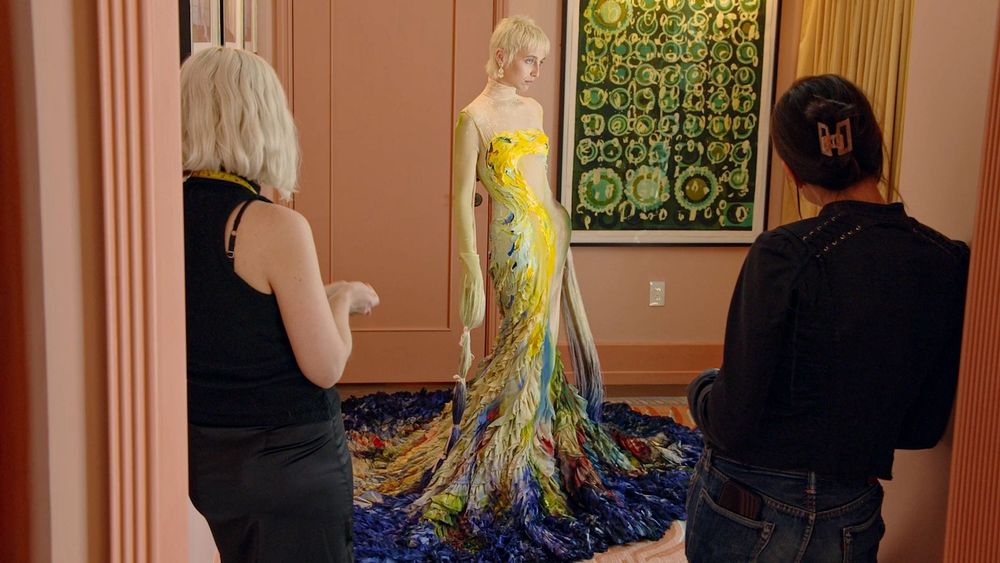
Emma Chamberlain showed up to the 2026 Met Gala in a custom Mugler gown she'd spent six weeks painting herself. Not styling. Not approving mood boards. Actually painting—brushstrokes on silk, metallic pigments layered by hand, embroidery she'd stitched into the bodice during fittings. The dress looked like something between a Renaissance fresco and a contemporary art installation, all gold-leaf florals and hand-drawn vines climbing up white silk. It was gorgeous. It was labor-intensive. And it was hers in a way most red carpet moments aren't.
Chamberlain told Vogue the gown "might just be her most personal look to date." That's underselling it. This wasn't celebrity styling elevated by a good archive pull or a clever designer collaboration. This was an influencer who'd built her brand on relatability—coffee runs, thrift hauls, unfiltered vlogs—stepping into the Met Gala with something she'd literally made. The kind of craft credibility fashion has historically reserved for designers, not the people who wear their work.
The timing matters. Influencer fashion has spent the last decade climbing from sponsored Instagram posts to front-row invites to custom campaign work. But it's always been transactional—brand partnerships, gifted looks, carefully negotiated visibility. Chamberlain's hand-painted Mugler gown flips that script. She wasn't lending her platform to a designer's vision. She was co-creating it, hands-on, in a way that makes the final product feel authored rather than worn.
It's the same move Alexis Franklin pulled off when she hand-painted The Devil Wears Prada 2's movie poster—turning what could have been an AI shortcut into a statement about craft. Both moments signal the same thing: the way to earn credibility in an image-saturated culture is to make the labor visible. Not just the result. The process.
Mugler's design team facilitated the collaboration, but the gown's aesthetic DNA came from Chamberlain—her sketches, her color palette, her willingness to spend weeks in a studio with fabric paint instead of approving mockups from her couch. That's a different kind of celebrity involvement than what most Met Gala attendees bring to the carpet. It's closer to what designers do than what clients typically contribute.
The craft argument matters because influencer fashion has always had a legitimacy problem. The industry respects designers who can drape, pattern-make, and construct. It respects stylists who understand proportion, color theory, and archive context. It has been slower to respect influencers, even the ones with impeccable taste, because their value proposition has always been audience reach—not creative authorship. Chamberlain's gown doesn't solve that tension entirely. But it reframes it. She's not just borrowing fashion's credibility. She's earning it through the same labor the industry claims to value.
The hand-painted detailing also does something smart visually: it makes the dress impossible to replicate. You can't knock off a hand-painted gown the way you can a logo bag or a trending silhouette. The irregularities in the brushwork, the specific color gradients, the embroidery stitches—those are signatures, not specifications. It's the same reason Acne Studios' hand-finished pieces command higher prices than their ready-to-wear: the labor is legible, and the uniqueness is guaranteed.
This won't become the standard for influencer red carpet fashion. Most celebrities don't have the time, skill, or interest to hand-paint their own gowns, and most designers aren't set up to facilitate that level of client involvement. But Chamberlain's Mugler moment does something important: it proves that influencers can move beyond being well-dressed and into being creatively involved. The next step isn't more custom looks. It's more co-created ones—where the celebrity's input goes beyond "I like this" and into "I made this."
The Met Gala has always been about spectacle. But the real power moves happen when someone shows up with something that couldn't exist without them. Chamberlain's hand-painted Mugler gown is that. It's influencer fashion finally earning the kind of craft credibility the industry has withheld—not by asking for it, but by doing the work that makes the question irrelevant.