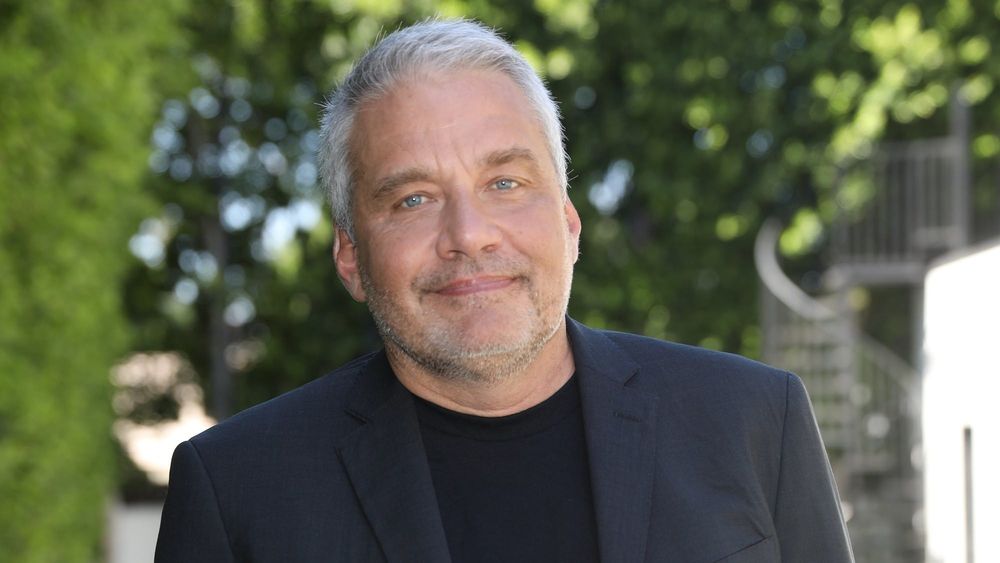
Every day, somewhere in Don Worley's notifications, a stranger is calling Pastor Shepherd a disgrace to the church. And every day, Worley wants to answer.
"I have to resist every day replying to a comment and questioning the intelligence of the poster," he told me.
He resists. He has been resisting since January, through what is now, by his count, more than 100 million views, and the discipline is the whole ballgame. Pastor Shepherd only works if enough of the congregation believes the collection plate is real.
If you have not met him yet, Pastor Shepherd is a televangelist of the recognizable American type. Good suit, better hair, a voice that has comforted thousands of people out of their savings. He gets caught on camera saying the quiet parts. He prays over a waitress instead of tipping her. He reminds the flock, warmly and often, that the ministry accepts Zelle. He is played by Worley, the mass tort attorney turned filmmaker Tinsel profiled in April, the man currently juggling six films at once through Second Chance Pictures, and he is no more a pastor than the suit is.
@shepherdprayerhour No blessing without sacrifice #pastorshepherd #prayerhour #pj ♬ original sound - Pastor Shepherd
The audience is not so sure. Type the character's name into TikTok and the platform, which builds landing pages wherever enough people type the same question, will offer you "Pastor Shepherd skit or real." Also "Pastor Shepherd explained." Also "Pastor Shepherd controversy explained," which is a page dedicated to a scandal that does not exist, attached to a man who does not exist. There is even one for "is Pastor Shepard satire," spelled the way people hear it rather than the way Worley writes it. Somewhere out there, a lot of people watched a preacher behave appallingly on their phone, and their first move was not to laugh. It was to check.
Worley finds none of this new. The character started years ago as a YouTube series called Prayer Hour, built out of a specific and personal resentment. Worley left the church for a stretch of his life before finding his way back, and he has been plain about why he left: ministers he had bad experiences with. Pastor Shepherd was what he did with them. "It was always this way, even in the old YouTube days," he says of the confusion. "Sad that we can't tell a real televangelist from a parody, but true. It takes most people a few videos to 'get it.' Some get it immediately and, sadly, some never get it."
The YouTube version found a cult audience and a strange afterlife, a 2019 feature film with Danny Trejo, and then went quiet. Worley had no plans for a revival. "It was something I had done and it didn't really go anywhere," he says. The push came from Paolo Moreno, a friend who ran social media for Jake and Logan Paul from 2014 to 2020 and who kept telling Worley the timing had changed. "He felt the timing was right to reintroduce the world to this character. With everything going on in the world today, from televangelists being even more bold now to MAGA and the success of verticals, it appears Paolo was right."
The first post went up January 10. Six months later, Worley's own channels have logged 81.8 million views, and by his tally the videos have been reshared onto other people's accounts more than 180,000 times, collecting another 20 million views he never posted. One clip, in which the pastor panics upon realizing he cannot delete his own live footage, sits at 24.1 million views. The March press coverage of the character said 15 million total. That number is now off by an order of magnitude, and it was four months ago.
@rosapercs01 #fyp #clips #streaming ♬ original sound - rosapercs01
But the statistic that actually explains Pastor Shepherd is smaller and stranger. His TikTok account has about 7,700 followers. A single video on that account has 15,300 comments.
"The downside with playing the character as if he is real," Worley says, "is that I have more comments than I do followers."
Sit with that ratio for a second, because it is the whole phenomenon. People are not subscribing to Pastor Shepherd. They are stopping mid-scroll to fight about him. The top comment across the whole run, with 306,000 likes and a long thread underneath, is not a joke or a fan quote. It reads, "That's the creepiest thing I've ever seen." Under a video about giving, someone wrote "God doesn't ask for money" and nearly 200,000 people pressed like, while seventy-four more argued below. His catchphrase gets quoted back at him constantly, viewers howling "the ministry accepts Zelle" at each other like it's scripture. One woman's entire review was two words: "unchoose me." A man posted a reaction video confessing on camera that it was a skit and he fell for it, and the confession alone did 2.7 million views.
It would be easy, reading those threads, to conclude that people have gotten dumber. Worley's answer is more forgiving than the one he wants to type, and it is worth taking seriously, because the audience believing him is not actually a mystery. To spot a fake televangelist, you need a working sense of how far a real one will go, and the real ones removed the ceiling years ago. Kenneth Copeland owns three private jets, one purchased from Tyler Perry, and when a reporter asked him about it on camera he told her his aircraft were none of her business. Jesse Duplantis asked his followers to fund his fourth jet, a $54 million Falcon, reasoning that Jesus today would not be riding a donkey. Against that field, a man who accepts Zelle is playing it modest. There is an old internet rule holding that parody of extremism becomes indistinguishable from the real thing without a wink attached. Worley's entire craft choice is that Pastor Shepherd never winks.
The season he relaunched into did him a favor, too. Two months earlier, a Kentucky veteran named Nikalie Monroe had gone viral calling more than forty churches to ask for baby formula for a hungry infant, with a crying baby audible behind her. Nine said yes. Lakewood hung up. The country had just spent a news cycle watching real churches fail a fake mother when Worley showed up playing a fake pastor failing everyone, and the audience slid from one to the other without adjusting its expectations at all. Three days after his first post, the comedian Druski dropped a megachurch sketch that pulled tens of millions of views and drew responses from actual pulpits. Pastor Shepherd, naturally, answered Druski in character, telling him to laugh if he wants and reflect if he's real. January 2026 turned out to be a very good month to be a fictional preacher.
For all the volume, Worley is precise about where the character stops. Pastor Shepherd, as he builds him, is a man performing goodness over something colder. "He wants to be good and certainly has that online persona, like most televangelists. But on the inside, he is selfish and narcissistic." The line he will not cross has not moved since the YouTube days: the character never mocks anyone with real faith. "This is a parody of the televangelists or other ministers who abuse religion for their own personal financial gain."
Which leaves the delicious problem of the audience itself. By simple math, some of the millions watching are the very people being described, and by the evidence of the comments they are enjoying themselves. Worley shrugs at this. "It is natural for people to think a parody is always about someone else and not them, because they think, 'Glad I am not like that.'"
If the character sounds like an act of hostility toward faith, consider that the same man made A Time for Sunset, a film that is entirely sincere about belief, and sees no contradiction. "I think it is the same world," he says. "Pastor Shepherd exposes those not sincere about faith to encourage anyone with a faith to be sincere about it and live what they preach." Six months and 195 posts in, the character has held to that. He has never once gone after belief. He goes after the business model.
What happens next is partly out of Worley's hands. Television producers have come around, encouraged by what The Righteous Gemstones proved about the appetite and by half a year of evidence that the audience has already assembled itself. "We shall see if a network picks it up," he says, sounding like a man who has sat through enough meetings to know what circling is worth. And if nobody does? Pastor Shepherd stays right where he is, Worley says, until televangelists stop. "Or someone stops them, like law enforcement or civil suits."
That last part is not a punchline. In his other life, Worley built one of the largest mass tort practices in the country. He has spent decades extracting money from institutions that hurt people. Asked how the age of the televangelist finally ends, the man in the fake collar did not reach for a joke. He gave a professional opinion.
Pastor Shepherd appears on TikTok at @shepherdprayerhour and @shepherd.caught, and on Instagram at @shepherd.caught. The feature film Pastor Shepherd, with Danny Trejo, streams on major platforms. Don Worley's A Time for Sunset streams on Apple TV, Amazon Prime, and Tubi.