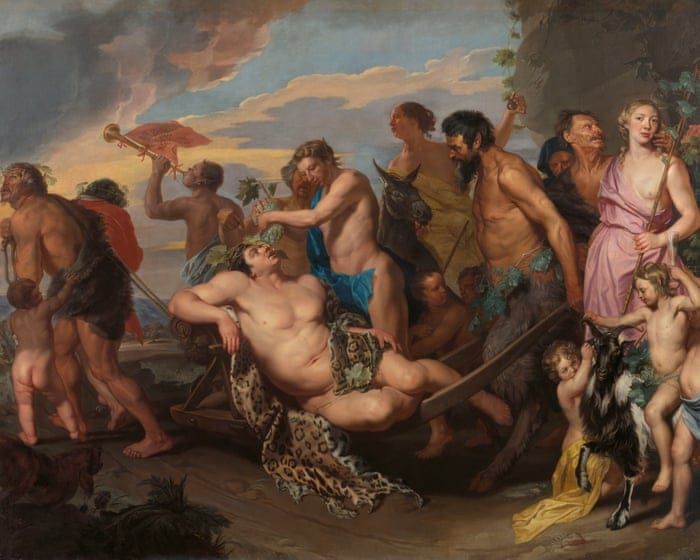
For most of the twentieth century, the largest painting Michaelina Wautier ever made hung in Vienna under almost everyone's name but her own. The Triumph of Bacchus is three and a half meters of mythological bodies — a drunken god, his stumbling retinue, a satyr leering at the edge of the frame — rendered with the muscular confidence of a painter who had plainly studied anatomy a woman of her time was forbidden to look at. Curators at the Kunsthistorisches Museum worked through the alternatives: School of Rubens, a copy after Rubens, perhaps Luca Giordano, possibly Cornelis Schut. Anyone, it seemed, would do — except the woman who painted it.
Wautier, born in Mons around 1604 and working out of Brussels, was the rare seventeenth-century woman who refused to stay in a lane. While the era steered its few female painters toward flowers and miniatures, she took on everything: history paintings, portraits, religious commissions, genre scenes, the occasional garland. The Art Newspaper calls her unique among known women artists of the period for working across all the major genres. She likely trained alongside her brother Charles, himself a painter, and the two kept a household together in Brussels. Nor was she marginal in her lifetime: Archduke Leopold Wilhelm, the Habsburg governor of the Spanish Netherlands and one of the great collectors of the age, owned four of her canvases. She was successful, and then she was forgotten. The forgetting is the part worth examining.
It ran on a circular logic. A painting this assured could not be a woman's; a woman had therefore not made it; the name attached to it must be wrong. The Vienna curator Gustav Glück put the reflex on the record in the early twentieth century, writing that even in "our age of female emancipation, one would hardly wish to ascribe this picture … to a woman's hand." The quality of the work became the evidence against its maker. Wautier was, in the institution's eyes, too good to be herself.
When the correction finally came, it came fast. In 1993 the Flemish art historian Katlijne Van der Stighelen found the Bacchus in the museum's stores, recognized the hand, and spent the next decades reassembling an artist from a scatter of misattributed canvases. The scholarship took years. The institutional will to do anything with it took generations. Van der Stighelen's research produced the first Wautier retrospective only in 2018, at the Rubenshuis and MAS in Antwerp; London is seeing her for the first time now, in 2026, at the Royal Academy. Thirty-three years stand between the rediscovery and the blockbuster — a gap that has nothing to do with scholarship and everything to do with timing.
The Royal Academy show is, by every account, the real thing: twenty-five paintings, the Bacchus on loan from Vienna, portraits of children handled with startling tenderness, the recently unearthed Five Senses (1650) and a Flower Garland with a Butterfly (1652) hung beside a self-portrait from around 1650 in which she looks back at the viewer with no apparent doubt about her own standing. "She is genuinely a rediscovery of the last 20 or 30 years," the RA curator Julien Domercq told the Art Newspaper, praising "a real virtuosic way of painting." One reviewer for The Conversation called her astoundingly skilled and returned to her rightful place. It is a serious exhibition about a serious painter, and UK audiences are right to go.
It is also a co-production with the Kunsthistorisches Museum — the institution that spent decades filing Wautier's masterpiece under other men. The machinery that lost her and the machinery now staging her return are, in several cases, the same building. Museums run on these exchanges; the same loan logistics that move a Raphael between countries move a Wautier from Vienna to Piccadilly. The art's quality was never the variable here. Its market value was: "rediscovered woman master" has climbed from academic footnote to reliable draw, and the climb is what made the wall space available.
That economics explains the selectivity of the rediscovery. It favors women whose work slots into the existing canon without rearranging the furniture. Wautier painted in the dominant idiom of her century — ambitious, Italianate, technically flawless — so she can be welcomed as the men's equal, retroactively, the way the canon periodically absorbs the figures it once shut out. Artemisia Gentileschi was rehabilitated on similar terms. The painters who worked outside the prestige genres, or against them, are still waiting, because the apparatus was built to honor the artists who were "good enough" by the very standards that excluded them.
None of this makes the celebration false. It makes it cheap. The institutional embrace arrives precisely when it costs nothing — no commissions to make good on, no living artist to pay, no career to rebuild, only a label to revise and a catalogue to sell. The collectors and curators who get to feel generous about Wautier in 2026 are spending a currency she never received in life: recognition with no invoice attached. The same appetite is reshaping the contemporary market, where institutional attention now follows demonstrated value rather than leading it.
Van der Stighelen suspects the work isn't finished. Given how long Wautier lived, she predicted in 2018, "many more works will pop up," and Domercq concedes the new catalogue "will be almost obsolete when the show ends." The market that ignored her for three centuries will now move quickly to find whatever is left — attics, auction houses, the back rooms of museums that have been holding her all along. After three hundred years of incuriosity, the speed of that hunt may be the most honest thing the art world has ever said about Michaelina Wautier.