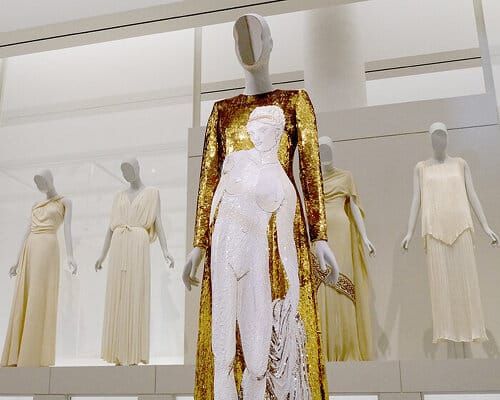
The Metropolitan Museum of Art's new exhibition, Costume Art, pairs historical garments with paintings and sculptures in an attempt to situate fashion within the broader narrative of art history. It's an admirable curatorial ambition—one that acknowledges fashion as a visual language worthy of the same institutional reverence as oil on canvas. But the show's organizing principle—grouping works by body type rather than by aesthetic movement, historical context, or conceptual framework—according to Designboom, suggests the Met still doesn't trust fashion to stand on intellectual ground without a corporeal anchor.
The decision to structure the exhibition around the body—silhouettes, proportions, anatomical ideals—places fashion in conversation with art history's long tradition of depicting the human form. A Renaissance portrait next to a corset. A Baroque painting beside a structured gown. The pairings are visually compelling, and they make a legitimate argument: fashion has always been about how we shape, conceal, and present the body, just as painting and sculpture have been.
But the body-first framework also flattens fashion into illustration. It treats garments as evidence of how people looked rather than as autonomous objects with their own formal, political, and conceptual weight. A Balenciaga coat isn't just a garment that fits a particular body—it's an architectural statement, a rejection of convention, a material argument about structure and volume. Reducing it to "this is what bodies wore" strips away the very thing that makes fashion worth exhibiting in the first place: its capacity to function as art independent of the wearer.
The Met has been here before. The Costume Institute has spent decades negotiating fashion's place within the museum, oscillating between treating it as decorative craft and elevating it to fine art. The Met Gala has done more to legitimize fashion in the public imagination than any exhibition ever could, but the gala's spectacle often overshadows the curatorial work happening inside the museum. Costume Art feels like an attempt to reclaim that intellectual authority—to say, "We can make fashion serious without needing celebrities to validate it." But the body-type structure undermines that claim. It suggests the Met still needs a safety net, a way to make fashion legible to audiences who might not otherwise take it seriously.
Compare this to how the museum treats painting or sculpture. No one organizes a Caravaggio retrospective by grouping works according to the proportions of the figures depicted. The focus is on technique, iconography, patronage, influence—the intellectual architecture of the work itself. Fashion deserves the same rigor. Organize a show by construction methods. By material innovation. By the designers who broke conventions or the houses that redefined luxury. By the political contexts that shaped what people wore and why. Any of these frameworks would position fashion as a discipline with its own internal logic, rather than as a reflection of bodies that existed in proximity to art.
The pairing strategy—garment next to painting—also raises questions about hierarchy. Is the painting the primary object, with the garment serving as supporting evidence? Or are they equals in the gallery? The curatorial framing matters. If the Met is serious about treating fashion as art, the garments need to be the protagonists, not the footnotes. The National Portrait Gallery added Lily Allen's album art to its contemporary collection without needing to justify it through adjacency to traditional portraiture. The work earned its place on its own terms. Fashion should get the same treatment.
There's also the matter of what gets left out when you organize by body type. Fashion's most radical moments have often been about rejecting the body entirely—or at least refusing to flatter it. Rei Kawakubo's Comme des Garçons collections that distorted the silhouette beyond recognition. Martin Margiela's deconstruction work that turned garments inside out. John Galliano's Margiela, which treats the runway as a conceptual laboratory rather than a commercial showcase. These designers weren't dressing bodies—they were interrogating what a garment could be when freed from the obligation to serve the wearer's form. A body-first curation can't accommodate that work without diminishing it.
The Met's discomfort with fashion-as-art isn't unique. Most museums still treat fashion as a special case, something that requires explanation or contextualization in ways that painting and sculpture do not. Part of that is institutional inertia—fashion arrived late to the museum, and it's still fighting for legitimacy. Part of it is the medium's commercial entanglement. A painting might sell for millions at auction, but it was created as art. A couture gown was created as commerce, even if the craftsmanship rivals anything in a gallery. That tension makes curators nervous. They want to celebrate fashion's artistry while distancing it from its market origins, and the result is exhibitions that hedge their bets.
Costume Art isn't a failure—it's a compromise. The Met is trying to make fashion accessible to audiences who might not have the vocabulary to engage with it on purely formal terms. Pairing garments with paintings gives viewers a familiar entry point, a way to understand fashion through something they already recognize as art. But accessibility shouldn't require diminishment. Eric Lusito's Soviet Science Institute photography documents architecture that was built to inspire awe and assert ideological power—viewers don't need a guided tour through "what buildings looked like" to understand the stakes. The work earns its authority through formal rigor and historical weight. Fashion can do the same.
The body-type framework also risks reinforcing the idea that fashion is primarily about appearance—about how we look rather than what we think. That's reductive. Fashion is a language, a system of signs and symbols that communicates status, identity, rebellion, conformity, desire. It's a material practice shaped by labor, economics, technology, and politics. It's a site of innovation where designers experiment with form, structure, and material in ways that push the boundaries of what clothing can be. None of that fits neatly into a body-first curation.
If the Met wants to make a serious case for fashion as art, the next exhibition should abandon the safety nets. No paintings as validation. No body types as organizing principle. Just garments, presented with the same intellectual rigor the museum applies to any other medium. Context, yes—historical, cultural, technical. But not apology. Not adjacency. Just the work itself, demanding to be taken seriously on its own terms.
Until then, Costume Art stands as evidence of how far fashion has come in the museum—and how far it still has to go. The Met knows fashion belongs in the conversation. It just doesn't quite trust it to hold the room alone.
More from Tinsel Magazine