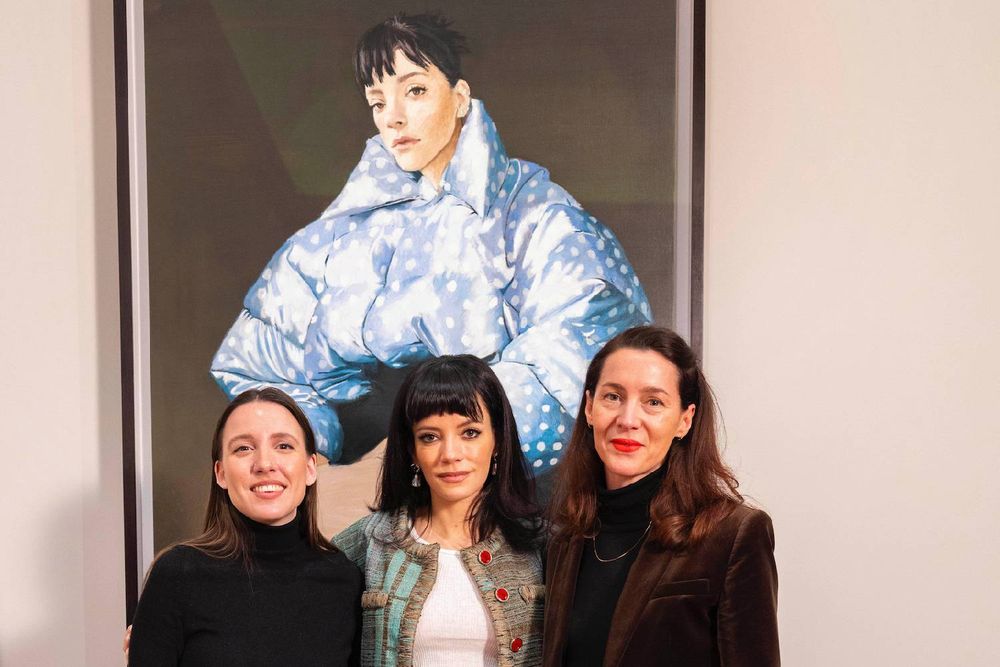
Lily Allen's West End Girl album cover is now part of the National Portrait Gallery's permanent collection. The painting — a portrait by Spanish artist Nieves González showing Allen in an oversized blue-and-white polka-dotted puffer jacket against a dark background — was commissioned for the album's release last year and is now on view at the museum as part of its contemporary holdings. Allen owns the work, but chose to make it available to the public through the gallery.
This isn't a loan or a temporary exhibition. It's a permanent acquisition signal — the museum treating a piece of commercial album art as culturally significant enough to hang alongside centuries of British portraiture. The move positions González's work within the museum's ongoing contemporary collection rather than in a separate pop culture annex, which is the institutional equivalent of saying: this is art first, album packaging second.
The National Portrait Gallery's decision to display the piece reflects a broader shift in how museums are approaching portraiture created for commercial purposes. Galleries have been slow to embrace digital tools and even slower to acknowledge that some of the most culturally resonant portraiture of the last two decades has been created for album covers, magazine editorials, and celebrity branding campaigns rather than gallery walls. But the line between commercial and fine art portraiture has always been porous — Warhol proved that in the 1960s, and contemporary institutions are finally catching up.
González, a master's graduate of the University of Seville who draws heavily from Baroque traditions, has built a practice around dramatic, opulent portraits of women in voluminous puffer jackets. Her work uses the visual language of historical portraiture — chiaroscuro, frontal composition, rich color — but applies it to contemporary subjects and contemporary fashion. "Using the language of the great historical portraits is not about looking back, it's about claiming that authority and putting it at the service of a new narrative," González explained in a statement. The puffer jacket — a garment with no historical precedent in portraiture — becomes the equivalent of the elaborate ruffs and velvet robes that signaled status in 17th-century Dutch painting.
Allen described the portrait as capturing "strength, power, vulnerability, determination, and confusion," and said it "acts as a key to the whole listening experience." That framing — the idea that a portrait can function as both standalone artwork and interpretive guide to a separate creative work — is precisely what makes this kind of cross-disciplinary work interesting to institutions. It's not just a picture of a famous person. It's a piece that exists in dialogue with another medium, and that layered function gives it editorial and curatorial weight.
The broader context here is that fashion and celebrity portraiture have always operated in the space between commerce and culture, but museums have historically treated that space as a problem rather than a feature. The National Portrait Gallery's move suggests that institutions are starting to recognize that the most culturally significant portraits of the 21st century might not be the ones created for gallery exhibitions — they might be the ones created for album covers, magazine covers, and brand campaigns that reach millions of people before they ever reach a museum wall.
González has shown work at SC Gallery in Bilbao, July/T239 Gallery in Rome, and Espacio O Gallery in Huelva, Spain, and has an upcoming exhibition at Richard Heller Gallery in Los Angeles this June. Her inclusion in the National Portrait Gallery's contemporary collection positions her within a lineage of portraitists who have used fashion, fabric, and contemporary dress as subject matter — a tradition that includes everyone from John Singer Sargent to Lucian Freud, whose recent National Portrait Gallery retrospective demonstrated how portraiture can function as both psychological study and cultural document.
The distinction between a portrait made for a museum and a portrait made for an album cover has always been more about distribution strategy than artistic intent. What the National Portrait Gallery is acknowledging by adding González's work to its collection is that the cultural impact of a portrait — how widely it's seen, how it shapes public perception, how it enters the visual vocabulary of a particular moment — matters as much as where it was originally intended to hang. Allen's album sold thousands of copies. The portrait was seen by everyone who streamed the record, bought the vinyl, or scrolled past it on a playlist. That's a level of cultural penetration most gallery artists will never achieve, and institutions are finally starting to treat that reach as culturally significant rather than commercially suspect.