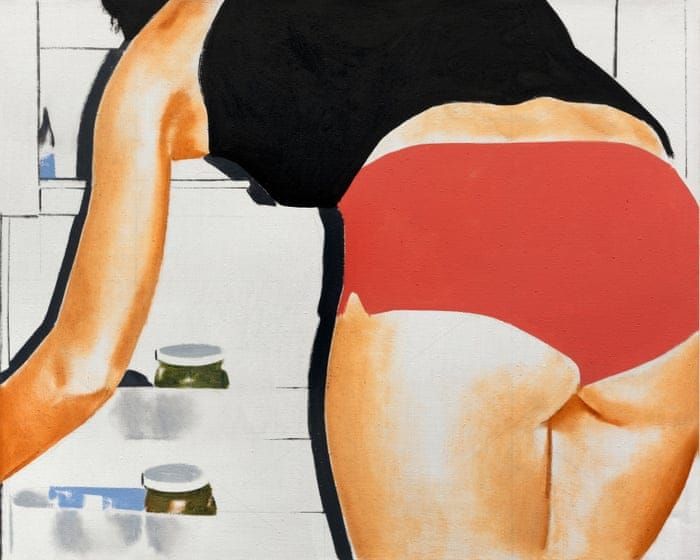
Wilhelm Sasnal's exhibition at Sadie Coles HQ opens with a burnt-out cigarette hole where Donald Trump's face should be. The painting hangs alongside a British post-punk album cover, a blasted tree trunk, holiday snapshots, and a forest so unsettling it reads like a still from a horror film. According to The Guardian, most of the works are untitled, and the connections between them feel deliberately severed—like clicking through a feed where the algorithm has given up on coherence entirely.
This isn't fragmentation as critique. It's fragmentation as documentation. Sasnal isn't making a statement about the internet—he's painting what it feels like to live inside it. The work treats scattered attention as subject matter, not context, and that distinction makes it more honest than the majority of digital art being shown in galleries right now.
Most contemporary artists approaching internet culture treat it as a theme to explore or a problem to solve. They make work about algorithmic feeds, about information overload, about the flattening of perspective. Sasnal skips the commentary and goes straight to the structure. His paintings don't explain how social media fragments our attention—they reproduce the experience of that fragmentation on the gallery wall. The Oval Office painting, rendered in acid greens and fecal browns, sits next to his wife and daughter. Throbbing Gristle sits next to a tree trunk. There's no curatorial thesis holding it together, and that's the point.
The formal strategy here is closer to meme logic than art-world precedent. Memes work by juxtaposition without explanation—absurdity becomes meaning through proximity. Sasnal's exhibition operates the same way. The viewer's brain scrambles to find the through-line, the unifying concept, the reason these images are together. But the reason is that this is how we encounter images now: in rapid, disconnected succession, stripped of their original context, flattened into a continuous scroll.
What makes the show effective is that Sasnal doesn't apologize for this structure. He doesn't frame it as dystopian or tragic. He doesn't add a wall text explaining how social media has broken our brains. He just paints what he sees when he looks at a screen, and lets the gallery become a physical manifestation of that experience. The work doesn't ask you to step back and think critically about the internet—it asks you to recognize that you're already inside it, and painting is one way to map that territory.
This approach positions Sasnal's work in direct opposition to the digital art that gets institutional validation. Museums and galleries still largely treat internet culture as a subject to be examined from the outside—something that happens over there, on screens, in feeds, in communities the art world observes but doesn't inhabit. Sasnal's paintings don't perform that distance. They assume the viewer already lives in the same fragmented attention economy the artist does, and they build from that shared experience rather than explaining it.
The business logic of the art market has been slow to catch up to this shift. Mega-galleries still sign artists based on traditional markers of credibility—museum shows, critical consensus, recognizable formal strategies. But Sasnal's work suggests that the most interesting contemporary painting might be happening in the gap between fine art and internet vernacular, where artists treat digital experience as native rather than foreign. The market hasn't figured out how to price that yet, which is why this kind of work still reads as experimental even when it's describing something every viewer already knows.
The exhibition's refusal to provide connective tissue also functions as a test of the viewer's cultural literacy. If you recognize the Throbbing Gristle reference, you get a different reading than someone who doesn't. If you know what the Oval Office looked like during Trump's first term, the painting hits differently. If you've spent enough time online to recognize the specific texture of a feed that's stopped making sense, the whole show clicks into place. Sasnal isn't interested in universal legibility—he's painting for people who already live where he does, and letting everyone else catch up on their own time.
This strategy aligns with how prestige filmmakers are finally engaging with vertical video—not by rejecting the format, but by treating it as legitimate infrastructure for storytelling. Sasnal does the same thing with internet attention. He's not lamenting its effects or mourning the loss of sustained focus. He's painting the world as it actually operates, and trusting that the formal structure will communicate what a thesis statement never could.
The Guardian's review describes the images as "broken in the sense that an online link can be broken: it is difficult to connect them to their source." That's the most precise description of the work's logic. These aren't paintings of things—they're paintings of the experience of encountering things through a screen, where the source is always already obscured, the context is always already lost, and the only coherence comes from the fact that you saw them in sequence.
What Sasnal has done is turn the scroll into a medium. Not as metaphor, not as subject, but as structure. The exhibition doesn't critique the way we look at images now—it paints that looking, directly and without apology. That's a more radical move than most digital art attempts, because it refuses the safety of critical distance. It assumes the viewer is already complicit, already scrolling, already living inside the fragmentation it documents.
The art world has spent the last decade trying to figure out how to engage with internet culture without losing institutional credibility. Sasnal's show suggests the answer isn't engagement—it's inhabitation. Stop treating the internet as a subject and start treating it as the condition under which all subjects now appear. Paint what that feels like, and let the paintings be as broken, scattered, and unresolved as the feeds they're documenting. The honesty is the point.