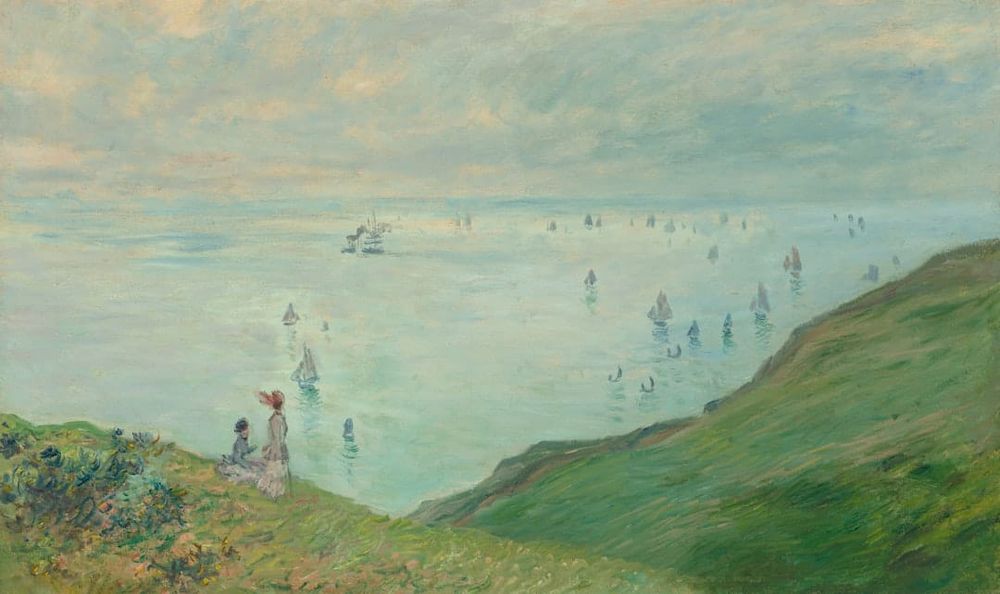
Georges Seurat once said his seascapes were meant to "cleanse one's eyes of the days spent in the studio." That single line, preserved in a new exhibition at the Museum of Modern Art, does more to explain the tension at the heart of his career than any amount of art historical analysis. Here was a painter who built an entire movement—Neo-Impressionism, Pointillism, call it what you want—on systematic color theory and painstaking dot-by-dot application. And every summer, he fled to the Channel coast to paint horizons with fewer rules.
The seascapes Seurat produced during these trips weren't studies or warm-ups. They were finished works, exhibited alongside his monumental studio paintings. But they operated under a different logic. Where A Sunday Afternoon on the Island of La Grande Jatte required months of preparation, color charts, and compositional geometry, the coastal paintings were looser, faster, less architecturally rigid. The discipline was still there—Seurat never stopped being Seurat—but it was discipline applied with a lighter hand. The horizons were clean. The skies were open. The figures, when they appeared at all, were small and incidental.
What makes this worth revisiting now is how clearly it maps onto contemporary creative labor. Seurat's studio work was the grind: methodical, exhausting, intellectually demanding, the kind of thing that required total focus and left you depleted. The seascapes were the reset—still work, still serious, but operating in a different register. He wasn't abandoning his principles. He was giving himself permission to apply them differently. That's not the same as taking a break. It's closer to what happens when a designer who spends months on a single brand identity takes a weekend to make posters for fun, or when a novelist writes essays between books. The rigor doesn't disappear. It just gets deployed somewhere else, with lower stakes and more air.
The art world has always romanticized the idea of the artist's retreat—the countryside studio, the seaside escape, the cabin in the woods. But Seurat's version wasn't about disconnection. He was still painting. He was still exhibiting. He was still building a body of work that would be studied for the next century. The difference was that the Channel coast gave him a subject that didn't require the same level of conceptual architecture. A horizon is a horizon. A sailboat is a sailboat. You can paint them with intelligence and precision without needing to reinvent compositional space every time.
This is the same logic that drives Christopher John Rogers's use of color as a form of discipline rather than abandon, or the way Acne Studios makes intellectual fashion feel effortless by knowing when to pull back. Discipline isn't always about adding more. Sometimes it's about knowing when to subtract, when to let the work breathe, when to give yourself a different kind of problem to solve. Seurat's seascapes weren't a rejection of his studio practice. They were the valve that made the studio practice sustainable.
The MoMA exhibition frames these paintings as postcard-perfect, and they are—clean, composed, visually satisfying in a way that doesn't demand much from the viewer. But that's not a critique. It's a feature. Not every painting needs to be a manifesto. Not every project needs to be a statement. Some work exists to give the maker room to think, to reset, to remember why they started in the first place. Seurat's summers on the Channel coast weren't downtime. They were maintenance.
What the art market has never quite figured out how to value is this kind of in-between work—the pieces that aren't minor but also aren't monumental, that don't fit neatly into the narrative of an artist's "important" period. Seurat's seascapes sell, but they don't command the same prices or attention as his studio compositions. The same dynamic plays out across contemporary art collecting, where collectors want the flagship pieces, the works that anchor a retrospective, not the quieter experiments that made those pieces possible. But the truth is, you can't have one without the other. The discipline that produced La Grande Jatte required an escape route. The seascapes were that route.
Seurat died at 31, which means he didn't have time to find out what would have happened if he'd kept painting for another 30 years. Would the seascapes have remained a summer ritual, or would they have eventually become the main body of work? Would the studio discipline have loosened, or would he have found new ways to tighten it? We don't know. What we do know is that for the decade he had, he built a system that included its own release valve—and that's smarter than most artists ever manage.