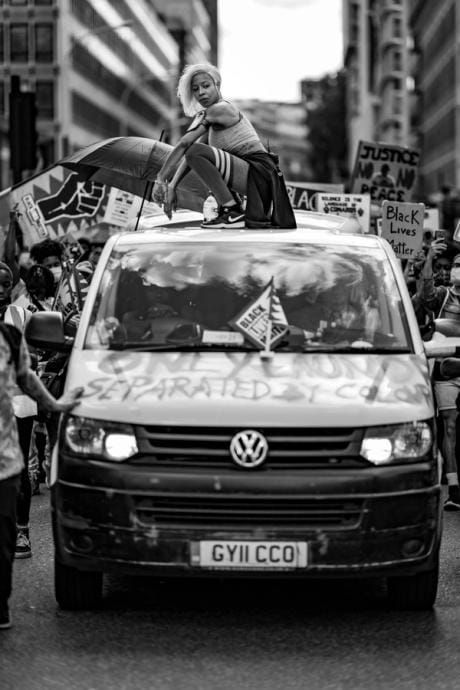
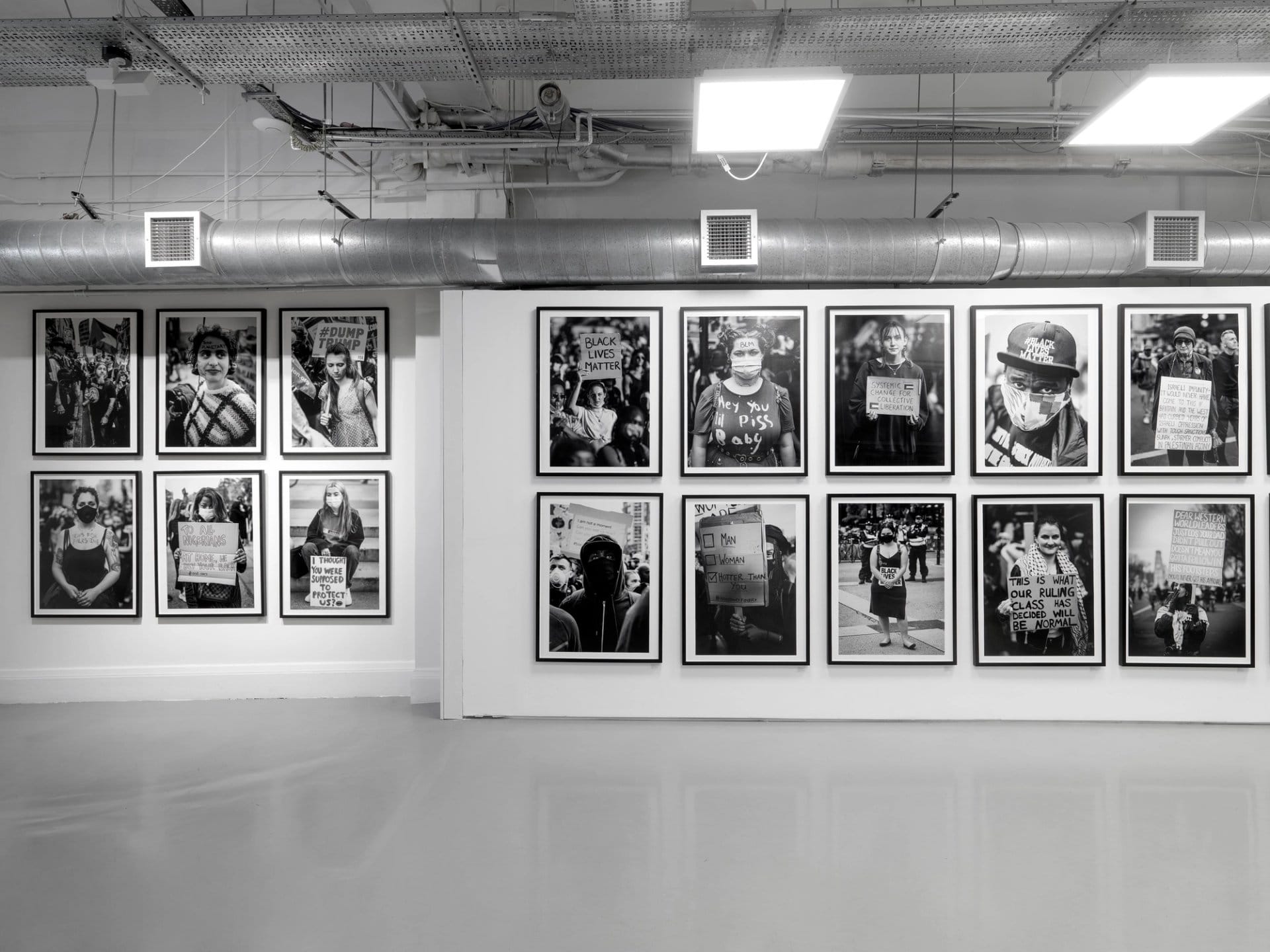
Misan Harriman's exhibition at Hope 93 gallery in London brings together seven years of protest photography—work that The Art Newspaper describes as reflecting "a time of upheaval." The show spans Black Lives Matter demonstrations, climate activism, and moments of collective solidarity that Harriman documented as they happened, often posting them to Instagram before they reached any gallery wall. Now they're hanging in a physical space, reframed as institutional art rather than social media content.
That transition matters. Harriman built his reputation on Instagram, where his images of protests and political moments circulated with the speed and reach that traditional photography exhibitions could never match. His 2020 photograph of a Black Lives Matter protester carrying an injured counter-protester to safety went viral within hours—a document of solidarity that moved faster than any gallery press release. But institutional credibility still requires physical space, wall text, and the legitimacy that comes with a gallery show. Harriman's Hope 93 exhibition is proof that photographers who built their careers on social platforms are now successfully translating that work into the art world's traditional infrastructure.
The seven-year span of the exhibition is significant. It captures a specific period when protest photography shifted from photojournalism's domain into the hands of anyone with a camera phone and an Instagram account. Harriman operated in both worlds—trained as a photographer, fluent in social media distribution, and positioned to document moments that legacy publications either missed or arrived at too late. His work didn't just document protests; it participated in them, circulating in real time as part of the cultural conversation rather than as retrospective analysis.
That real-time documentation is what makes social media-native artists different from their predecessors. Harriman told The Art Newspaper that "as an artist I have a duty to reflect the times." That reflection happened instantly on Instagram, where images could shape public perception of events as they unfolded. The gallery exhibition adds historical weight to that immediacy—recontextualizing work that was consumed as content into work that will be archived as art.
This path from platform to gallery is becoming more common, but it's not automatic. Social media provides distribution and visibility, but it doesn't confer the kind of institutional legitimacy that galleries, museums, and collectors still control. Artists like Harriman—and Anastasiia Pischanska, whose Ukraine Gen Z portraits document war through stillness—are proving that documentation of upheaval can transition from Instagram posts to gallery walls if the work carries both journalistic rigor and artistic intention. But the art world still treats social media provenance with skepticism. A photographer who built their career on Instagram has to prove their work belongs in a gallery in ways that a photographer who started with gallery representation never does.
Harriman's exhibition also raises questions about what happens to protest photography once the protests end. The images at Hope 93 document moments that were urgent and immediate when they happened. Now they're historical records, distanced from the adrenaline and stakes that produced them. That distance is both the point and the problem. The gallery context asks viewers to reflect rather than react—to see the work as art rather than activism. That shift is what gives the work institutional legitimacy, but it also removes it from the context that made it powerful in the first place.
The exhibition's title and framing suggest that Harriman sees his role as documentarian first, artist second. But the decision to show seven years of work together in a gallery is an argument for the opposite—that this work deserves to be seen as art, not just as photojournalism or social media content. It's a claim for permanence in a medium that prioritizes the immediate. And it's working. Harriman's gallery show is proof that artists who built their reputations on platforms are now successfully leveraging that visibility into the kind of institutional recognition that used to require decades of gallery representation.
What comes next will determine whether this path remains open. If galleries continue to recognize social media-native artists who document upheaval with journalistic integrity and artistic intention, the art world's relationship to platforms will shift. If they don't—if Harriman's success is treated as an exception rather than a model—then the divide between platform visibility and institutional legitimacy will remain as wide as ever. For now, the Hope 93 exhibition is evidence that the gap is closing, even if the art world hasn't fully decided whether that's a good thing.